Deck and Book Review: Womb Rites: The Sacred Spiral Thresholds of Womanhood Oracle Deck & Sacred Spiral Journal: A Journal of Remembering
- Author of both: Cas Watene
- Artist for both: Alexandra Gallagher
- Publisher of both: Blue Angel Publishing
- Publication Date for both: 2026 / UK – Nov 2026 / US – Oct 2026
- Country of Publication for both: Australia
- Both Reviewed by: Kim Goldsmith Cosmic Snail Tarot
ORACLE DECK: - RRP: (AUD) $36.95 / (UK) £19.98 / (US) $28.95
- ISBN: 978-1-922574-71-8
JOURNAL: - RRP: (AUD) $29.95 / (UK) £16.99 / (US) $23.95
- ISBN: 978-1-922574-73-2

In this review I explore using the Sacred Spiral Journal in combination with the accompanying oracle deck Womb Rites: The Sacred Spiral Thresholds of Womanhood
The Oracle Deck

How do you react when you hear the words ‘menstruation, ovulation, menopause’? Do you recoil in horror, blush, leave the room, feel confused? Maybe you get angry because after all, the cycles of the female body can…quite frankly…suck.
I feel awkward. Uncomfortable. Unsure. Repelled when hearing the words above. In turn, perhaps these words describe how I feel at times in my female form. Why is that? What is it about the natural state of living in a woman’s body that is so triggering?
The female body is often a site of trauma for many women – whether that is due to illness, abuse, social pressures, or the monthly pain that accompanies menstruation. This oracle deck is not asking you to unearth or do shadow work with these experiences. “The womb does not heal by remembering pain. She heals by remembering herself” (p. 10 guidebook). Using the deck may help you reclaim ownership of your body, through the intimate observance of your cycles of change from puberty to menopause and beyond. Activities and affirmations within the guidebook, and prompts on the cards, offer an entry point for thoughtful journaling or body movements that encourage connectivity and receptivity. I am challenged by, and a little nervous, about using this oracle deck. But that reaction reveals that it is just what I might need to feel more connected as a woman.
Although the deck is designed for women, it is not just for women of reproductive age – there is a “note for women who no longer carry a physical womb”. “Your connection to your feminine wisdom does not disappear because your body has changed”. When women are no longer fertile, or perhaps never were, there could be a sense of shame or not being enough. The Womb Rites Oracle deck emphasises that femininity is “beyond the physical form”. I appreciate that the deck is not just geared towards youth and fertility, but to women of all stages and experiences in life.
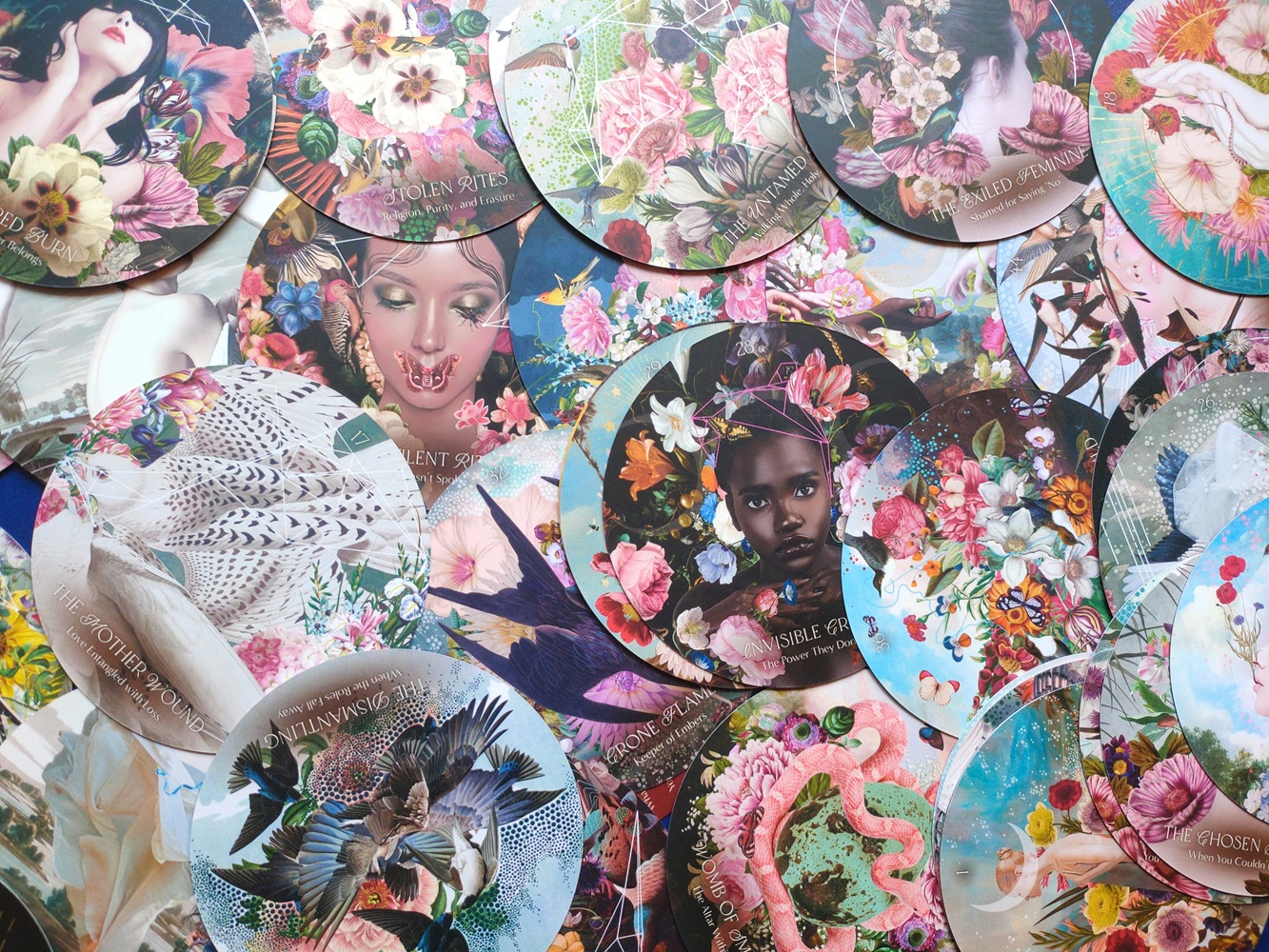
Womb Rites: The Sacred Spiral Thresholds of Womanhood is a circular oracle deck composed of 45 cards, and a 192 page colour guidebook. The card stock is satin and the box is square and compact. I love the small round cards that have burgundy backs, depicting a crescent moon and spiral. Round cards are always a little hard to shuffle but you can mix them around on the table easily. The title and numbers on the cards are a very fine white font which I find hard to see, but it does mean there is no distraction from the artwork. The guidebook is in colour and contains 192 pages and has detailed information on ways to use the deck, including 5 different spreads.
Cas Watene refers to the natural process of aging as the spiral of transformation. It is not a linear process. The cards are described as ‘keys’ and they are organised into categories which reflect the physical, emotional and psychological ‘rights of passage’ experienced in a woman’s lifetime.
There are six categories:
- Red Beginnings – the start of menstruation but also initiation as a young woman into the world.
- The Womb Years – reproduction but also sensuality and creative power.
- The Threshold Fire – perimenopause but also a spiritual reckoning and dismantling of concepts of identity.
- The Crone’s Arrival – menopause and eldership.
- The Silent Rites – topics that are taboo in society, including shame, abortion, miscarriage and choosing not to be a mother.
- The Integration Codes – a return to a sense of wholeness and rediscovering your voice.
Card descriptions include: Essence (meaning); The Wound (the dark side or challenge of the card); You may carry…(experiences you may have in life that demonstrate you are struggling with the themes in the card); The Blessing (the positive outcome of working with the card); and Affirmation (a positive statement you can use as a voice activation).

Bear in mind that some cards address themes that may be triggering for some people and so if you are using them with a client it is important to prepare them and be in a safe space. For example, 13. Blood Loss – miscarriage, memory and mystery, 35. Blood Not Shed – infertility, stillness, stolen time, and 37. The Exiled Feminine – Shamed for saying ‘no’, and 39. The Sacred No-Mother – a different kind of creation. There are some powerful statements in the cards and guidebook, and ‘taboo’ topics of infertility and abortion are addressed in a sensitive but thought provoking way.

However, not all cards bear such intense topics. Many are celebratory, and emphasise the body but also the voice as sacred – Card 22. The Breaking Voice – Sound of Self-returning.

The Womb Rites oracle deck is specifically for women who want to plug in again to their body’s natural rhythms but also face their discomfort about femininity and the body. It is not a deck for a card of the day reading, but more for slowly working on your self esteem and agency. There are no quick fixes or answers in the guidebook. I also suggest using the deck alongside therapy or an allied health professional if some of the themes bring up intense emotions.
I immediately loved the vivid and dense imagery in the cards and the luxury feel to the packaging and artwork design. The artwork is a combination of painted and collage elements with hyper detailed photos of women of different ethnicities submerged in landscapes that blend elements of traditional still life/memento mori paintings, halos from religious iconography and compositions that nod to Dada and Surrealist collages. Floral and bird motifs saturate each card and there are red dot patterns which I think gently symbolise menstrual flow. I would just say that the art is beautiful but I do get tired of associating women with floral motifs, yet in this deck I think flowers represent the stages of menstruation. Another critique of the artwork is that there are a few cards which look repetitive – just birds and red line patterns which I find hard to interpret alone. I get more meaning out of the cards which feature women immersed in the landscape. This oracle would pair well with collage Tarot decks, particularly Tarot of Mystical Moments.
The Journal

Journals often sprung from an oracle deck concept don’t usually work well on their own. The Sacred Spiral Journal, on the contrary, can function as a standalone journal because it has detailed introductory pages explaining what the spiral means and how you can work with the journal, with or without the oracle deck. The text mirrors what is written in the oracle’s guidebook, and so there is a page for each inner season connecting to which stage of the cycle you are in (see photos to get the idea) but also what this means emotionally or archetypally. For example, Inner Summer’s archetype is the Inner Mother and occurs during ovulation with the theme of blooming. There is an empowering poem to read, and then four questions which have whole blank pages in the journal section for you to write about: soft-reflection, temple inquiry, body check-in and micro-ritual.

For every journal entry there are seven large pages to write down your observations or feelings during a cycle, including a cover page which is a snapshot of the phases of the moon and cycle you are in, as well as a card you may have drawn from the oracle deck. The prompts are invitations not prescriptions for how to use the journal. You can pick it up and work with it for one part of your cycle or sequentially through all the cycles – it is up to you. I chose to pick one stage of my menstrual cycle to write about and I used all of the questions for Inner Summer in the introductory pages. I pulled a card from the oracle deck, wrote my impressions then wrote down anything interesting about it from the guidebook. The guidebook messages are more general affirmations and sensory explorations, so to get some specific actions or advice I paired the oracle with a card from The Field Tarot by Hannah Elizabeth Fofana to add some clarity. At the bottom of the page I wrote any experiences I had connected to the card. There was plenty of space to write a lot and investigate the card’s meaning. Additional pages for ongoing notes/visions related to your cycle are available and a reflection page with questions to answer at the end of that phase. There is enough room to try writing up your spreads from the oracle deck here too. I think you could keep entries only for one part of your cycle like ovulation each month and compare entries across a year to see if there are any recurring thoughts, worries, dreams or experiences you repeat.

The Body Check in question for Inner Summer was: Where is my energy rising, overflowing, or calling for expression in my body?

I pulled 6. Body before voice: Losing language, keeping form, and 13. Death from The Field Tarot. For card 6, the guidebook says that experiencing a loss of language could manifest as an inability to speak my needs or set boundaries, and that I may simply be ‘learning to endure, instead of express’. The affirmation was “I speak my needs with clarity and power”. The Death card was advice telling me to let go, and put a final end to this phase of my life so I can enter a new chapter where I find my voice, and stand up for myself again. In the experiences section of my journal page, I started to note down small changes I am making to set firm boundaries for myself.

I loved working with the Sacred Spiral Journal alongside the Womb Rites oracle and a tarot deck. I gained so much insight about recurring insecurities that rise palpably to the surface at certain times of my period. Instead of literally just ‘going with the flow’ and being governed by the phases of my reproductive organs, I felt for the first time in a while that I had some agency and awareness of what my body has been telling me. Journaling about the little signals which I dismissed as just being ‘pre-menstrual moody’ showed me that my body wants to work with me, and has a warning system in place if I dare to tune in. Recording my unique ‘spiral’ can help me take time out when needed, prepare to set boundaries during parts of my cycles, but also to understand the deeper discomfort I have about the mechanisms of the feminine body – physical, emotional, psychological and social – that impact on the way I move through the world.

The Womb Rites Oracle deck works well as a standalone item, but I highly recommend purchasing the Sacred Spiral Journal and combining these with your favourite female-centred tarot deck to be sure to get the maximum benefit from the card messages.
More on the Creators:

Cas Watene: Through her business The Living Temple, Cas offers clients holistic healing, integrating her knowledge of kinesiology, reiki and human design. All modalities are intended to help clients understand their energy (physical, mental and emotional) and then assist them in channeling it more effectively.
Alexandra Gallagher: is an Award-winning British multidisciplinary artist. She creates striking works that span collage, street art, prints, painting, and mixed media. Her art celebrates the surreal and sublime, delving into the realms of memory, dreams, and imagination. With a strong focus on feminist narratives, Gallagher’s work weaves layers of rich symbolism to tell intricate, surrealist stories that explore inner thoughts, emotions, and societal experiences. Each piece evolves unpredictably, guided by a fluid and organic creative process.