Blog Post: I Ching Divination & Tarot Practice
What Traditional Chinese I Ching Divination Can Add to Tarot Practice: Concrete Questions, Outcomes, and Timing Through the Na Jia Method (Wen Wang Gua)
Guest blogger: Xuan Wanyan
Tarot and the I Ching may look very different, but both begin with a question and a divinatory result. Drawing the cards or forming a hexagram is only the beginning. The next step is to understand what that result reveals about the situation.
For many English-speaking readers, the I Ching means using three coins, or the more traditional yarrow stalk method, to obtain a hexagram and then consulting its hexagram and line statements. This is an authentic part of the tradition, but only one doorway. In Chinese practice, forming the hexagram begins the analysis. The diviner can identify the querent, the subject of the question, relevant people, support, obstacles, change, outcome, and timing within its six lines.
From a Divinatory Classic to an Interpretive System
The I Ching first took shape as a divinatory classic roughly three thousand years ago, addressing concrete questions about action, danger, fortune, and change. Later commentaries expanded its philosophical meanings, making it foundational to Chinese thought. Richard Wilhelm’s translation and Carl Jung’s foreword established it internationally as a book of wisdom and psychological reflection, so English-speaking readers often encounter the text before China’s practical interpretive systems.
Throughout Chinese history, rulers, ministers, military commanders, scholars, and ordinary people consulted the I Ching on affairs of state, warfare, appointments, journeys, marriage, illness, property, and other personal concerns. Historical records and classical case collections preserve these judgements, showing its place in both public and private decision making.
I Ching divination is the foundation of the I Ching tradition and one of its earliest practical applications. The Zhouyi first served as a divinatory classic for addressing questions, judging circumstances, and guiding decisions. Its philosophical and scholarly traditions developed from this foundation. The I Ching became one of the foundational works of Chinese civilisation and one of the roots of Chinese philosophy, shaping Chinese culture and life for millennia.
Universities across China, Europe, and North America study the I Ching through philosophy, philology, archaeology, manuscripts, intellectual history, and divination. Their research, programmes, projects, and courses include I Ching divination because it is fundamental to understanding the hexagrams, line statements, patterns of change, and later interpretive traditions.
Across traditions, divination has two basic stages: obtaining a result and interpreting it. Tarot produces cards arranged in a spread; I Ching methods produce a hexagram through yarrow stalks, coins, time, numbers, or other means. Interpretation may use hexagram and line images, external signs, the statements, or symbolic information assigned to the six lines.
The yarrow-stalk divination familiar overseas, centred on interpreting the hexagram and line statements, was known in China as the Da Yan method. Its full interpretive procedure was lost from continuous transmission for more than a millennium. Beginning in the Han dynasty about two thousand years ago, the Na Jia method associated with Jing Fang gradually superseded it and became China’s mainstream practical method. Another familiar system, Meihua Yishu, emerged in the Song dynasty, later than Na Jia, and relies primarily on image-based interpretation while also consulting the statements. In contemporary Chinese practice, no major I Ching divination method depends solely on hexagram and line statements; they function mainly as supplementary information.
Na Jia, also known as Wen Wang Gua, forms the core of modern Six Lines Divination. It incorporates Chinese calendrical time into the hexagram and analyses support, restriction, movement, and change, enabling the diviner to judge development, outcome, and when necessary conditions may be fulfilled.
An Independent System for Concrete Questions
I Ching divination begins with a specific question. A job application, examination, transaction, property matter, contract, approval process, relationship, journey, or awaited result is an independent subject of divination. The diviner determines how the subject and people are represented, then follows the relationships that support, obstruct, or change the situation.
For tarot practitioners, Wen Wang Gua offers a second, independent system rather than a hybrid method. Tarot readers already understand clear questions, symbolic relationships, and real-world context. Wen Wang Gua examines the same matter through a different structure, adding a distinct view of conditions, development, outcome, and timing. Agreement may strengthen a judgement; difference may reveal what one system overlooked.
Time operates within the judgement. The month and day affect the lines at casting, while later dates can show when a restriction is removed, a hidden factor becomes available, or a result manifests. A favourable outcome may therefore be delayed until its conditions are met.
Ancient Case: When Would a Marriage Take Place?
Case 382 of Zengshan Buyi records a man asking about marriage in year A, month H, on day VI H (void A and B), producing Ming Yi transforming into Feng. In a man’s marriage reading, Wife and Wealth represents the prospective wife, while Host represents the querent. Here B Earth Officials and Ghosts held Host. Both H month and H day clashed with B, placing Host in monthly break and daily break.
However, the active Host transformed into G Fire Wife and Wealth. Because Fire generates Earth, the transformed line returned to generate Host: the prospective wife would support the querent despite his present weakness. In this context, the Corresponding D Wood line also overcame Host, so both representations of the other party acted directly on the querent. The following B year would fill the broken Host branch, so the diviner predicted a suitable match then. A good marriage was arranged in the fourth month. Outcome and timing followed one chain: present break, return generation, and future filling.
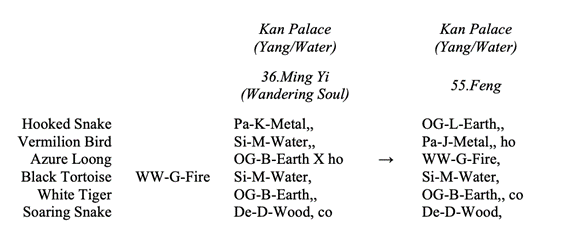
Figure 1. Case 382 of Zengshan Buyi: Ming Yi transforming into Feng.
Modern Case: When Would a Dissertation Review Result Arrive?
In I Ching Stream Case Study 2026-025, a doctoral dissertation entered an additional blind review after an appeal. The querent asked whether it would pass and when the result would be released. Two separate hexagrams kept the questions precise. The first showed the written work receiving strong support and indicated that the dissertation would pass.
The second hexagram focused only on timing. The line representing the result was hidden beneath another line. In this method, a hidden factor can become present when it coincides with a date, is activated through clash, or when the line covering it is opened. These relationships produced May 14, May 15, and May 20 as possible dates. Taking the actual review process into account, May 15 was identified as the most likely date, with May 20 as the latest expected boundary.
The dissertation passed, and the official result recorded by the university system was dated May 15. This does not mean that every reading produces an exact day. It shows that timing can be derived from defined relationships within the hexagram rather than supplied as an intuitive afterthought.
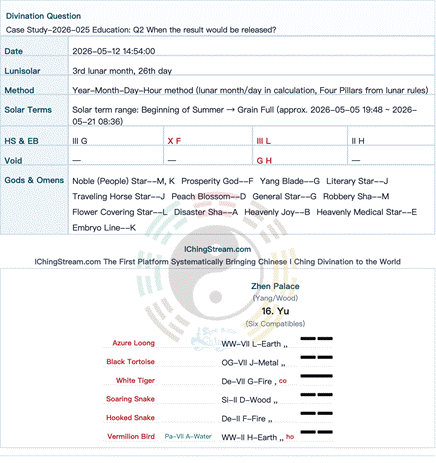
Figure 2. Case Study 2026-025: the hexagram used to judge the release date.
From Divination to Wisdom
Wen Wang Gua follows a stable path: define the question, identify the central subject, judge support and restriction, observe change, and infer development, outcome, and timing. Classical cases preserve judgements and feedback, allowing students to test interpretation against events.
I Ching Stream is the first platform systematically bringing Chinese I Ching Divination to the World. Among the works translated and organised by Xuan Wanyan are I Ching Divination: Complete and Restored (Zengshan Buyi); The Orthodox Method of I Ching Divination (Bushi Zhengzong); Fire Pearl Forest (Huo Zhu Lin); Undersea Eye (Haidi Yan); Encompassing I Ching Divination (Yi Mao); and Studies on Ancient I Ching Divination Cases (Zhouyi Gushi Kao). Together, these editions preserve the practical rules used to interpret hexagrams, documented judgement processes, timing analysis, and real-world feedback.
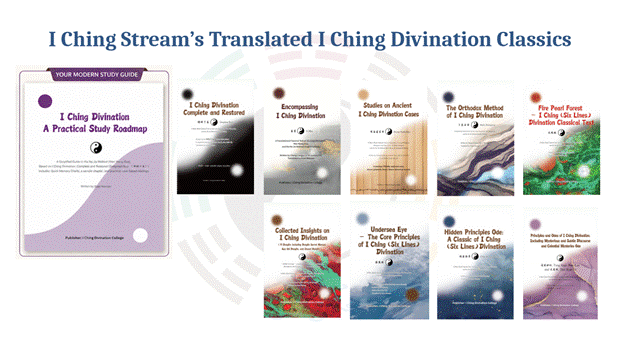
Figure 3. I Ching Stream’s translated classics.
Yet learning I Ching divination is not only about resolving individual doubts. A traditional saying holds, “Before studying the Yi, first study divination,” while another says, “Those skilled in the Yi do not divine.” The Daodejing speaks to the nature of the Dao; the I Ching reveals the patterns through which change unfolds. Through casting, judgement, feedback, and reflection, students learn to recognise these patterns and act in alignment with them. The deeper aim is wisdom: to understand circumstances, remain composed before change, and act in accordance with its direction. Divination is the entry point; the greater attainment is clarity, composure, and timely action.
Author Bio
Xuan Wanyan is a Chinese I Ching divination translator, researcher, teacher, and founder of I Ching Stream. A Columbia University graduate, she is the first translator to publish a systematic English series of classical Chinese I Ching divination texts. Her work includes translated classics, case archives, learning tools, and structured courses in Na Jia, Wen Wang Gua, and practical interpretation.
Further Resources
I Ching Stream: https://www.ichingstream.com/
Your Study Roadmap: https://amzn.to/4epAtxe
Books: https://www.ichingstream.com/books/
Case Studies and Study Notes: https://substack.com/@ichingstream
Course: https://www.skool.com/i-ching-divination-group-9696/classroom
Academic Overview: https://www.academia.edu/170210670/I_Ching_Divination_Methods_Development_Map