Deck Review: The Marginal Lenormand – An Irreverent Oracle of Medieval Marginalia
- Creator: Anastasia Kashian
- Publisher: Red Feather – https://schifferbooks.com/products/the-marginal-lenormand
- Publication Date: 28-Jun-26
- RRP: GB £18.99 / US $19.99
- ISBN: 978-0-7643-7092-2
- Review and interview by Margo Benson
Any followers of Anastasia Kashian’s fabulous creations will have been watching this wonderful deck come to life, card by card, on social media. It’s a joy to see it in its full glory! Anastasia is an artist and the creator of Les Dinosaures de Marseille and Baba Yaga’s Little Book of Hut Maintenance, or, Chicken Legs for the Soul, as well as co-creator with Caitlín Matthews on The Magic Lantern Sibilla.

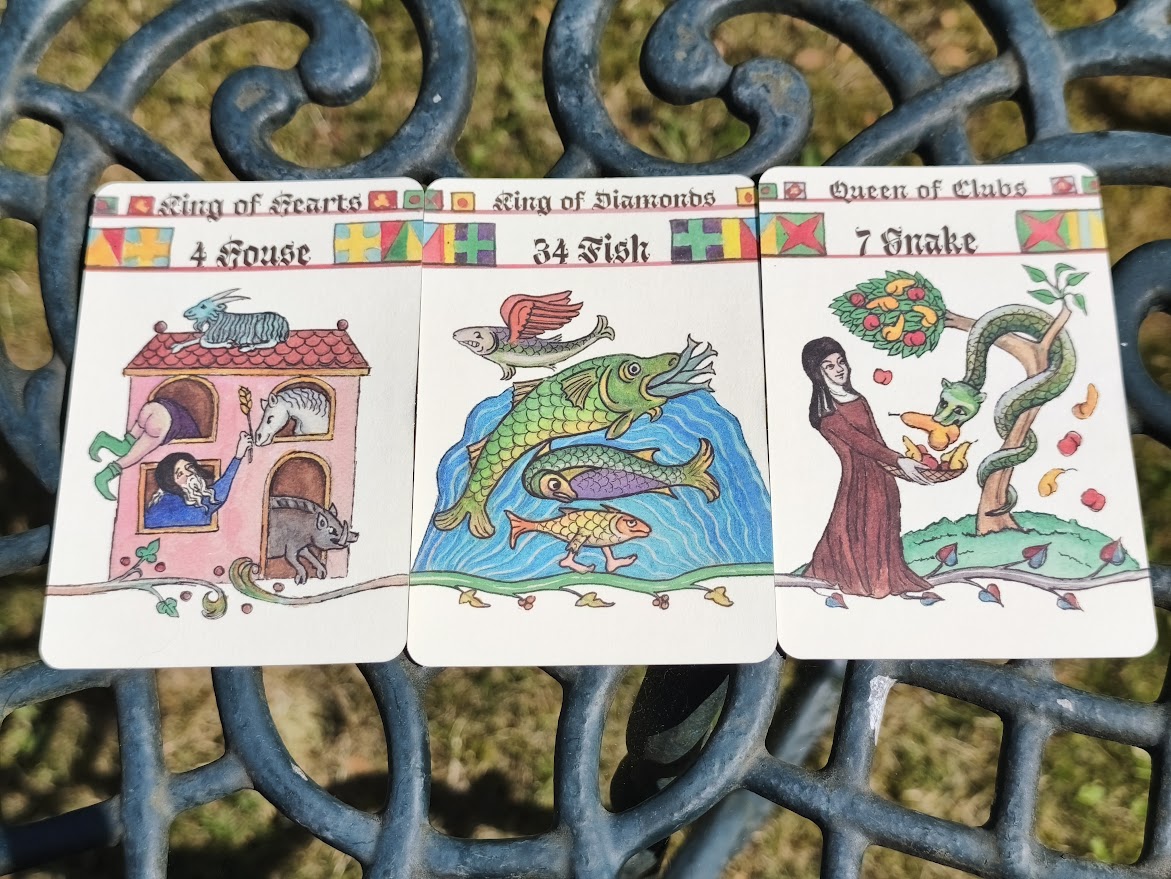
Inspired by the (often risqué) doodles, comments and imagery made by scribes, monks and nuns in Medieval manuscripts, the deck is hilarious, yet doesn’t lose any traditional Lenormand integrity. We have genitalia trees, saucy devils, a fiddle-playing hound and myriad creatures going into battle. The publisher didn’t censor any images, but Anastasia informed me that the Facebook bots weren’t always so accommodating! The deck is presented in a sturdy box with a whopper of an accompanying guidebook at 208 pages.

The book is written by Anastasia and offers very amusing interpretations and meanings (truly laugh out loud!) as well as combined meanings when paired with other cards. A detailed and informative Forward is by Caitlín Matthews, herself the creator and author of several Lenormand decks and books.
Fun aside, Lenormand is an emblematic system and The Marginal Lenormand reads as well as any more traditionally illustrated deck.

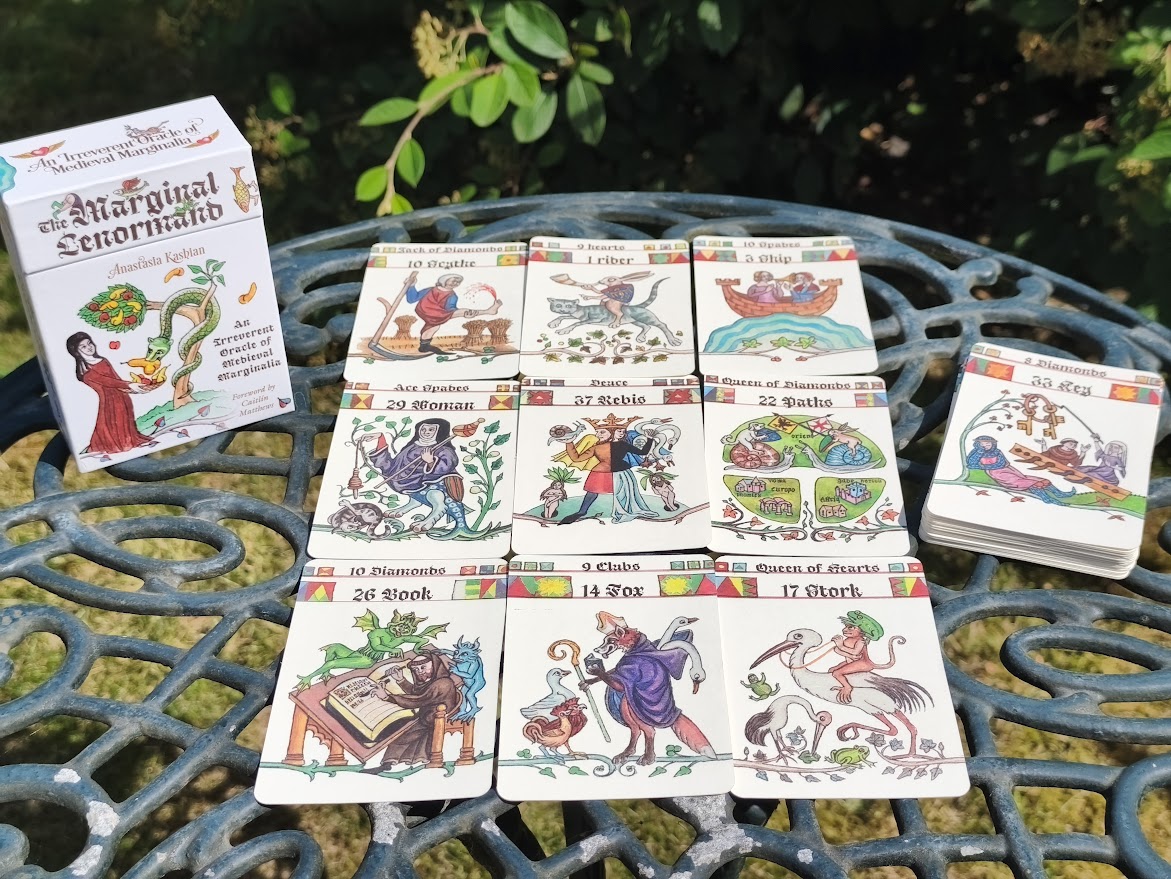
The cards themselves are pretty large for Lenormand – 11.5cm x 7.5cm, so if you’re laying a Grand Tableau you’ll need lots of space. However, the size does mean we enjoy the vibrant watercolour images all the more (there’s a lot to see). The soft, matte finish makes the cards a dream to shuffle.
Anastasia has painted a colourful banner around the titles and numbers at the top of the cards, plus a weaving vine at the bottom, so when they’re laid out, the visuals are beautiful. I often lay a 9×9 box spread, so you can see just how gorgeous this deck is.
The card backs are equally colourful, showing tumbling minstrels and contorted figures.

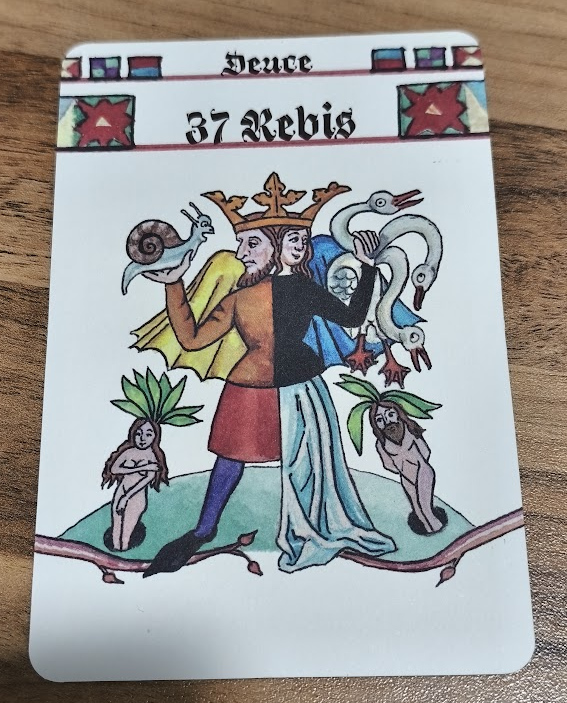
Many Lenormand decks include extra Man and Woman cards – the Marginal Lenormand has Card No37 named ‘Rebis’ and given the title ‘Deuce’. Anastasia explains that the Rebis symbolises the completion of a great work and combines “all possible elemental aspects and genders of the earthly material”. A true Wild Card and a positive addition.
I’m a keen Lenormand reader and am so thrilled to have this unique, original deck.
Anastasia kindly gave me her time to answer some questions about the inspiration around The Marginal Lenormand.
MB: What were your source manuscripts – and were some more ‘decorated’ with marginalia than others?
AK: I used a LOT of sources. Of course there’s the Luttrell Psalter, the Metz Hours, the Macclesfield Psalter, the Hours of Jean de Berry, quite a few unnamed but delightful documents from the Walters Art Museum collection in Baltimore, the Maastricht Hours, and the Lampeter Bible, which I’ve actually had the privilege of handling in person… and many, many more. A complete image reference index for Marginal Lenormand would be another book by itself! And whilst some of my images are very close to original models, in other cases I’ve sort of put on the costume, customs and symbology of the medieval artist and steered them off in new and exciting directions…
MB: In such a disciplined environment, do you think the scribes wondered what they’d get away with?
AK: I think the scribes were very much aware of what they could and couldn’t get away with! And I also think that a number of them saw these limitations as a challenge – how far can you go without actually getting denounced?
MB: Did you get a sense of some of the individual personalities behind the marginalia?
AK: Yes, absolutely! There are some very distinctive voices behind the images, and you do start to get a sense of them. There are some who are just very interested in what some would consider the mundane details of life – they really care that you should be able to distinguish varieties of flowers, breeds of sheep, all the different agricultural and domestic implements in use. A lot of what we know about life in the Middle Ages actually comes from these guys. Others are definitely born comedians – there might be some didactic content to their visual tales, but you feel they are really out for laughs before anything else. In others, the decorative sense predominates, and the story is secondary – they’re focused on making the most beautiful object they can, whether it’s a book or a plan for a salt-cellar. And still others convey an extraordinary sense of real anger at the status quo – the satire and mockery is very edgy, very biting with these. So no, they weren’t all formulaic factory “artisans”, nor were they all doing the same thing – the people who commissioned the work might have been thinking along similar lines, i.e. to have a book that was pleasant to handle, read and re-read – but the aims of the artists were reasonably diverse. You have some who are clearly making more or less approved commentary on the texts, perhaps were even employed to do precisely that – but also others who were much more subversive!
MB: And lastly… Are you working on another project that you’re able to share a hint with us?
AK: Right now I’m working on a Kipper deck, Grimm’s Kipper, in which I try to get closer to an understanding of the very formal and rather alien social structure that lies behind the original Kipper cards by putting them through the prism of Grimm’s Fairytales (and other contemporary retellings). Because the tales and the cards share a sense of very complex and very rigid framework, within which, nevertheless, we can still find tools and ways to challenge the current zeitgeist and rewrite our own stories. I’ve set it visually in the years somewhere between 1500 and 1600, the early days of printing, when for the first time there began to be something like a mass media, aimed at ordinary people… and after this I am working on a Tarot Sequel for the Marginal Lenormand, and a Baba Yaga Lenormand, partly inspired by those wonderfully rich-coloured Soyuzmultfilm productions that the BBC used to air in the early 1980s when they ran out of proper children’s telly. The aesthetic of those was jaw-dropping – Disney, eat yer heart out!
Wasn’t that great! I’m very much looking forward to a Grimm-inspired Kipper deck.
Author Bios:
Anastasia Kashian is an artist and the creator of the Les Dinosaures de Marseille (2021) and Baba Yaga’s Little Book of Hut Maintenance, or, Chicken Legs for the Soul. Anastasia lives and works mainly in West Wales. Anastasia can be found at:
https://www.anastasiakashian.com.
Caitlín Matthews is one of the world’s foremost cartomancers. Author of The Complete Lenormand Oracle Handbook, The Time Changer’s Tarot, and The Celtic Book of the Dead, she teaches many modes of divination internationally. She lives in Oxfordshire, UK, and can be found at www.hallowquest.org.uk.