Book Review: The Tarot Book of the Dead: A Chthonic Journey of Death, Mediumship, and the Art of Guiding Souls
- Author: Jenna Matlin
- Publisher: Weiser Books (an imprint of Red Wheel/Weiser)
- Publication Date: October 5, 2026
- RRP: USD $22.95 / GBP £19.99
- ISBN: 978-1-5786-3930-4
- Published in the United States
- Reviewed by: Tracye Quinlan, Prairie Moon Coaching & Healing
About a year into my tarot studies, I signed up for a class with Jenna Matlin on using tarot for mediumship. It set me on the path to becoming a medium. Jenna’s classes (and her first book, Will You Give Me A Reading?) are who I attribute my learning to read tarot intuitively, beyond the keywords, and to use the imagery itself as a layer of meaning. Jenna holds a master’s in Organizational Psychology and a background in anthropology, trained as an end-of-life doula, and has run a full-time tarot practice since 2012 — founding the Masters of Tarot Conference and teaching mediumship-focused tarot work internationally.
Opening to the introduction of The Tarot Book of the Dead, I was back in the sense of awe I’ve felt whenever I’ve heard Jenna speak about tarot’s history — its birth as a response to the Black Plague in Europe, and now exploring its untapped potential for healing unbearable grief. Reminding us how much death and tarot have always been intertwined.
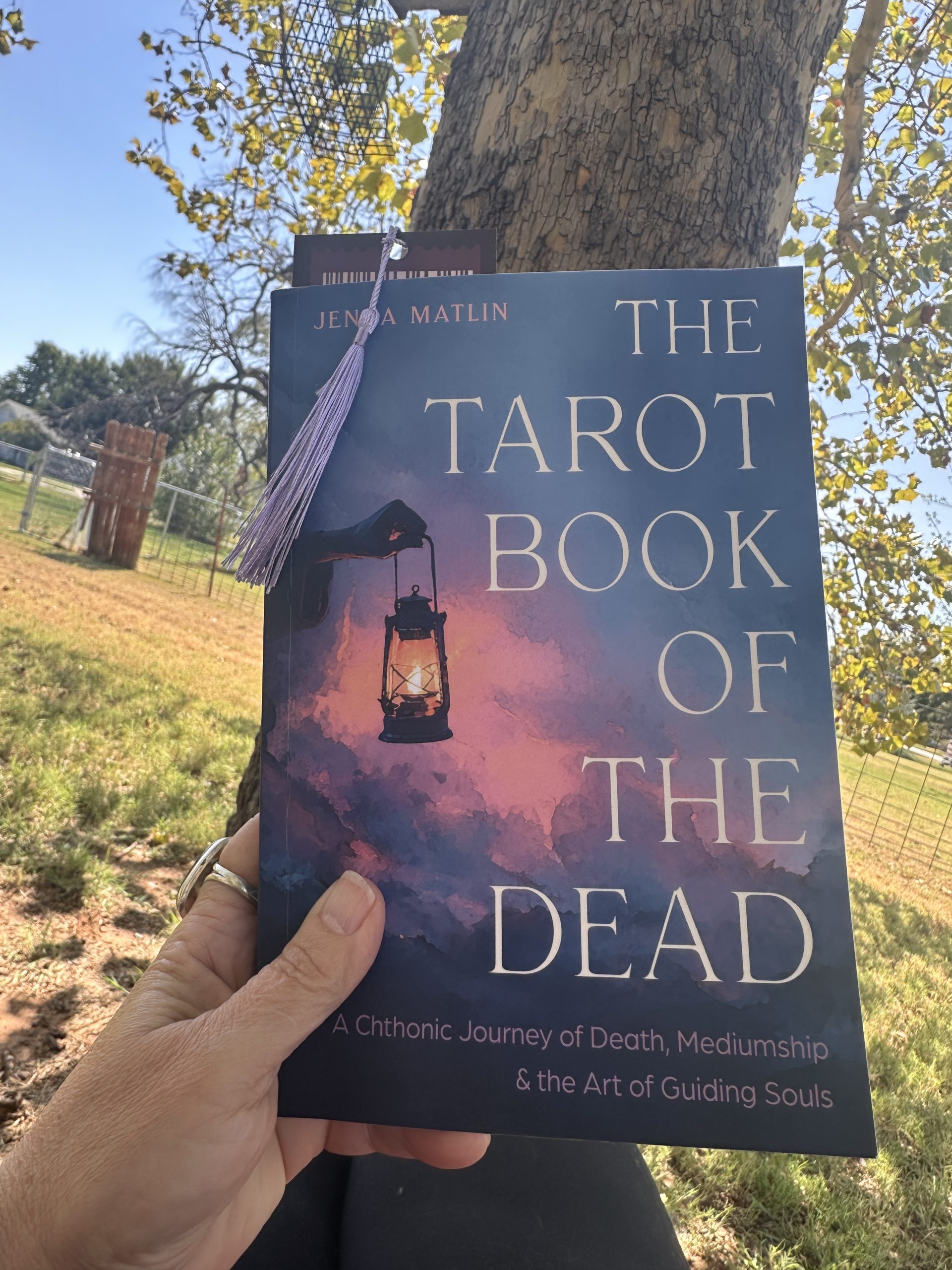
The deck and card meanings follow the Rider-Waite-Smith system throughout. The book also includes reproductions of earlier historical artwork — decks like the Visconti di Modrone, along with period woodcuts — used to illustrate tarot’s origins and its roots in the Black Plague era, rather than as part of any reading itself.
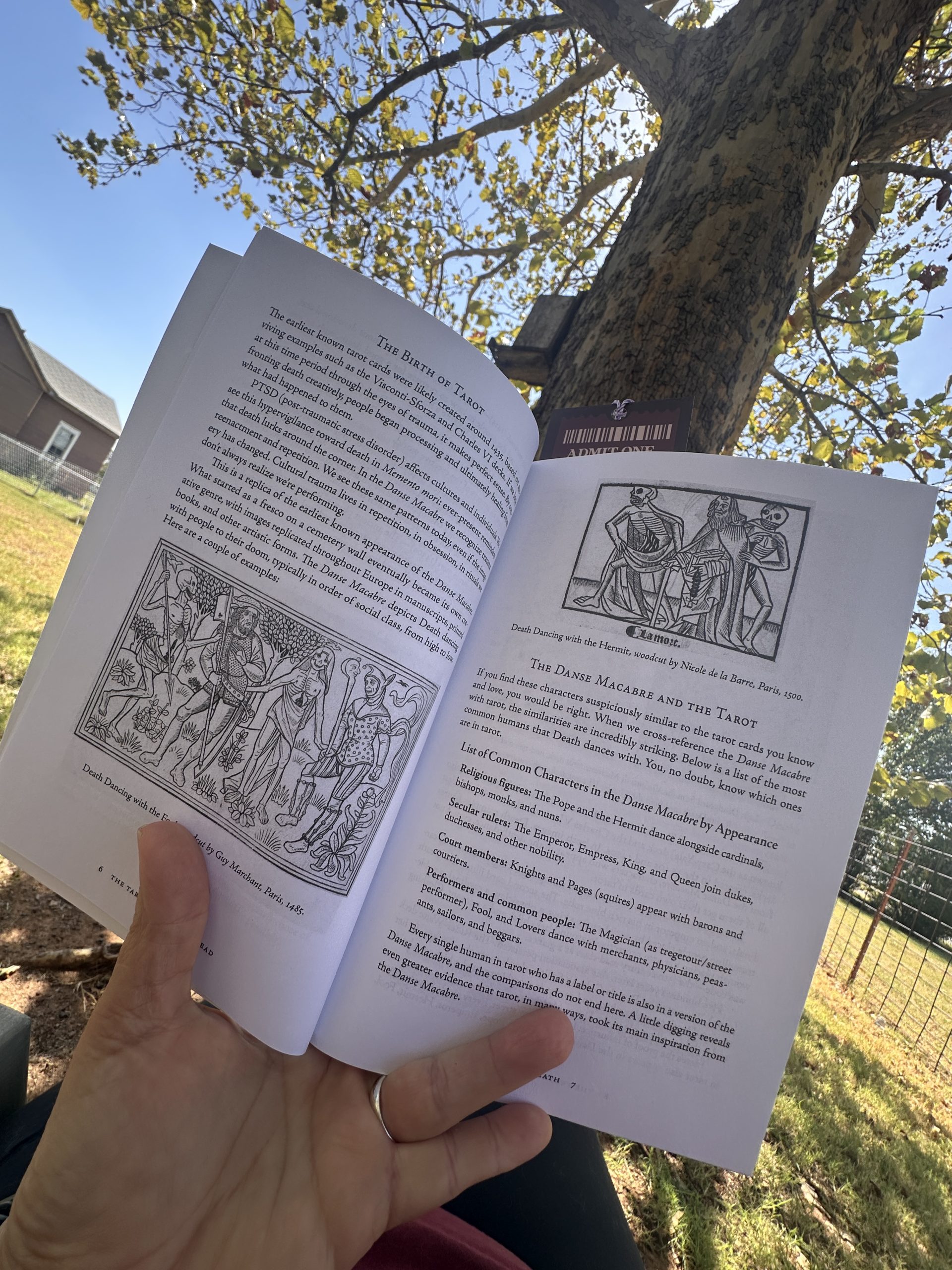
Each chapter is called an Aeon, headed by its Major Arcana card and a descriptive subtitle — for example, “Aeon II: The Tower, Lightning Strikes What Must Fall.” Once you’ve completed that chapter’s task or spread, the book grants you passage: a paragraph of encouragement or instruction, written as if spoken by that chapter’s card, inviting you to continue — “You have completed the High Priestess’s challenge; continue on to the next stage of your chthonic journey” — signed off with the name of the Aeon waiting on the other side of the threshold.
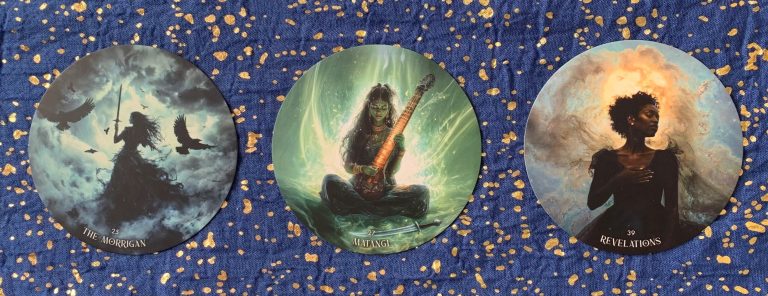
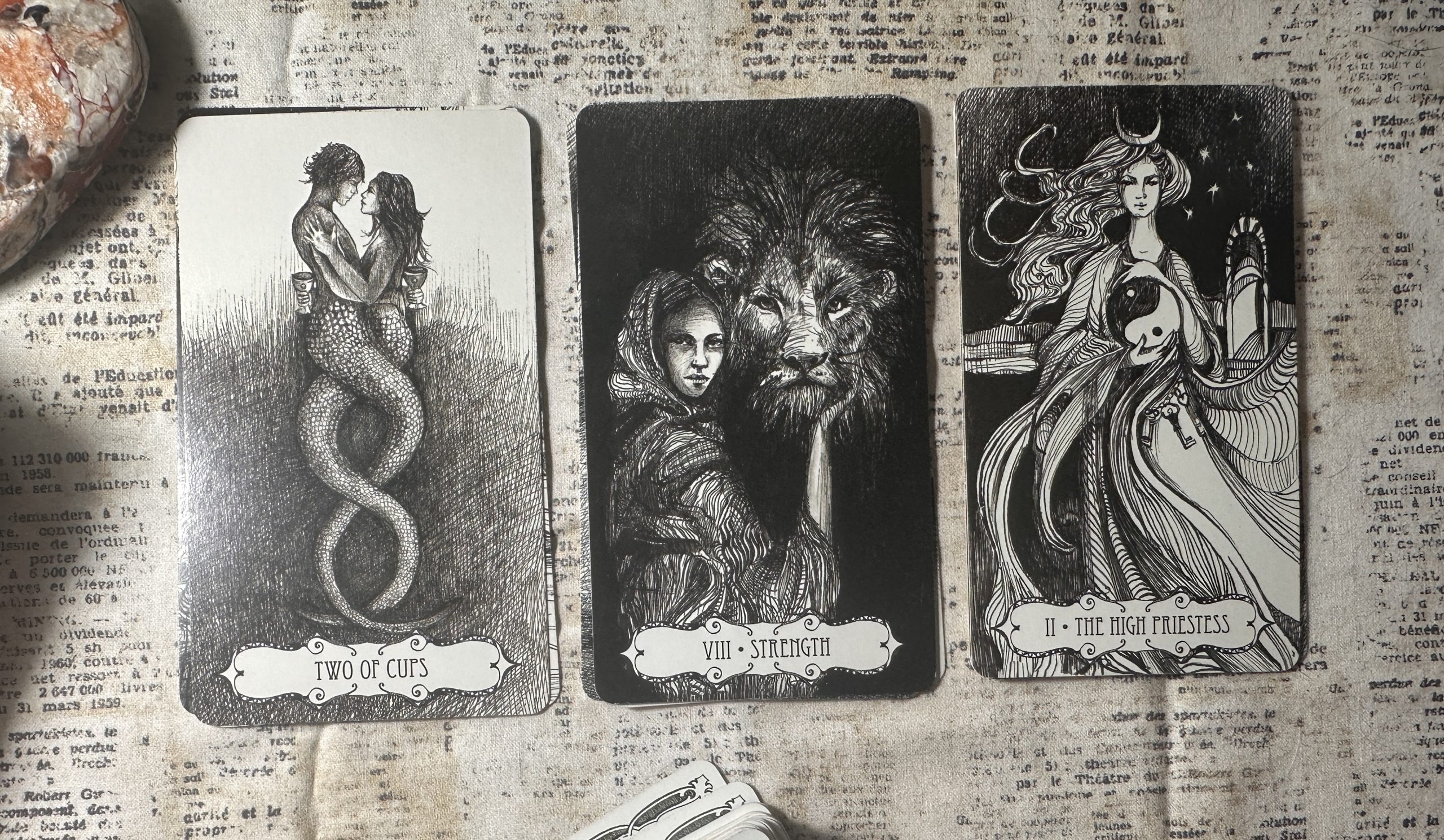
We start our journey with an exercise entitled Death’s Challenge. I vaguely recalled it from her class but didn’t remember any details that would’ve skewed me this time around. The depth and the accuracy of it literally moved me to tears. I was not expecting that.
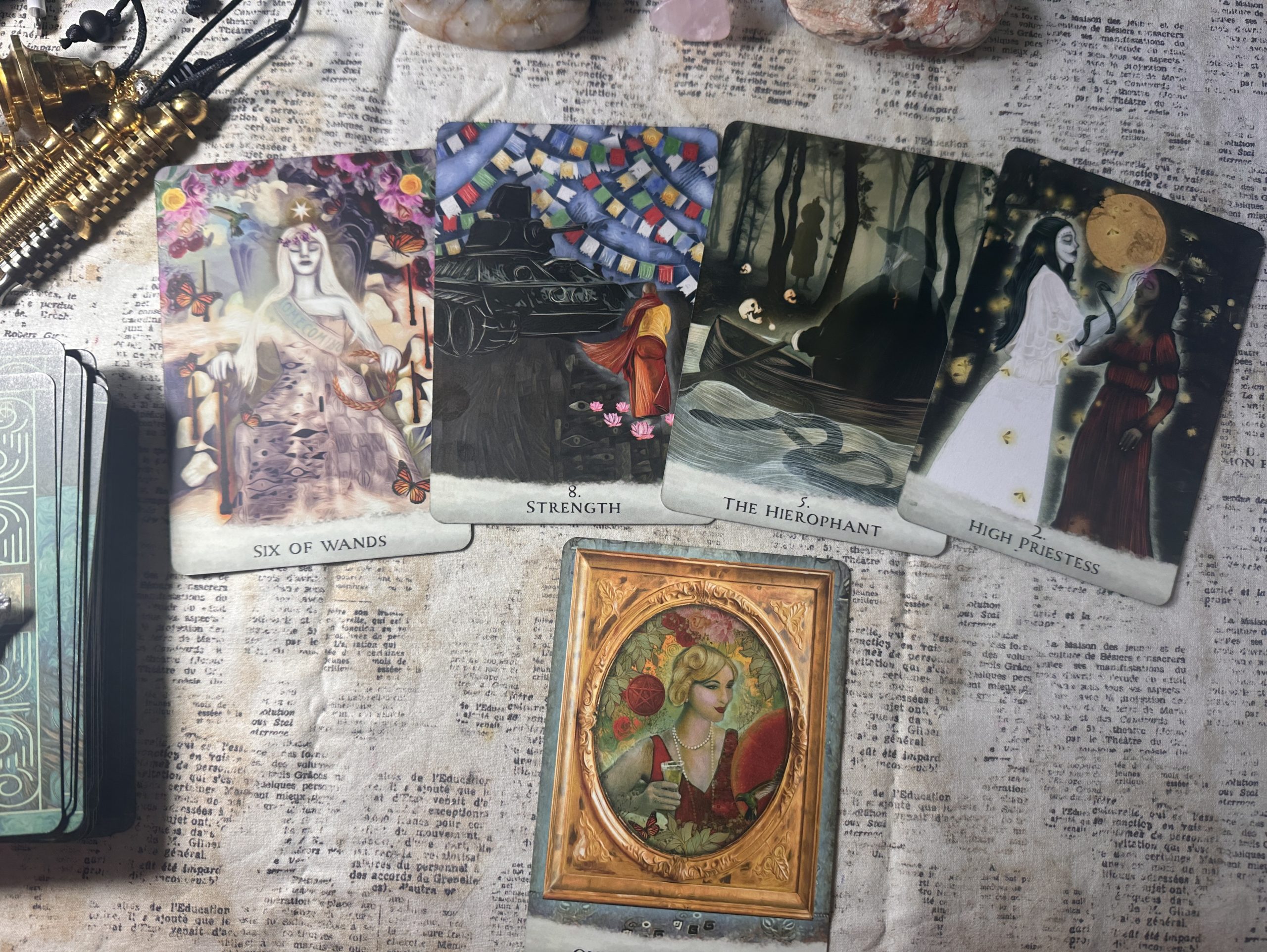
Deck used: The Unfinished Business Tarot by MJ Cullinane
It felt appropriate that the next lines in the book were “Death grants you passage.” I have goosebumps even now.
After taking Jenna’s classes, I spent the next couple of years studying mediumship with several professional mediums and teachers, at least some of whom had trained in the Spiritualist tradition at some point in their own education, and lately I’ve wondered whether using tarot for mediumship work might actually get in the way — that it might engage my left brain and make it too hard to set aside the standard meanings. So this book found me at an interesting point in that question. Partway through Chapter 2, Jenna lays out exactly how that divide came to be: not an inherent truth about the tools, but a wall built out of Spiritualist-era customs and mediumship lineages that banned tarot outright, with justifications invented after the fact to explain a split that was really just inherited habit. Reading that, I had to stop and ask myself whether my own doubt about the cards was really mine, or a prejudice I’d unconsciously picked up somewhere along my travels through both the tarot and mediumship worlds. I kept reading for clarity — and the book kept giving it to me, chapter after chapter.
That clarity showed up concretely when we come to the Wheel of Fortune, where there’s a challenge called Memento Fati (remember fate), in which we use the tarot to look back on our life and identify what we might regret at its end — unfinished actions or suffering that could’ve been eased. A second card reveals what intervention we could take now, and a third shows what would happen if we made it. If we don’t like that outcome, the exercise lets us go back and try the intervention again, pulling further cards for more information, so we genuinely “have a chance to take responsibility now while you still can.” This was also very enlightening.
Wheel of Fortune’s Challenge. Deck used Tarot of the Abyss, by Ana Tourian
That same clarity extends into how the book reframes the reader’s role itself. While my beliefs about the spirit world may differ from the author’s, it takes nothing away from what I’m learning of the value of tarot in spirit communication. She explains how the deck itself moves from a tool to a medium for communication with a third party, referring to the querent as a caller instead — signifying the shift from someone asking questions to someone calling someone else into the reading. I appreciate this shift. Even though I don’t personally feel the need for companion decks as a form of protection, the ritual and relationship she teaches you to build with these specially chosen decks is every bit as powerful, and can bring you into the same space that psychic and evidential mediums reach through sitting in the power.
This is so much more than a guidebook, or even a course in a book — it’s a journey. I don’t think it’s too grandiose to call it epic in breadth. But here’s the thing: in this mythic journey, you, the reader, are the protagonist.
It will teach you everything you need to know to become a tarot medium, but it will also take you into places within yourself and your relationship with the cards — to call them merely archetypes is an understatement. Jenna takes you into the birth of where these archetypes actually originated: sometimes back to gods and goddesses, sometimes to other figures of the time and place the card came from. I realize now it was probably her class that first taught me to notice where my eye goes on a card — the symbol, the stance, the expression — and to listen to my own intuition about it. She teaches you how to do that here, too.
Reading it feels like sitting down with the figures and forces behind each archetype — gods and goddesses, saints, elders, shamanic guides, forces beyond any single form. Each chapter doesn’t just explain an archetype; it puts you in conversation with the being or force behind it, and drops you into their world — whether that’s the cold dark at the base of a volcano, or a deserted city full of the dead — flowing in an order built around the arc of the journey itself, rather than the sequence you’d expect from the deck.
I want to say this book is for anyone who loves tarot — whether they want to pursue mediumship or not. We already use these cards for self-reflection, for therapy, for predicting the future, and they’ve proven themselves at all of it. But this book takes you somewhere further back: into the mystical, mythical place tarot was born from. It’s like knowing someone, genuinely loving them as a friend, and then learning their backstory — suddenly understanding why they were so remarkable all along. That’s what reading this book did for my relationship with my own cards. You will come away from it changed — I believe for the better — and with a broadened perspective on a deck that had probably already changed your world long before you picked this book up.
This book might not be for someone brand new to tarot who isn’t especially interested in history — tarot history or history in general, though I personally found that part of the book fascinating. If you’re still deciding whether you even like the cards, you might not be ready for their origin story just yet. That said, I still think it’s worth a try — you might be just as enchanted as I have been by this book.
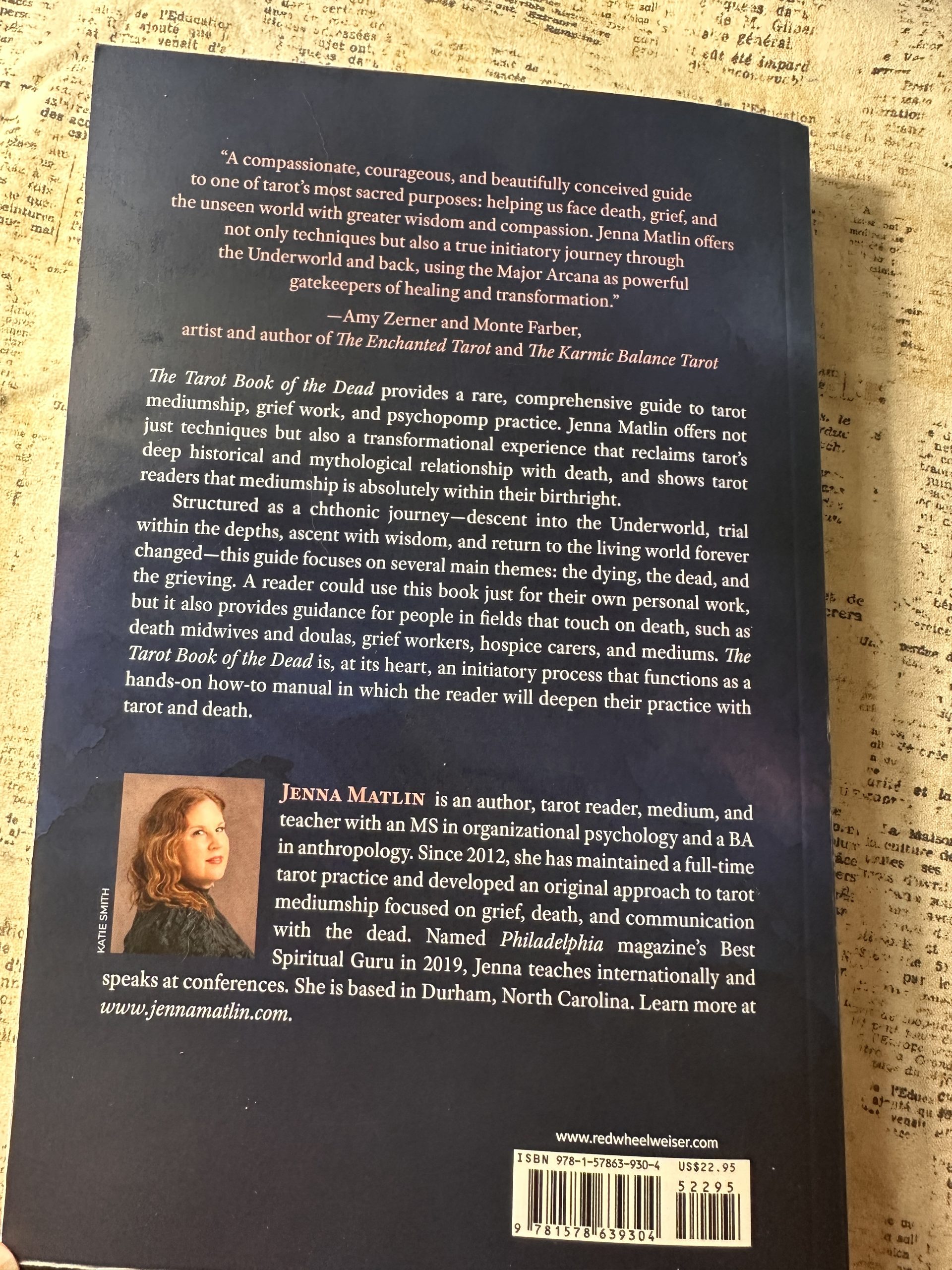
Author Bio:
Jenna Matlin holds an MS in organizational psychology and a BA in anthropology, with end-of-life doula training through INELDA as well as training in psychedelic integration support. Since 2012, she has maintained a full-time tarot practice, which is known for its highly intuitive and innovative techniques. She has been involved with the Masters of Tarot Conference at the Omega Institute. Her revolutionary approach to tarot mediumship specifically helps clients navigate grief, death, and communication with the dead. Based in Chapel Hill, NC, Jenna teaches internationally and domestically and speaks at conferences. Learn more at jennamatlin.com.
The Tarot Book of the Dead by Jenna Matlin can be purchased here: The Tarot Book of the Dead