
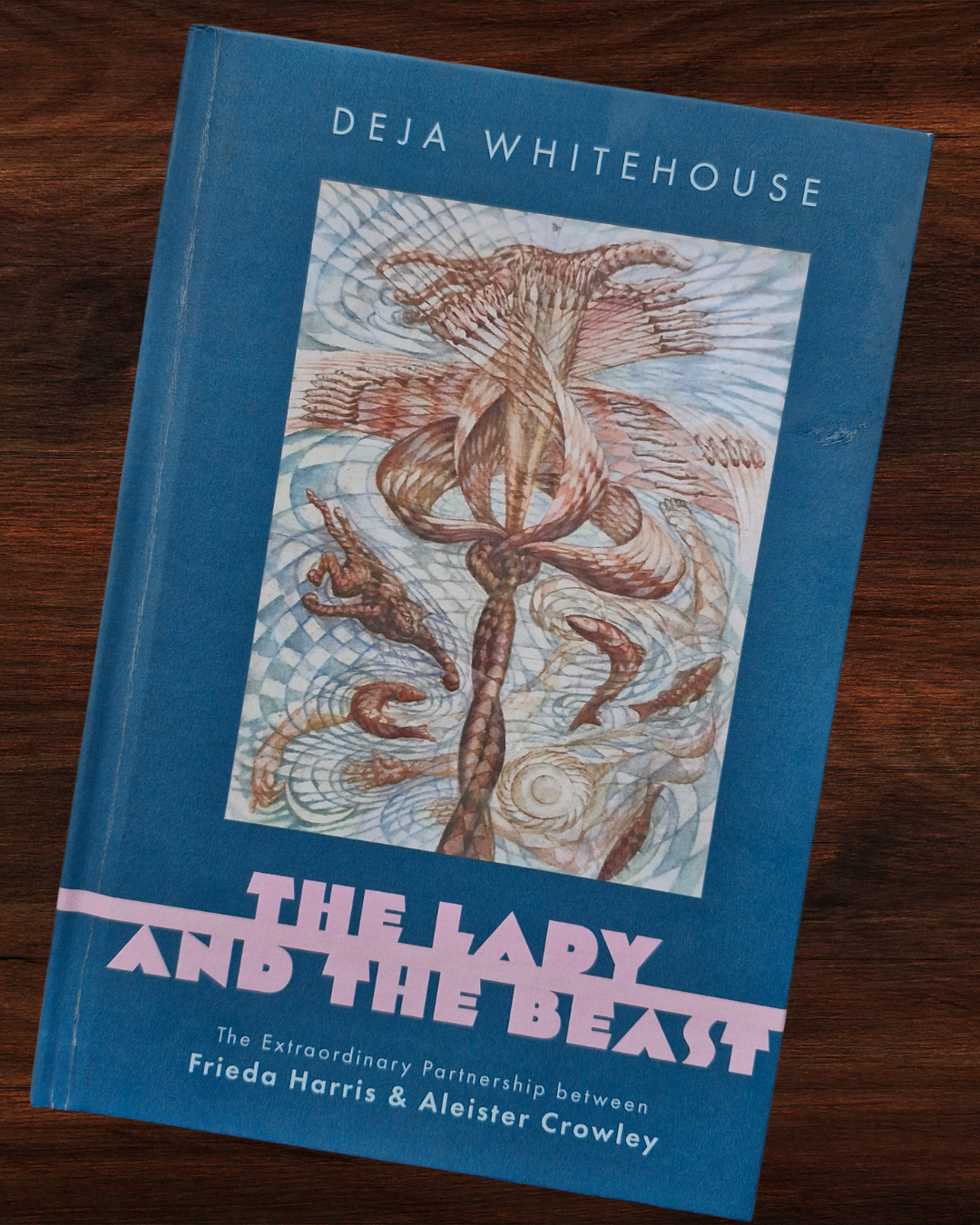
Book Review: The Lady and the Beast: The Extraordinary Partnership Between Frieda Harris & Aleister Crowley
- Author: Deja Whitehouse https://dejawhitehouse.com/academia/
- Publisher: Oxford University Press https://global.oup.com/academic/product/the-lady-and-the-beast-9780197645147?cc=gb&lang=en&
- Publication Date: April 2025
- RRP: Hardback £59.00; Ebook £49.17
- ISBN: 978-0-19-764514-7
- Reviewer: Gwen Enstam @goldenpomt on IG
…Crowley’s Book of Thoth was his last major magical work and could not have been achieved without Frieda Harris, not only for manifesting his vision, but also for her unstinting efforts to secure sponsorship and publication. In return, Crowley enabled her to realise that Art was her true spiritual path. (p.193)
A couple of years ago, I happened across an article entitled “Mercury is in a Very Ape-like Mood: Frieda Harris’ Perception of Thelema”* by Deja Whitehouse. I was absolutely thrilled. It isn’t easy to find anything substantial about Lady Frieda Harris, the artist responsible for the artwork of the Thoth Tarot, and the article whetted my appetite for what was to come – The Lady and The Beast, a full monograph that builds on research for Whitehouse’s 2000 PhD, In Search of Frieda Harris. In The Lady and The Beast, Whitehouse not only fleshes out Harris’ personal life and her complicated relationship with Aleister Crowley, but also highlights her passionate, life-long search for spiritual understanding.
It is amazing that The Lady and The Beast is the first biography of Frieda Harris, an esotericist and artist so much more generally well-known than her contemporaries. Dion Fortune and Moira Mathers, for example, are deservedly famous for their work, but primarily within esoteric circles. You have to go looking to find them. But the Thoth Tarot is one of the most popular decks in the world, whether you are interested in Qabalah etc or not, and Lady Harris’ name is right there on the box next to Crowley’s. Perhaps that is the problem. Her association with Crowley caused Harris problems for many years, and perhaps it is only now that the world is ready to take him seriously, that we want to take her seriously as well.
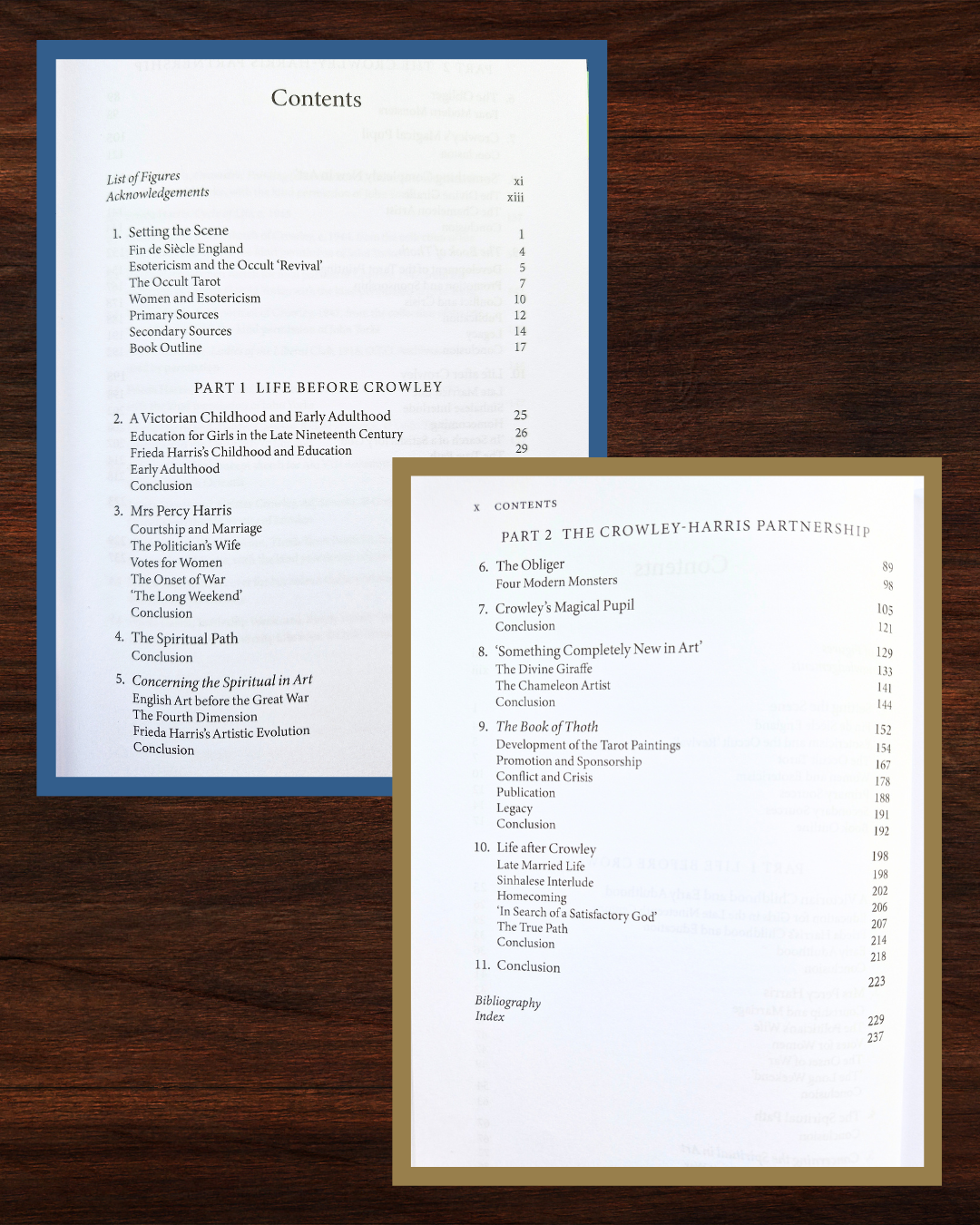
Whitehouse’s book is divided into three sections. Chapter 1, ‘Setting the scene’, introduces us to the culture and society of England at the end of the 19th century, focusing on the ‘revival’ of esotericism, and in particular, the role of women in the movement. It is an exciting start, setting a more hopeful tone than I had expected – in the context of what was still essentially a Victorian culture, women were encouraged to participate in occultism because it was considered a ‘spiritual’ practice – religion and spirituality being part of the domestic domain. This chapter also introduces us to the Tarot, giving a brief history (e.g. was it originally an Egyptian text) and its role within the development of Qabalah.
Now we have the context of the story, and we are ready for ‘Part I: Life Before Crowley’. Here we learn about Frieda Harris’ middle-class childhood, her education as a young woman in early 20th century England, and her marriage to Percy Harris. Frieda made comments all her life about her intelligence being ‘sub-par’ because she had less formal education than her peers, and she visibly struggled with spelling. But it becomes clear very quickly from the subjects she later studied and mastered – on her own and under Crowley’s tutelage – that this was an issue of confidence, not ability. Crowley:
instructed her in astronomy and astrology, mysticism, Yoga, geometry, algebra, history, literature, chemistry, and what not.’ Despite having received ‘no education’, Harris began to learn the Greek and Hebrew alphabets, the Kabbalah, and subsequently the Yi King. (p.109)
I can’t imagine what it would be like to have Crowley as a personal tutor, but we know that he didn’t waste his time. Girls of Harris’ generation would not have been offered any of the subjects listed above as part of their education, no matter how wealthy, so this would all have been new to Harris. If Crowley was willing to commit to such a rigorous course of study, he would undoubtedly have believed her capable of mastering all of it.
As much as I enjoyed the first sections of The Lady and the Beast, as a Thoth Tarot devotee, I admit it is Part II that I was looking forward to, and I was not disappointed. ‘The Crowley-Harris Partnership’ explores the relationship between two people who were sublimely confident in their own expertise; who could argue fiercely, and intentionally annoy each other with relish; and then find their way back to a deep friendship. I especially loved all the excerpts from letters between Harris and Crowley, and Harris and other friends. Harris and Crowley really come to life here, as we read their responses to each other and get to see (for better or worse) Crowley’s own personal notes written in the margins of her letters.
Throughout The Lady and The Beast, Whitehouse sets Frieda Harris within the context of her contemporaries, comparing her relationship with Crowley to that of Pamela Colman Smith and AE Waite; giving us quotes from fellow artists like Ithell Colquhoun; and comparing Harris’ personal life to that of contemporaries Annie Besant, Moina Mathers, and Dion Fortune. This is fascinating, as are the many comments from Frieda’s grandson, Jack.
In fact, I absolutely loved this book. I read it in a day. I added lots of sticky flags on the pages because I know I’m going to want to find those points again. As wonderful as it is to finally know something more about a woman I have long admired, The Lady and The Beast also gives us new insight into how Crowley saw the Thoth Tarot, notably from the perspective of an author with no axe to grind: for Whitehouse, Crowley is Crowley – it’s Harris who we are focused on here.
Harris spent the last ten years of her life in India, led there in her pursuit of spiritual truth following Crowley’s death, and:
According to her son, Jack, when he and his wife visited Frieda in Kashmir, she ‘had become some sort of saint and her portrait hung in her sitting room surrounded by flowers.’ (p.218)
It was at this point I realised The Lady and The Beast is also an account of a mystic – one who was recognised as such during her lifetime in the place she felt most spiritually at home.
The Lady and The Beast is a fantastic book that covers a lot of ground, publishing for the first time academic research that gives us an invaluable resource for historians and esotericists alike. It is an academic book but written in a way that is meant to be inclusive. It’s perfect, of course, for anyone interested in just about anything to do with Frieda, Lady Harris, but also for the political and social history of the late 19th and early 20th centuries, and the esoteric and artistic community that surrounded Harris and Crowley.
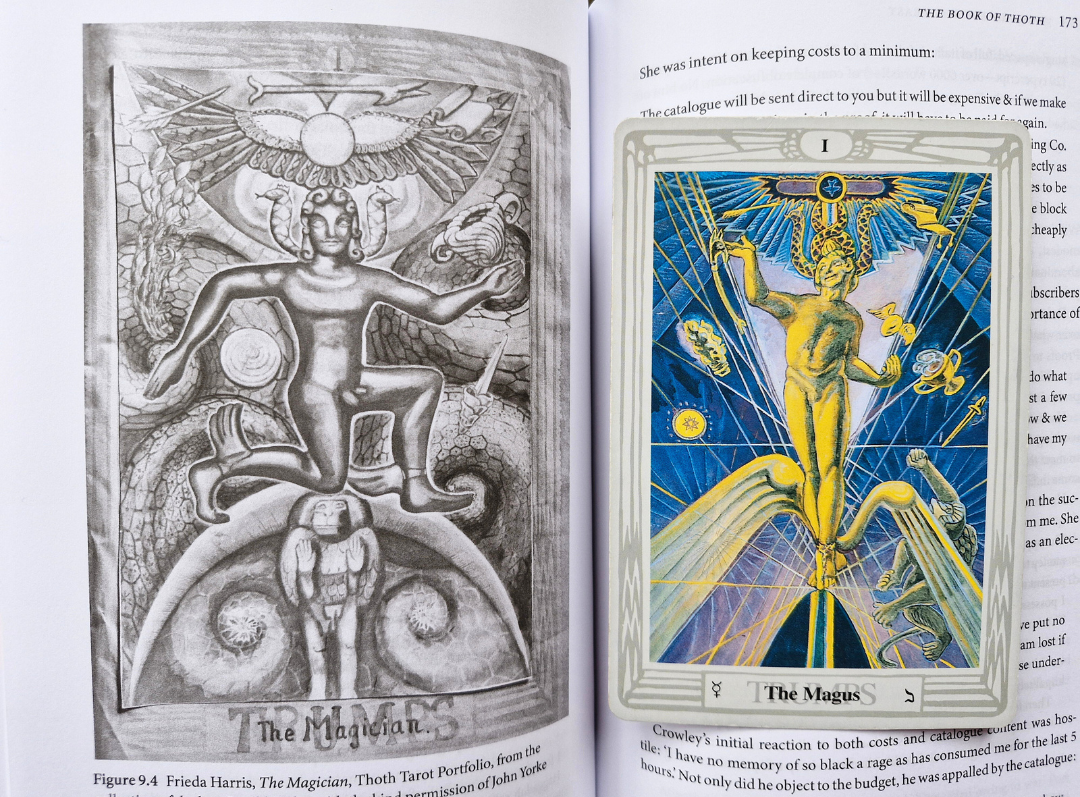
The point of The Lady and the Beast is not to prove that Harris did more work on the Thoth Tarot than Crowley, or vice versa. Exactly the opposite. Harris and Crowley interacted with each other – he on her spiritual side, she on his artistic side – which created an alchemised blend of something new. The point is that Lady Harris was a much more remarkable person than even the genius we see at work in the Thoth Tarot illustrations, artistically and spiritually. I would even go so far as to say that she had in fact already found what she was seeking in terms of a ‘satisfactory god’ but just didn’t have the words to go with it. The question remains, perhaps, of whether her answer is there, waiting for us, in the Tarot Trump that she struggled with the most – the vibrant Magus in his Ape-like mood.
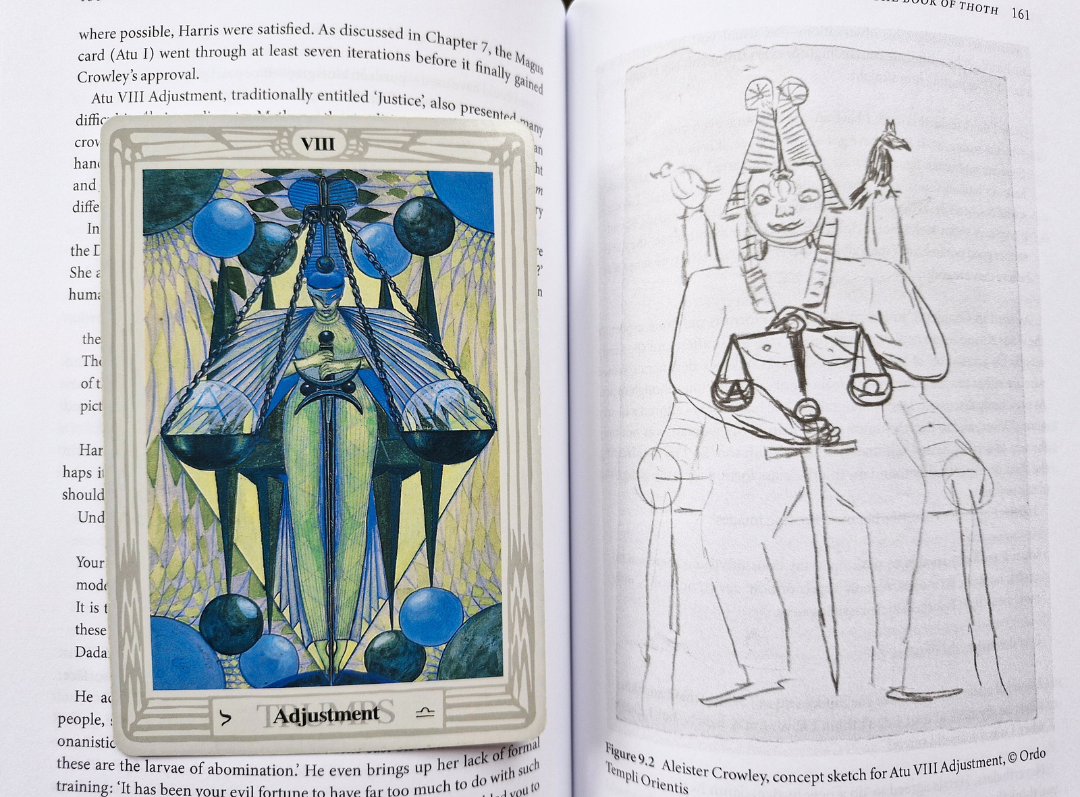
- “Mercury is in a Very Ape-Like Mood” by Deja Whitehouse, in Aries – Journal for the Study of Western Esotericism 21 (2021) 125–152. This is an open access article distributed under the terms of the cc by 4.0 license. The ape is a reference to one of the symbols of Mercury (in relation to the Egyptian god Thoth), the Cenocephalus, which can be seen in the image above of the Thoth Magus card. It represents the unconscious, and Mercury/Thoth’s trickster aspect. You can read the article here: https://brill.com/view/journals/arie/21/1/article-p125_6.xml?language=en&srsltid=AfmBOoo4i929hgcvlGIUYDLuzxtjh676sGK3dvVroloeQp_qkoAqek36
The Lady and The Beast is available from OUP: https://global.oup.com/academic/product/the-lady-and-the-beast-9780197645147?cc=gb&lang=en&
About the author: After many years as a business analyst, Deja Whitehouse decided to enrol as a postgraduate at the University of Bristol, studying the life and works of Lady Frieda Harris. Awarded her doctorate in January 2020, Whitehouse works as an independent scholar and freelance writer, and is a member of the European Society for the Study of Western Esotericism (ESSWE). Please visit https://dejawhitehouse.com/academia/ for more information.