Book Review: Tangible Tools for Intuition: Use Crystals, Pendulums, Tarot, and More to Develop Your Inner Guidance
- Author: Melanie Barnum
Publisher: Llewellyn Publications (a division of Llewellyn Worldwide Ltd.), Woodbury, MN
Publication Date: November 1, 2026
RRP: $17.99 US / £16.99 GB
ISBN: 978-0-7387-8329-1 (trade paperback)
Reviewer: Tracye Quinlan – Prairie Moon Coaching
Tangible Tools for Intuition was published in the United States by Llewellyn, with a foreword by Cyndi Dale. Melanie Barnum is a Connecticut-based psychic, medium, speaker, life coach, and hypnotist who has practiced professionally for over thirty years. Her other books include The Book of Psychic Symbols. This hands-on introduction uses physical tools, from crystals and pendulums to cards, runes, scrying, and charms, to develop your intuition, with exercises and journal prompts throughout.
I always appreciate when authors and teachers encourage us to use tools in our spiritual practices. Barnum points out that using tools doesn’t hinder our intuitive faculties but actually helps us access and trust our intuitive connections.
In this book, she does a good job of hitting all the bases, from explaining what intuition is to the chakras and all of the clairs (e.g. clairvoyance, clairaudience, etc) with specific experiments you can try yourself for each one. She also describes psychic protection and why we can benefit from it, and she includes a really lovely protection meditation for the reader to try.

Barnum is heavy on symbols and gives examples for all of the clairs. For her, a baseball diamond always means her mother. She tells of seeing it in a reading for a client, who cut her off to say it was her son Charlie, who plays Little League. Then Barnum saw a nurse, and she realized it was the client’s mother coming through: she had been a nurse and started watching baseball at the end of her life. That changed the reading. Her other symbols include a white cowboy hat when she’s sensing whether someone is good or bad, and a gold star for someone who is good, which can also mean law enforcement. These are Barnum’s symbols, and in real working, not everyone gets the same visuals. When you try to learn someone else’s symbols, they most likely won’t show up for you. Something else will. For someone new enough to metaphysical tools to pick up this book, this much symbolism could feel overwhelming or confusing. Fortunately, she also gives many exercises to help you come up with your own.
I plan to try her clairaudience exercise, which she compares to the spirit boxes ghost hunters use. You turn on several sources of sound at once, such as a TV, a radio, and videos on your phone or computer, with no question in mind, and note any words or sounds that stand out above the noise. When she did this for someone asking about a relationship, the words that stood out were “toxic” and “shake it off,” from songs by Britney Spears and Taylor Swift.
In the clairsentience section, I would have liked more symbols that weren’t physical sensations, including emotional feelings that aren’t your own. She mentions motion sickness as a symbol that someone is going on a trip, and the exercises have you notice your body temperature and other physical sensations, such as the warmth you feel when thinking of a friend.
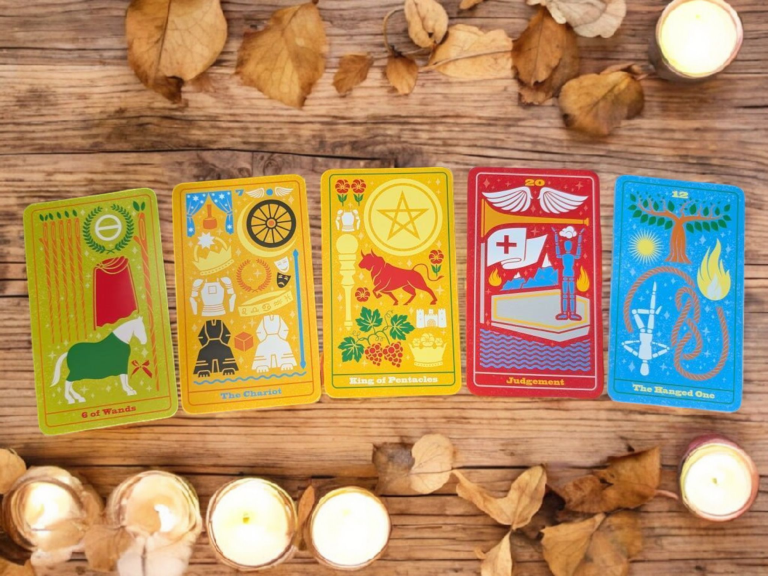
Her section on the different card systems (tarot, oracle, Lenormand, and Kipper) was well thought out, with good examples to practice so you get a taste of each. I have been reading Lenormand for a few years and had never seen this use of an extra card in a seven-card line: a concern card at the far left, with the situational outcome at the far right. I’ll be adding that to my repertoire.

In the chapter on chakras, auras, and crystals, Barnum explains how they work well together. She does a thorough job of briefly describing where the chakras are and the role they play in the connection to intuition, with basic information for each of the seven main chakras: their color, location, and the energy each is connected to. One thing I had not seen before was a discussion of the difference between the upper and lower chakras. While they play different roles, they work together to help our intuitive gifts.
Moving on to auras, she describes them as basically the energetic connection from our inner chakra system to our etheric body and outer self. I found this new and useful. I appreciate that she mentions auras are true for animals and even plants. I also didn’t know that they are elastic, that they change shape and condition, and that we can do this intentionally. This is something I would like to learn more about. The exercises in that chapter are for balancing your chakras, which I know from other teachers and from experience is an important part of energetic hygiene.

The end of the chapter covers crystals. I love that she reminds the reader that they are living transmitters and gives examples of how they can be used with other forms of metaphysical work and divination, such as pairing them with cards. I also appreciate that she reminds readers who are new to this work that you don’t have to spend a lot of money on crystals and can start with small pieces. She mentions rinsing them lightly or soaking them in water and sea salt to clear them of energetic residue, with a brief reminder to take care, since some may be damaged by soaking or too much sun exposure. I wish that had been stressed more, and that specific stones had been named. Selenite and lapis lazuli, both of which she lists in this chapter, can be damaged by water, so people risk damaging their crystals. The chapter goes on to teach you to read your crystals with crystal gazing, which is very fun. There are several exercises in that chapter that would be great practice.
In the chapter on pendulums, she does a thorough job of explaining that a pendulum is an extension of our own energy, not our thoughts, biases, or ideas. That same energy is our intuitive sense, and it’s what makes the pendulum move. At one point she says that if the pendulum doesn’t move at all, you might want to make or buy a different one. In my experience, and that of people I’ve taught, it’s usually your energy and a different pendulum will not change it. You just have to focus your intention. She does include a pendulum chart in the book that you could use right away with a homemade weight on a string.

The next few chapters cover runes, charm casting, and scrying. I found the chapter on scrying detailed and helpful, with several exercises in each.
Probably my favorite chapter was the one on psychometry and automatic writing. The psychometry exercises give you prompts as a springboard for tuning in to objects. She also gives prompts for the automatic writing and encourages you to use pen or computer, whichever is most comfortable for you. I appreciate that, because I’ve found it really does vary from person to person.
All in all, this is a book for someone new to these topics who wants a broad first taste of many tools. Readers with an established practice may find a few helpful exercises but much they already know, and some of the symbolism and crystal care guidance deserves caution.

Tangible Tools for Intuition is now available for purchase from Llewellyn here. It releases in the UK on 08-Dec-26 and is available for pre-order from all good online and offline book stores.
For more on the author please visit MelanieBarnum.com