Deck Review: The Southern Gothic Oracle & The Haunts Oracle
| Deck Titles: | The Southern Gothic Oracle |
| Creators: | Stacey Williams-Ng (Memphis, Tennessee, USA) |
| Publisher: | La Panthère Studio LLC, Memphis, TN, USA |
| Publication date: | This edition 2025 (first published 2021) |
| RRP: | USD $45.00 / GBP £33 |
| ISBN: | 979-8-9887096-9-5 |
| Cards: | 50 |
| Guidebook: | Full color |
| Series: | Deck 1 of the trilogy |
The Haunts Oracle |
| Stacey Williams-Ng (Memphis, Tennessee, USA) |
| La Panthère Studio LLC, Memphis, TN, USA |
| This edition 2025 (first published 2021) |
| USD $45.00 / GBP £33 |
| 979-8-9887096-5-7 |
| 40 |
| Full color |
| Deck 3 of the trilogy |
- Reviewed by: Tracye Quinlan | Prairie Moon Coaching
When I first saw the Haunts Oracle by Stacey Williams-Ng, I thought it was perfect for spooky season. A deck of 40 fears dressed up as monsters, ghosts, and scary places seemed made for Halloween. I had only asked to review the Haunts, but the publisher, La Panthère Studio, felt it worked better alongside the first deck in the trilogy, the Southern Gothic Oracle, and sent both. So this is a review of the two together.
The Cards
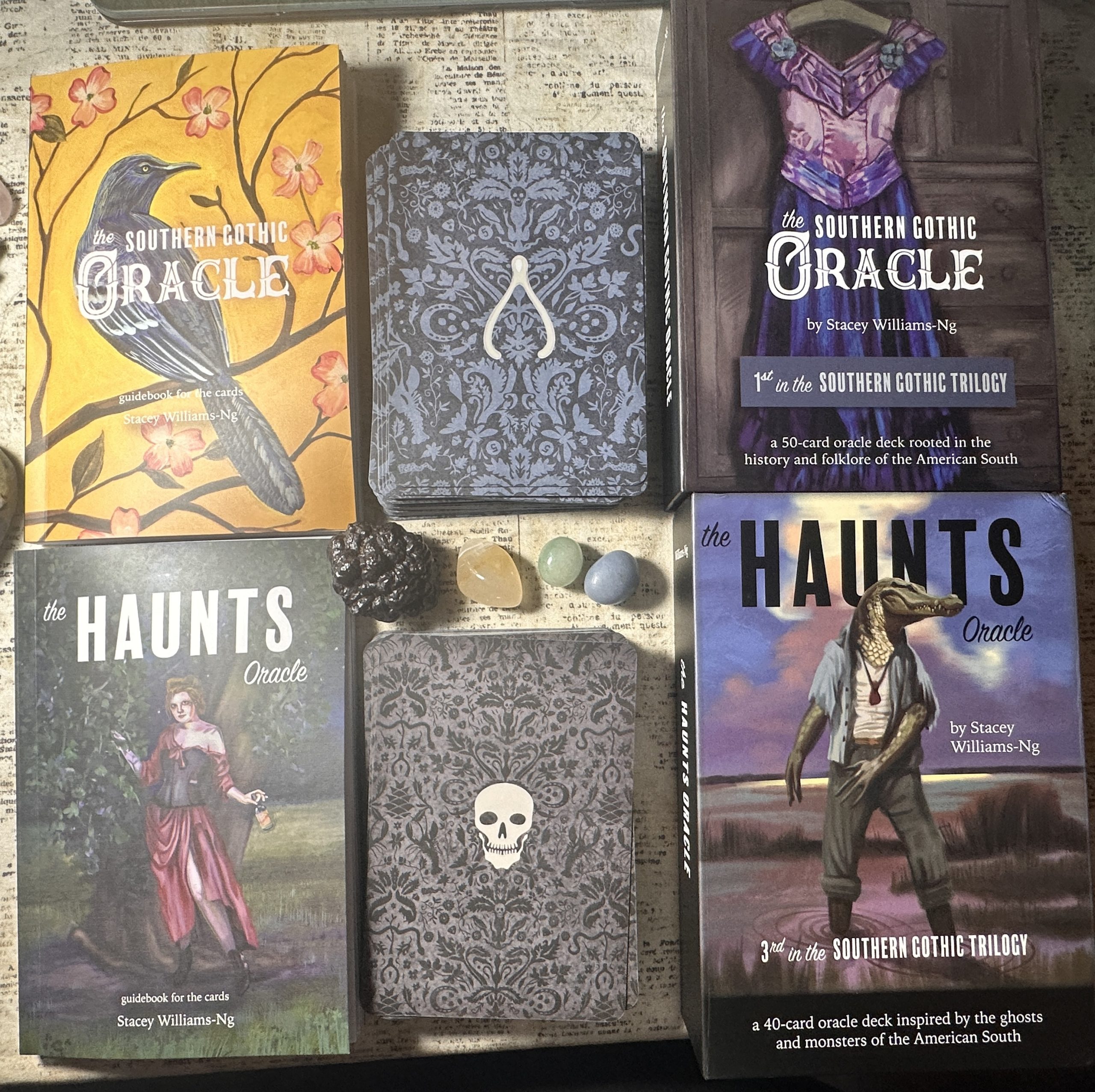
The cards in both decks are the same size and material, 3.5 by 5 inches (about 8.9 by 12.7 cm), with a matte finish that is easy to read and lovely to handle. They are about average width for oracle cards but not as tall, which makes them very comfortable in the hand. With my small hands, I can riffle, side, and overhand shuffle both decks easily. The backs are easy to tell apart: the Southern Gothic is a blue damask with a white wishbone, and the Haunts is a gray damask with a white skull.
Every card in both decks has a title and a number, with two keywords or keyword phrases beneath the title. That makes the decks usable even when the guidebook isn’t immediately handy. The writing on the cards is easy to read, even the small print under each title.
The Packaging
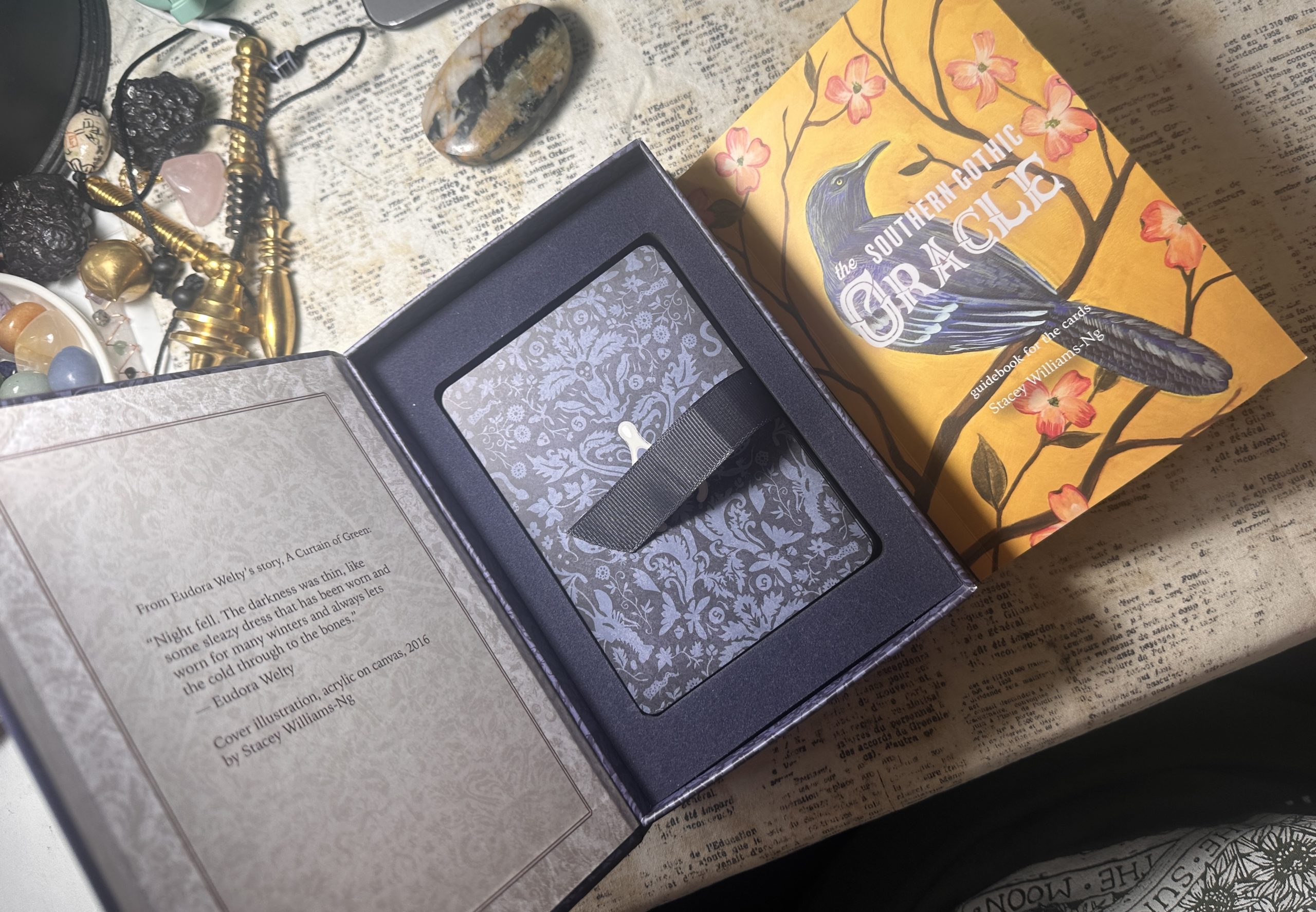
Both decks come in a sturdy box that opens like a book, with a magnetic closure that holds the cards securely and room for the guidebook on top.
Two Decks, Two Moods
The two decks have very different personalities. The Southern Gothic Oracle has gorgeous painted artwork, and its feeling is inviting and welcoming, what you’d expect from an oracle deck meant to stimulate your intuition and help you stay open to the guidance you’re seeking. The cards show objects, animals, and plants of the South, such as a hurricane lamp, a bottle tree, a catfish, and a raccoon peering from a hollow tree. Stacey told me it’s an intuitive, easy-to-read divinatory system that needs little introduction.
The Haunts is another matter. The art goes darker and more dramatic, with moody skies, ghostly light, and creatures like the Rougarou. Every card represents something unsavory: a flood, hot lava, a monster, a ghost. Stacey says that makes it best for direct questions where you expect a sobering answer, such as what stands between you and a job, which fears hold you back from becoming your true self, or what obstacle sits between you and your partner. Her guidebook introduction says not to be afraid to pull a card, but to “keep the lights on,” and she was not wrong. On some cards I caught myself quickly looking down at the title or keywords to ease the fear. There is nothing gory or unpleasant to look at, just creepy. The cards are exactly what she designed them to be, but maybe not for the faint of heart or easily put off.
The Guidebooks
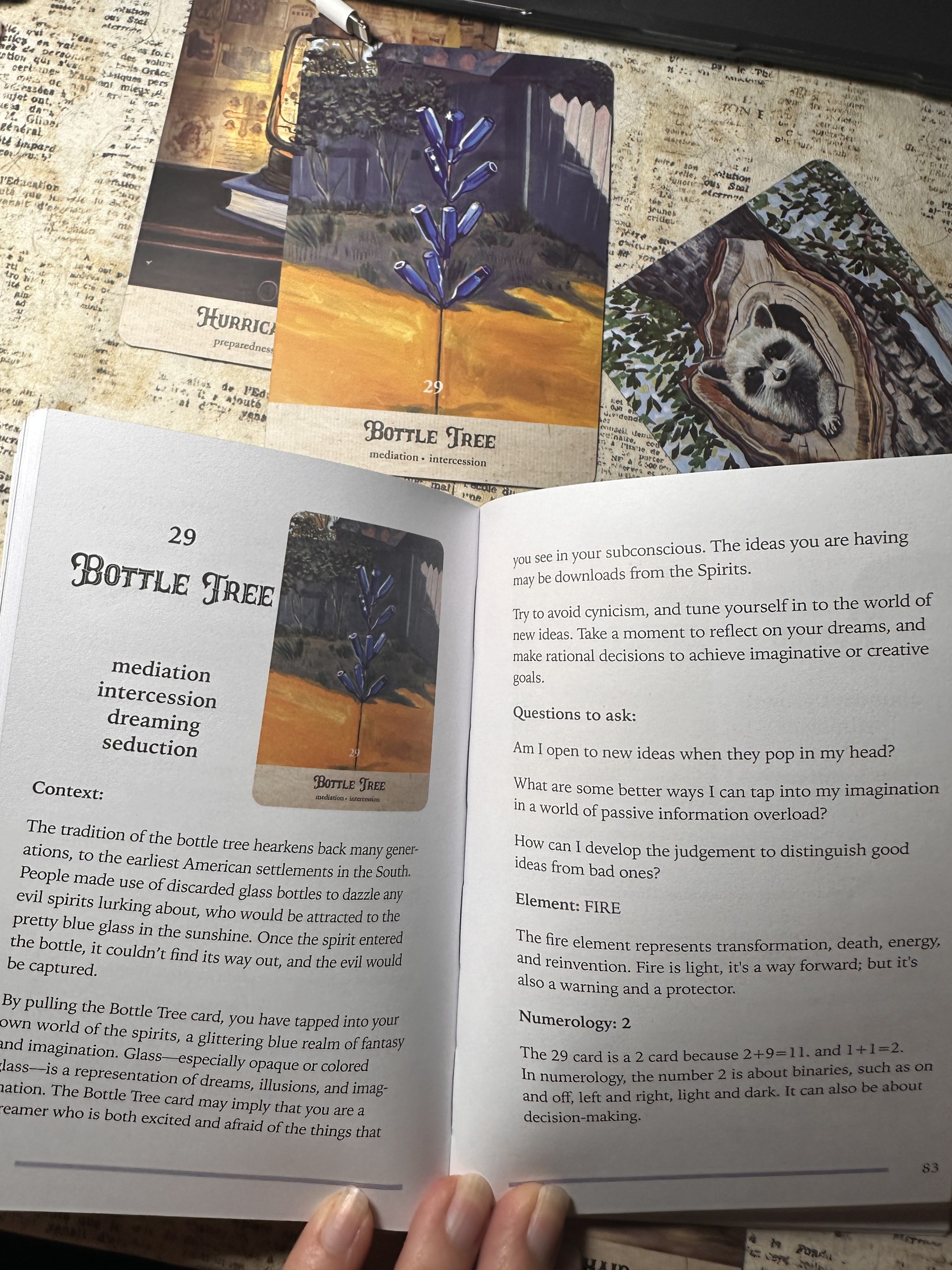
Both guidebooks are printed in full color, with a picture of each card and a two-page spread for every entry. The Southern Gothic Oracle guidebook gives the context for each card’s meaning, questions for reflection, the card’s element, and its numerology along with what that number means. I found the numerology especially interesting. The Haunts guidebook has no element or numerology. It is built around the fear. Each entry names one, such as fear of the wild for the Rougarou and fear of being ignored for the Witness, explains the creature behind it, and offers questions for reflection.
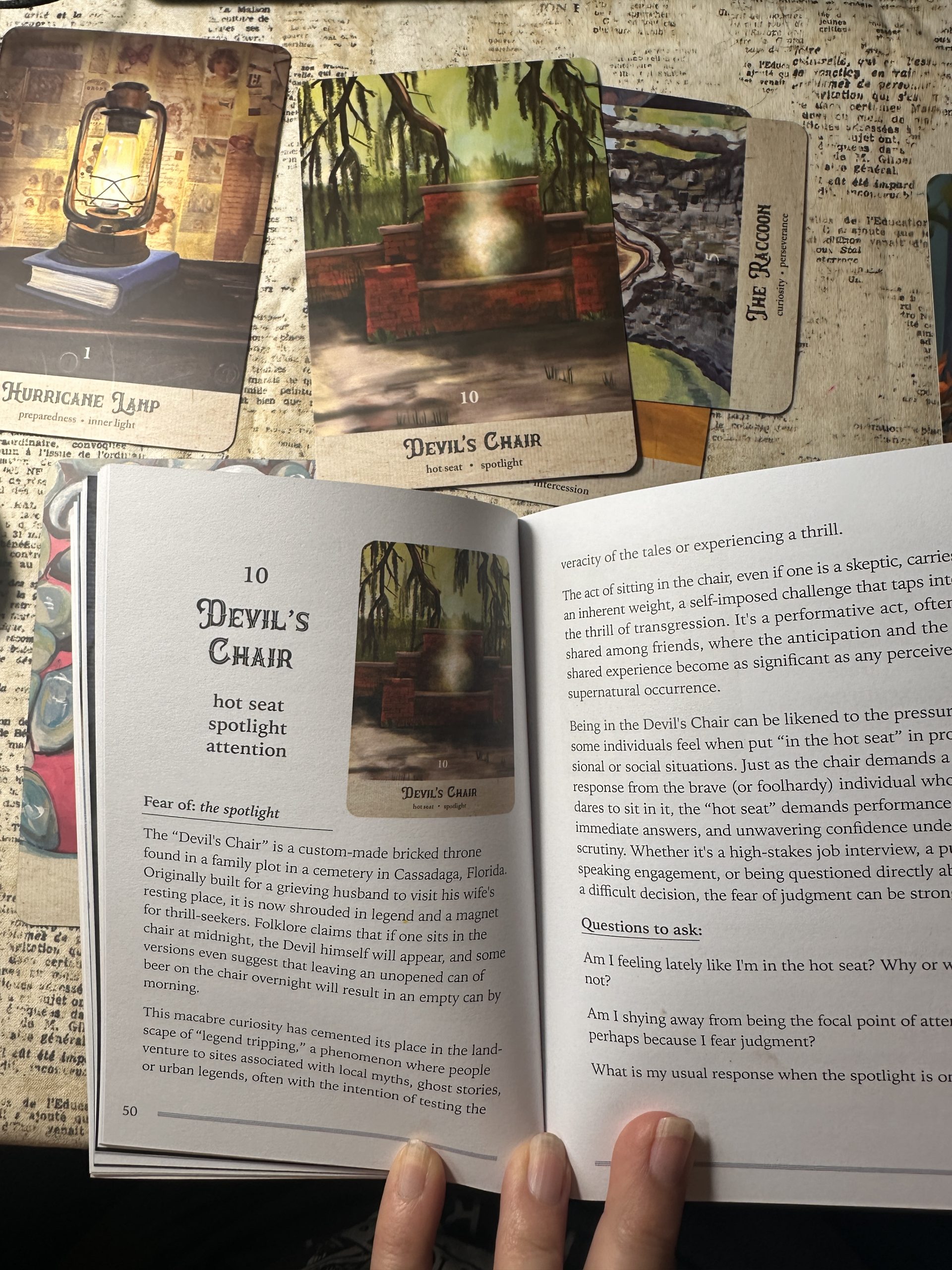
The two guidebooks also open very differently. The Southern Gothic Oracle’s introduction gives the history behind the deck’s folk traditions, including Hoodoo, conjure women, and granny women. The Haunts opens with the real fears of the South, including violence and the history of the civil rights movement. It handles that history respectfully, using it to show people facing fear, even threats of violence, and how their courage inspired others.
Both guidebooks include spreads. The Southern Gothic puts them at the back, with more of them, up to a seven-card Devil at the Crossroads spread. The Haunts puts them at the front, with none larger than three cards. Before those spreads, the Haunts guidebook does something I hadn’t seen in a guidebook before. It walks through worked examples, each with a real question, the cards pulled, and two ways to read them: as a targeted reading or as a deeper tool for exploring the fear underneath. It shows you how to use the deck and not only what the cards mean, and it lets a new reader see the method in action.
A Reading with the Haunts Oracle
I spread the cards face down, circled them around, and felt drawn to one. As I pulled it, the card on top of it came out too, so I kept both. My question was what was going on with me that day. An unpleasant family member had popped up, and I always worry about what drama is coming next. I drew Magic Potions (boosts, talismans, with power added in the book) and Clairvoyant (openness, listening, with empathy added in the book).
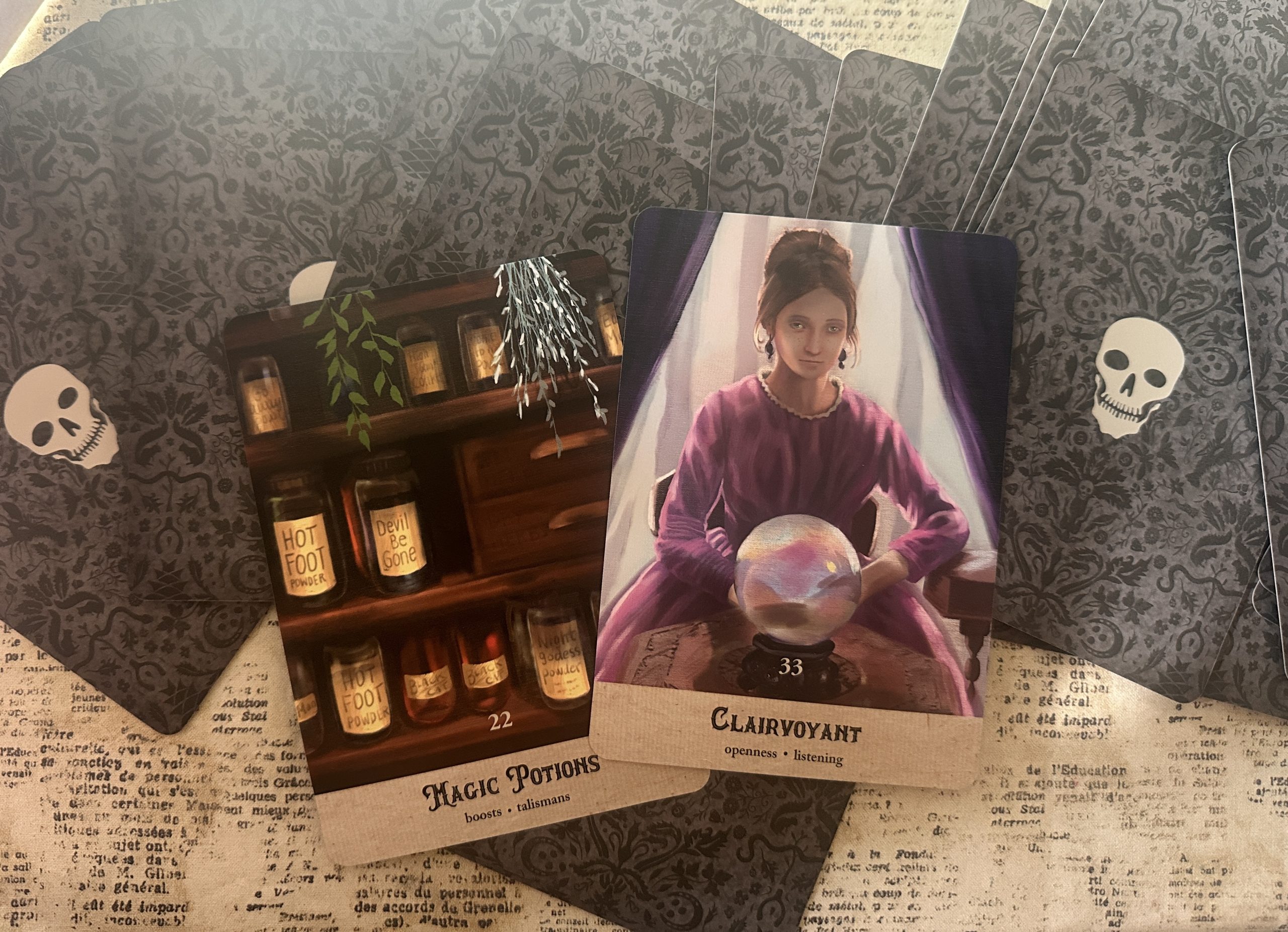
From the cards alone, I was struck by the idea of a talisman from Magic Potions, a way to feel protected from whatever this person might stir up, and by listening from the Clairvoyant, a reminder to trust my intuition and guidance about it all.
In the guidebook, the fear for Magic Potions was being unprepared, which summed up what was going on inside me. The rest of the entry spoke of our natural desire for control and security, the use of talismans, and a reminder that there’s a boost out there for any trouble. For the Clairvoyant, the fear of knowing the future didn’t add much about the situation, but the closing questions about where I need more openness and listening in my life made the combined message make sense. It reminded me of the old saying “trust but verify.”
A Reading with the Southern Gothic Oracle
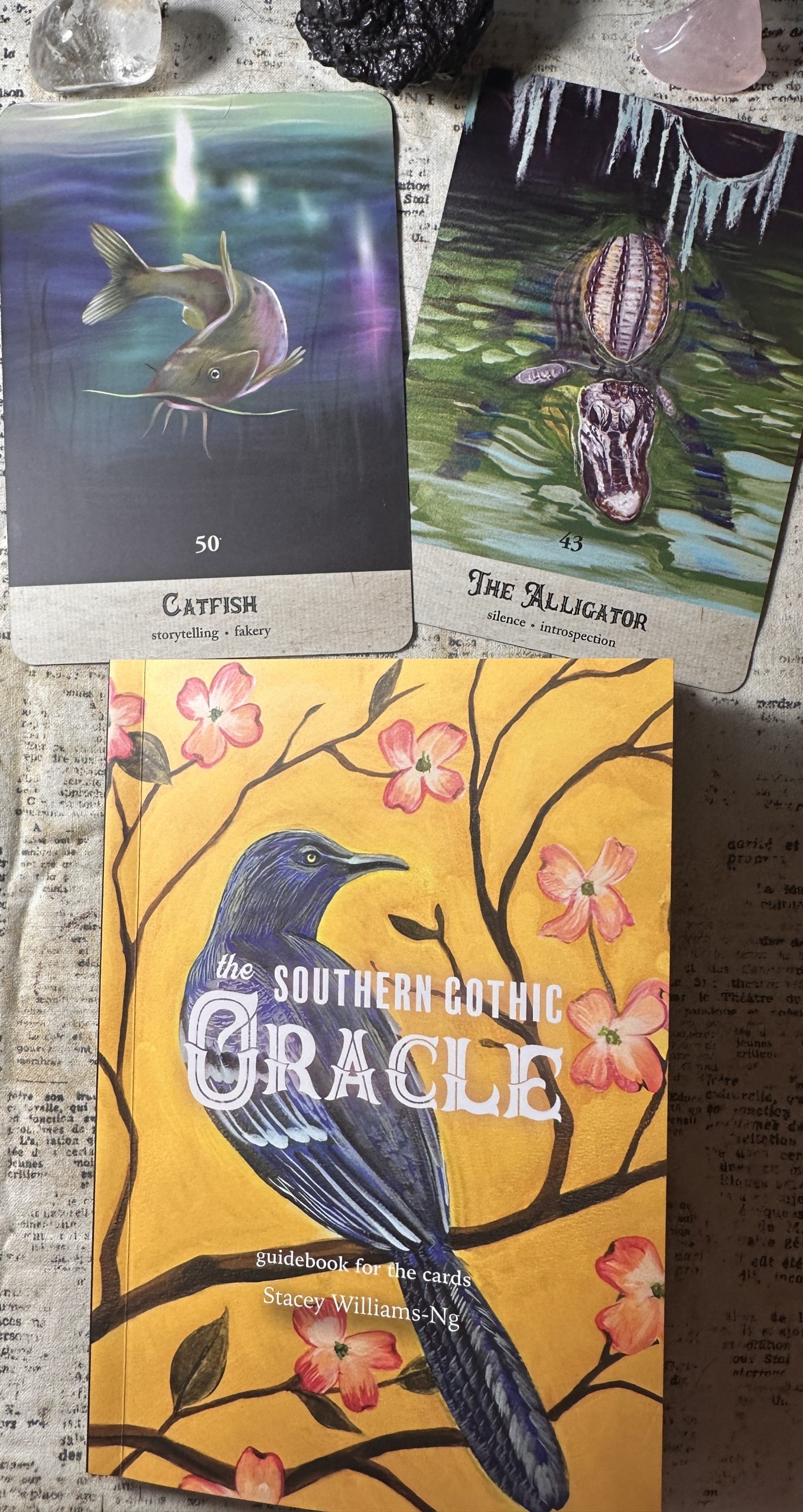
After going through the cards and doing my usual routine with a new deck, I shuffled and pulled two cards, loosely wondering what I needed to know right then, and feeling curious about what the deck had to offer. I drew the Catfish (storytelling, fakery) and the Alligator (silence, introspection). At first the keywords confused me. Why fakery, and why silence? Then it clicked. It was opening night for the community theater production I’m acting in. I had planned to meditate and settle myself beforehand, but I couldn’t resist getting acquainted with the decks first, and the cards were reminding me to do exactly that.
Using the Decks Together
The publisher suggested these two decks as a pair, but neither guidebook says how to combine them. When I asked, Stacey sent me a bonus spreads PDF she made for her Kickstarter backers. It’s a gift for backers and isn’t available to people who buy the decks, but she gave me permission to show pictures from it. In it, she uses the Haunts sparingly, for the problem, block, or fear positions, and draws the rest from the Southern Gothic or another deck.
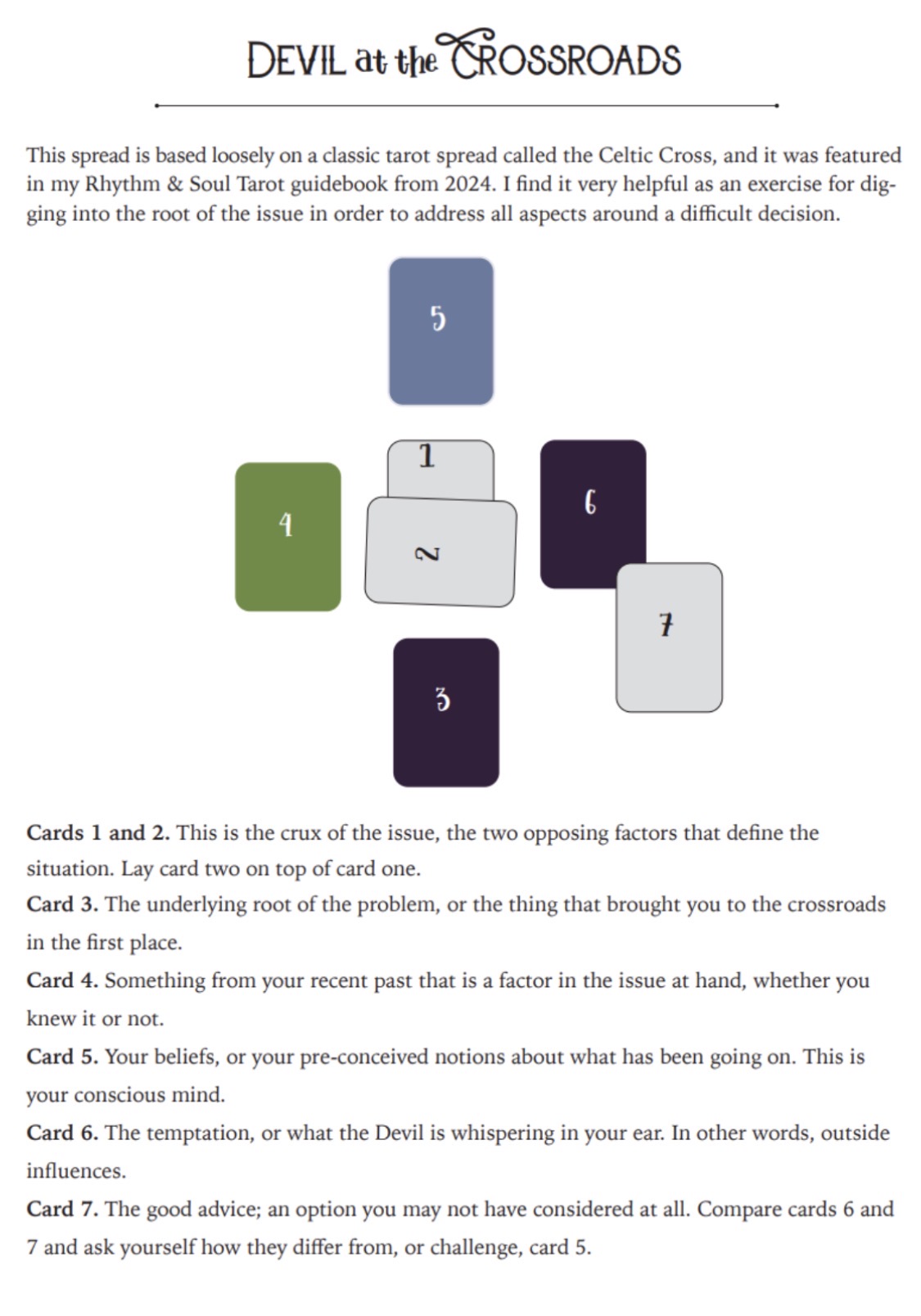
I laid out her Devil at the Crossroads spread, which is also in the back of the Southern Gothic guidebook. Positions 3 (the root of the problem) and 6 (the temptation, or outside influences) came from the Haunts and the rest from the Southern Gothic. One position calls for the Southern Botanic Oracle, which I don’t own (but will be ordering), so I drew that card from the Southern Gothic.
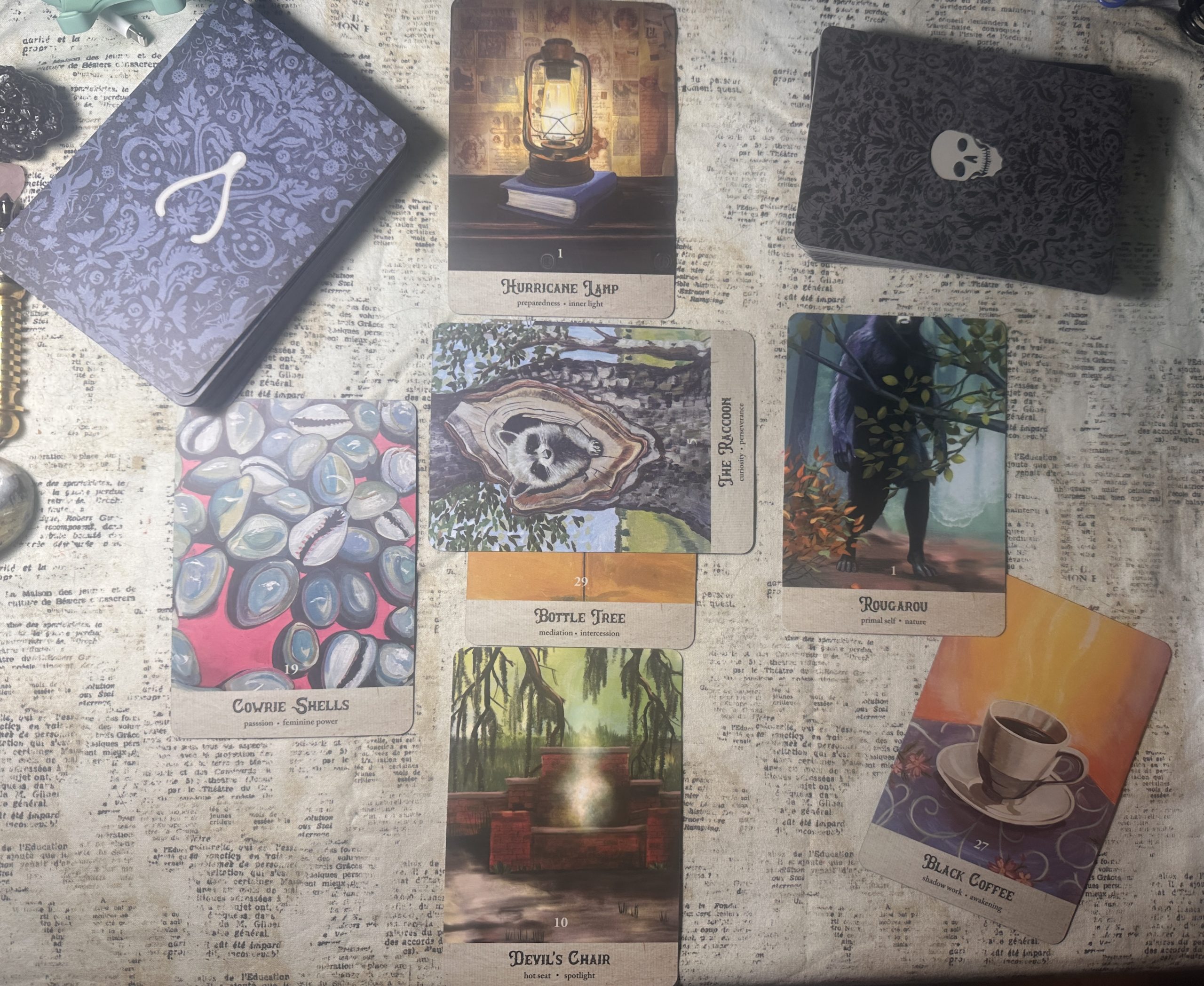
1 and 2, the crux of the issue. The Bottle Tree crossed by the Raccoon. These may be a little literal. I know I should meditate, quiet my mind, and tune in to spirit, but I avoid it by doing other busy things that I justify as good for me or my development. They don’t put me in touch with the unseen world the way sitting with it does. The Raccoon was emphasizing that I say I want more conscious contact with that world. I need to knuckle down and meditate.
3, the root of the problem (Haunts). The Devil’s Chair, whose fear is the spotlight. That’s not a fear of being on stage. I don’t mind that or being the hostess. But in my spiritual practice, I want to be accurate, and I judge myself harshly when I’m wrong.
4, recent past. Cowrie Shells. The guidebook goes into desire and physical attraction, but the questions resonated with me more, about my ideal vision of abundance and whether I have a healthy relationship with my personal power. I can see how those have followed me for a while.
5, my beliefs and conscious mind. The Hurricane Lamp (preparedness, inner light), which recalls the old Sunday school song “This Little Light of Mine.” My conscious mind knows I need to shine my light. I need to trust the inner light and shine it, and trust that I’m prepared enough to do so.
6, the temptation (Haunts). The Rougarou, whose fear is the wild. Its questions ask how well I’m caring for my body and about body shame and Puritanical beliefs, which hits home with the religious beliefs around where I live. It also circles back to card one’s meditation, grounding, and connection to the Earth.
7, the good advice. Black Coffee (shadow work, awakening). The guidebook calls it the shake-up you need right now and says to step forward with courage to see the light again.
Comparing cards 6 and 7 with card 5. The spread ends by asking how the temptation and the good advice differ from, or challenge, my beliefs in card 5. For me, the challenge is that I have a serious fear of losing my freedom. Letting my light shine, which is card 5, opens me up to being in the spotlight and to not being free. That fear is card 6. It has happened to me before, when everybody was aware of my business and had opinions on it.
Verdict
The Southern Gothic Oracle may not be for everyone, since not everyone is aware of or interested in the history and lore of the American South. I found it very interesting. I’ve spent time there and have ancestors from there, so I feel drawn to it. It works the way many other oracle decks do.
I understand why the publisher felt the Haunts wasn’t necessarily a deck to use alone, and I agree. It isn’t really for someone who doesn’t want to look at underlying shadow issues.
About the creator, from the guidebook: Stacey Williams-Ng (Memphis, Tennessee, USA) is a multidisciplinary artist and a graphic designer and illustrator of more than 25 years. She is a former design instructor and art teacher and a speaker at tarot and esoteric conferences. She is the author and illustrator of four oracle decks: The Southern Gothic Oracle, The Southern Botanic Oracle, The Haunts Oracle, and Roses, Dust & Ashes, which won the 2023 World Divination Association award for Best Indie. She also designed the Rhythm & Soul Tarot. She is the founder of La Panthère Studio, an indie publishing house online and in Memphis.
La Panthère Studio is an indie publishing house, and in my experience Stacey goes out of her way to help independent artists and creators.