Book Review: Aleister Crowley’s Mysticism
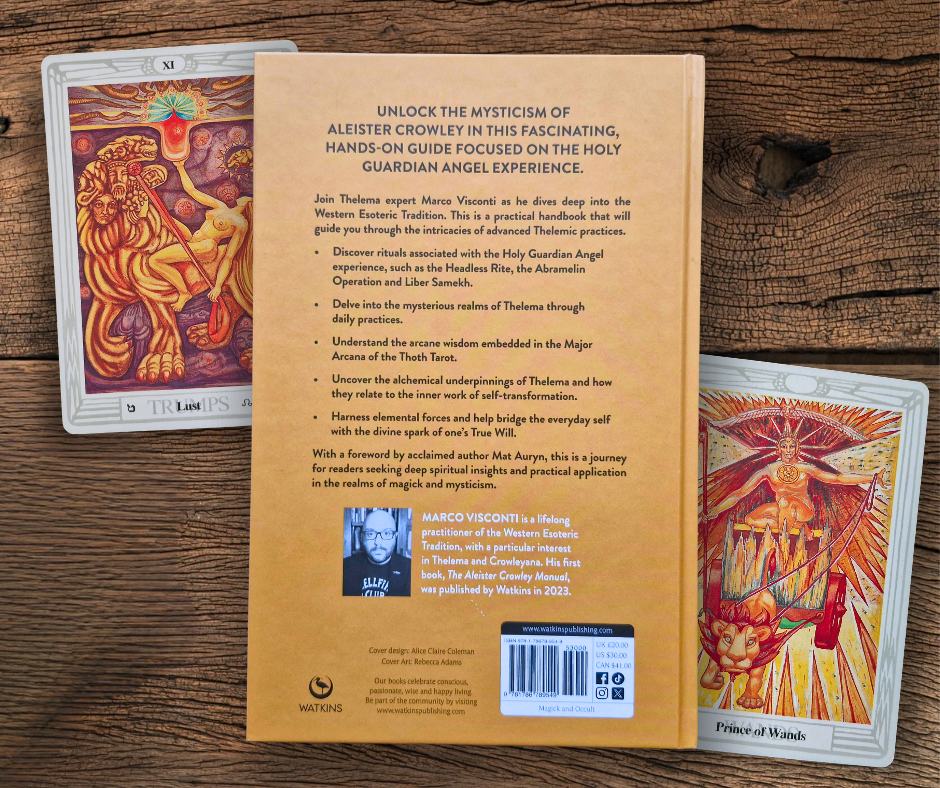
- Book Title: Aleister Crowley’s Mysticism: A Practical Guide
- Author: Marco Visconti
- Publisher: Watkins Publishing – December 2025
- RRP: GB £20.00
- ISBN: 978-1-78678-954-9 (Hardback)
- Reviewed by: Gwen Enstam @goldenpomt (IG)
Aleister Crowley’s Mysticism emerges as a definitive guide, demystifying the complexities of Crowley’s teachings, clarifying and simplifying the path toward the Holy Guardian Angel while preserving the depth required to tread it. (Foreword, p. xii)
You might now be asking yourself “What is a Holy Guardian Angel?” If so, you are in good company (and plenty of it). It’s a question that arises when you study Aleister Crowley and his work for any length of time, and it usually keeps coming up because it’s not easy to find an answer. Is it hidden because it’s just one of those mysteries? Or is there, maybe, a little bit of gatekeeping involved? Hard to know when you’re on this side of things … and the questions keep coming. How do we meet and ‘have [a] conversation’ with the Holy Guardian Angel (HGA)? Is the HGA a separate entity, like we usually think of angels, or is it a name that points to something much larger?

I’m ready for some solid answers, and in Aleister Crowley’s Mysticism, we get them. Marco Visconti’s explanation of the HGA is necessarily nestled deep within Crowley’s religion, Thelema, and its new Aeon, and his skilful interweaving of mystical concepts and their historical background is one reason the Aleister Crowley’s Mysticism is such a masterpiece.
Visconti explains that the HGA is part of Crowley’s new Aeon of Horus, the currently dawning age of humanity characterised in part by its focus on our interconnectedness vs the individuality of past ages. What great news! When we lose the hierarchies that have kept so many people suffering unnecessarily, the whole of humanity will evolve, together.
The HGA relates to the Aeon of Horus in a particular way because this new age also brings a new understanding of our existence – an awareness that there is something bigger behind all of creation, and within that we have the cycles of life and death. It’s no longer a matter of cycling through life and death in isolation, in other words, but doing so against a backdrop of something ineffable and eternal. These concepts tie in closely with non-dualism, which we might attribute to Crowley’s study of Eastern religion and thought. And of course Crowley takes the concept and runs with it, ultimately going on to add the magick that he is famous for: the crucible for the process of humanity’s transformation.
You see what we are dealing with. And yet, in Aleister Crowley’s Mysticism, Marco Visconti makes it all seem so easy. After starting us off with a fascinating discussion of the HGA, he then offers a step-by-step practical guide to the magick involved in meeting our HGA that is based on Crowley’s magical works.
Anyone researching Crowley for even a few minutes will know that he had a bit of a reputation, which makes Visconti’s observation of Crowley’s approach to magick particularly enlightening:
[Crowley] consistently emphasises throughout his writings that the ultimate aim of magic […] is to invoke the Holy Guardian Angel. For Crowley, any magical practice that falls short of this higher purpose is deemed black magic […] as they stray from the path of true spiritual attainment. This strict delineation underscores Crowley’s belief that all magical work must be focused on the profound goal of spiritual unification, transcending mere worldly desires. (p.44)
Surprised? Maybe Aleister Crowley wasn’t who you thought he was, and maybe neither is magick. ‘No gurus. No gatekeepers. No holds barred’ says a banner on Visconti’s website. Maybe we really are in a new Aeon, where what was once hidden is now freely given and we can see that what was considered pure devilry turns out to be our path to liberation.
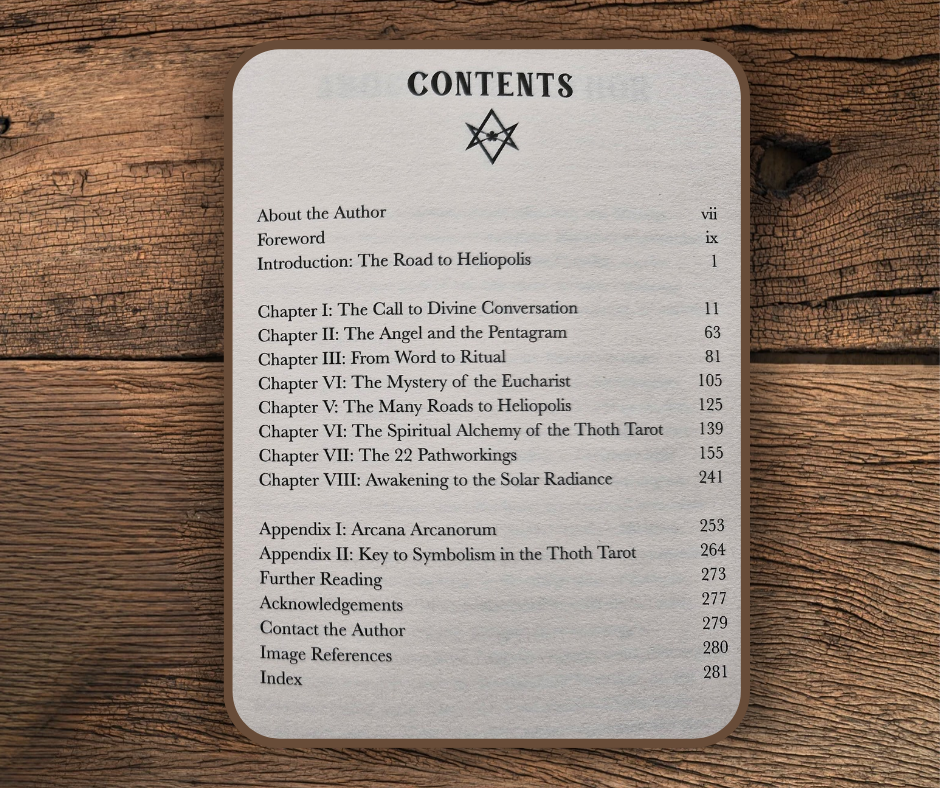
The magick leads naturally into a section on pathworking with the Thoth Tarot. Visconti lays out a meditation framework and then gives us twenty-two visualisations to apply within it – one for each of the Thoth Majors. They are beautiful, detailed, and inspiring, and I only wish there were a recording of them available so I could listen while meditating. Appendix I offers further work for the pathworking practitioner – a ‘Key to the Symbolism of the Thoth Tarot’ to supplement our meditations once they have taken their natural course.
Throughout, we are blessed with just enough helpful footnotes included here and there, exactly where they are needed, including a beautiful mini biography of Lady Frieda Harris, the sublimely talented artist who worked with Crowley to create the Thoth Tarot (p.159). There is also an unusually helpful Index at the back for those of us who forget where we read something and can’t find it again, and a Further Reading list that not only suggests more books for you to explore but gives a brief description of each.
Aleister Crowley’s Mysticism is presented as a book for beginners, but I would qualify that slightly – at least to say that if you are literally beginning your explorations into Crowley, the HGA, and the new Aeon, be prepared to do some additional research. But isn’t this part of the path as well? Seeking, questioning, pondering … they are what make your path your path, the importance of which Visconti emphasises. The path appears as we walk and Aleister Crowley’s Mysticism is the perfect guide for that journey.
About the Author:
Marco Visconti is an author, educator, and lifelong student of the Western Esoteric Tradition. In 2023, he published The Aleister Crowley Manual: Thelemic Magick for Modern Times with Watkins, and earlier this year, 2025, he published Stars and Snakes: A Thelemite’s Field Notes with Chnoubis Imprint. You can find him at https://www.marcovisconti.org/
Aleister Crowley’s Mysticism: A Practical Guide was published on December 2nd, 2025.