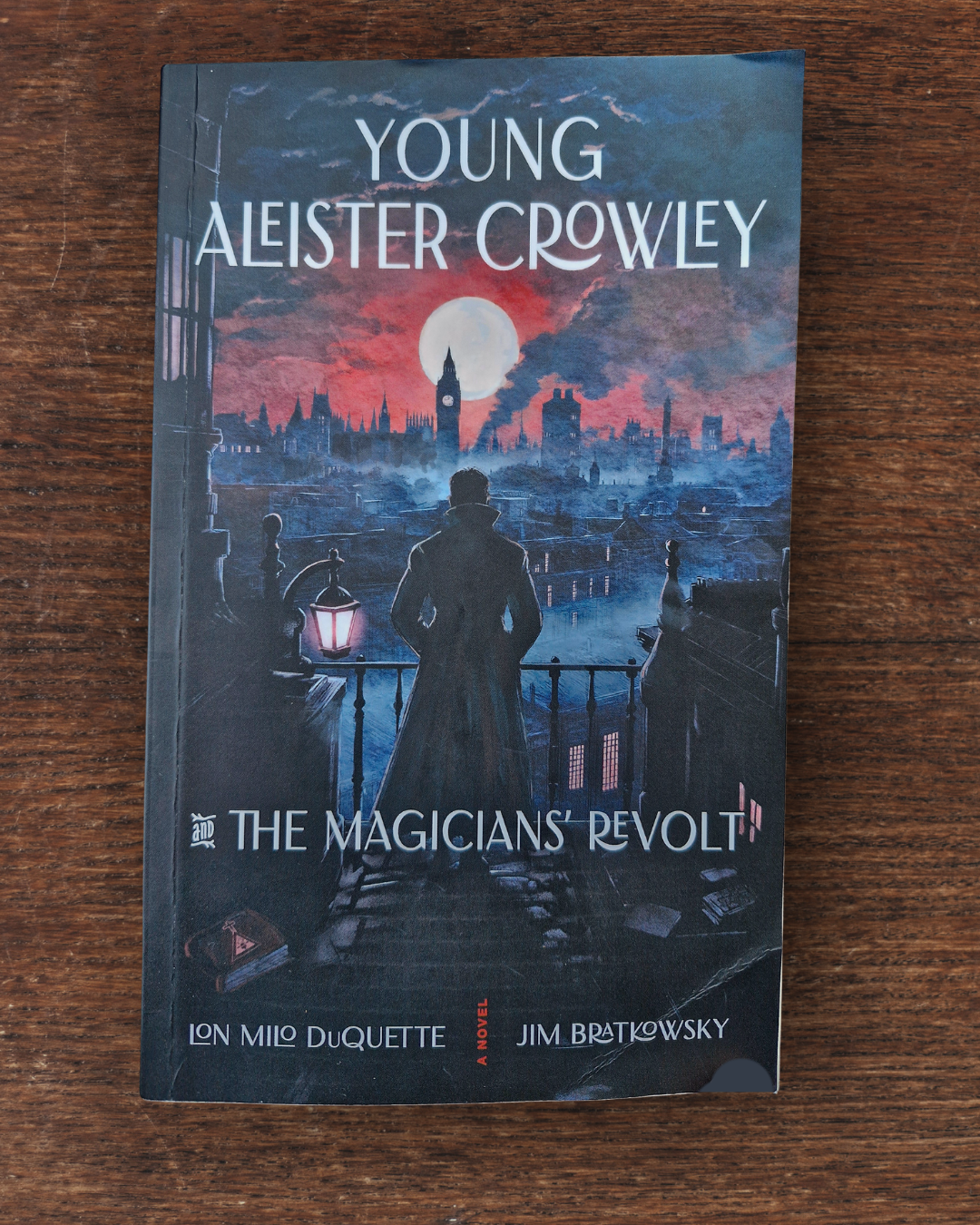
Book Review: Young Aleister Crowley and The Magicians’ Revolt
- Authors: Lon Milo DuQuette and Jim Bratkowsky
- Publisher: Weiser Books
- Publication Date: 2026
- ISBN: 978-1-57863-915-1
- RRP: USD $16.95 UK £11.99
- Reviewer: Gwen Enstam @goldenpomt on IG
[…] we confess that we have (for the benefit of those with eyes to see and ears to hear) woven within the tapestry of our tale what we consider to be serious spiritual observations, genuine secrets of high magic, tidbits of forbidden knowledge, and a generous serving of arcane wisdom – all designed to subliminally edify you as well as amuse. (p.x)
Young Aleister Crowley is a curious beast. It is ‘not a history book, nor is it a magical textbook, nor is it a biography of Aleister Crowley. It is a novel – a fantasy – a fairy tale created with the primary intent of entertaining you.’ (p.x) But it’s not exactly a novel, either. So, if we can’t choose, might it be all of these things? Novel, fantasy, and fairy tale, all at the same time?
That’s the best kind of story, after all, especially one that teaches – like parables offer what we might call the cover story, while the underlying symbolism tells us something more profound. Both are wonderful … and maybe the cover story plants a seed that, at some point, takes root and starts to sprout, seemingly from nowhere. I fully expect that to happen, now that I’ve finished Young Aleister Crowley.

The book Young Aleister Crowley started out life as a screenplay, and it reads like one. Sort of. We don’t have the character cues and dialogue blocks that you would expect to see in a screenplay (think about how Shakespeare plays are usually laid out). Characters’ speech is placed in quotation marks, just like in a novel, but the speech and narration also include what is essentially stage direction: description, action, and also the workings of the character’s inner mind, all woven neatly into the narrative. For example:
From behind, a robed officer pushes Crowley through the door and slams it shut, leaving Crowley alone in the room. He pauses for a moment to let his eyes adjust to the dim light; then he sits down and closes his eyes. He is so nervous that his hands shake. He starts to practice pranayama to calm himself. (p.61)
DuQuette and Bratowsky retain the filmic option to dip in and out of scenes at will, with a minimum of fuss and explanation, which allows them to move smoothly backward and forward in time, and to and from different places around the world. When Sir Francis says “We’ll fade to black at this point, Milo”, it feels natural and easy. When he says “Let’s start this next scene with the sharp sound of a chisel being pounded upon metal and a closeup on the face of the stone angel that adorns the tomb of Oscar Wilde. New words appear on the screen: Pere-Lachaise Cemetery, Paris”, that is all we need to find ourselves transported. (pp.63, 36)

The narrator, we might be tempted to say, is Milo Harland, a young scriptwriter from Hollywood. He is the one speaking as the novel opens. But once Sir Francis Bennett comes onto the scene (and it is Sir Francis who ends the book), our attention moves to him – he is the one who so urgently wants to tell us about Aleister Crowley and the Order of the Golden Dawn.
Ah, finally, we think. I have finally found a book that will tell me what really happened between all these superstars of the late 19th century! Bram Stoker, Francis Farr, Moira and MacGregor Mathers, Annie Horniman, Maude Gonne, and my personal crush, WB Yeats, all in one place. And yes, there is ceremonial magic: there is fire, there are incantations, there are creatures from beyond. But oh, such a fine line to walk:
The space around us felt softly illuminated by warm, indirect lighting that seemed to radiate from every pore of his exposed skin. I forgot my hunger and felt nourished by this man’s presence – fed upon his light. This is magic, I thought. Real magic. Magic isn’t something you do; it’s something you are. (p.7)
The title of the book, Young Aleister Crowley and The Magicians’ Revolt, suggests that this might be the start of a series, because, as Milo puts it, “Frankly, it doesn’t begin to tell Crowley’s story.” (p.156) And Sir Francis says something interesting. He says that “documentaries must come later”, that this book is intended only to “crack open the door to the creative imagination of the public”, and honestly, how could it not?

My only criticism of the book is that, for something we know is fiction, and for a narrative that includes plenty of exciting magical moments, it can read more like a list. It is a short book, and I realise that at 156 pages, you can only do so much. So, as a novel, I would have loved a longer book that lets us explore the meaning behind events.
As a work of magic, well, I am not a ceremonial magician. If you perform the rituals described in Young Aleister Crowley, will you see what is described? Will ceremonial magicians recognise what’s going on? I don’t know. But this I understand:
There is a single main definition of the object of all magical Ritual. It is the uniting of the Microcosm with the Macrocosm. The Supreme and Complete Ritual is therefore the Invocation of the Holy Guardian Angel; or, in the language of Mysticism, Union with God.
~ Aleister Crowley, Magick in Theory and Practice
We are presented with facades all day, every day. We ourselves wear masks, often without realising it. But masks work both ways – they appear, but they can also be a deliberate choice. A sleight of hand, let’s say, to direct others’ attention away, and only those with eyes to see, will see.

Young Aleister Crowley and The Magicians’ Revolt is available from Weiser Books: https://redwheelweiser.com/book/young-aleister-crowley-and-the-magicians-revolt-9781578639151/ and all good bookstores.