Deck Review: The Cascades Oracle Deck
- Creator and Artist: Lynda Stevens
- Publisher: Independent/Self-Published
- Publication Date: September 2020
- ISBN: n/a
- RRP: USD $29.99
- Reviewed by: Gwen Enstam @goldenpomt on IG
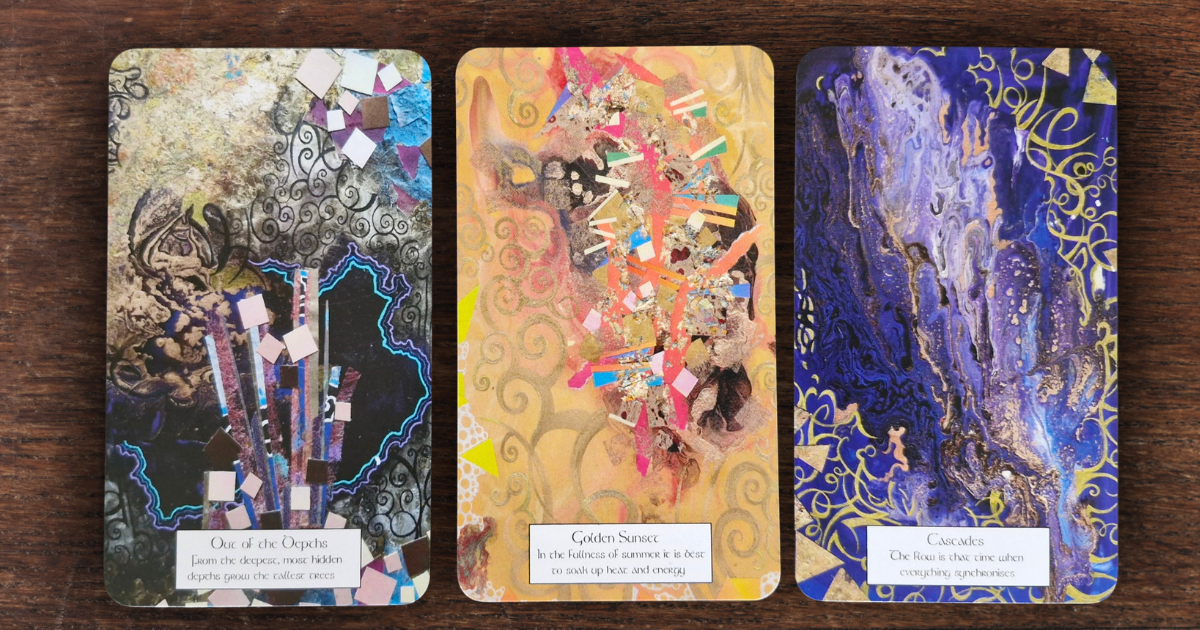
Artist Lynda Stevens tells us that The Cascades Oracle Deck is primarily ‘intended as a tool for anyone who may be stuck in some way, and the titles and short sentences [on the cards] are intended to help the querent think more laterally, in order to find a creative solution.’ For context, she draws our attention to Oblique Strategies by Brian Eno, a deck which aims to help artists work through ‘mental roadblocks’ with written prompts that can suggest new approaches. The goal may be the same in both cases, but the path could not be more different. Eno’s deck is a minimalist set of cards that offer text in black on white, while Stevens’ Cascades Oracle is a celebration of art and colour:
These compositions are part of a series of paper-based collage pieces of stiff A4-size paper, Each composition was created on a background pour of water-based acrylic mixed with oil-based enamel paint. Squares and triangles of colour paper were then glued onto this surface, and superimposed with metal foil, and added markings of gel pen in old and silver, often of spirals. In other cases, calligraphic markings were added, using a black ink pen. All of these works were guided by a process of psychic automatism. (Leaflet, p.1)
The approach and effect reminds me very much of Ithell Colquhoun’s Taro as Colour, in that the colours and shapes take priority over symbolism. If you don’t entirely believe Aleister Crowley’s assertion that Colours are living entities, you won’t doubt it once you pull this deck out of its box.
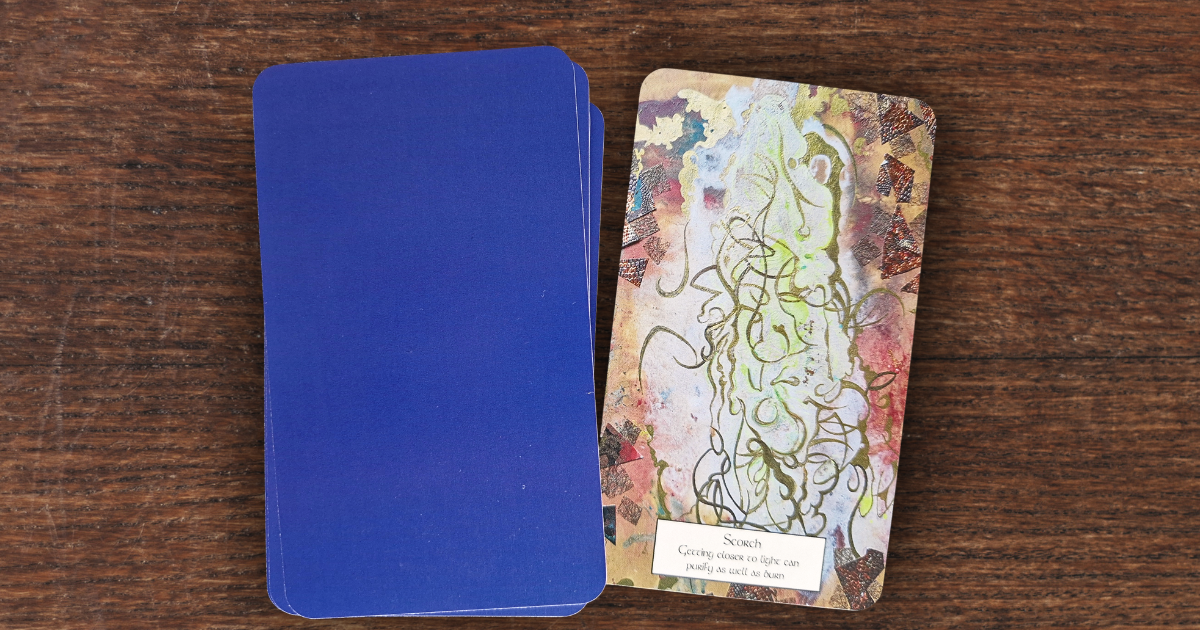
The 40 cards of The Cascades Oracle Deck have solid blue backs and my review copy came in a simple white tuck box. The perfect choice for a deck that is such a joy. The cards are strikingly beautiful abstract designs – alluring combinations of colour and pattern, of angular geometric shapes alongside elegant swirls, rivers, and sections of stained glass. The collage design on each card is unique, but the style is consistent throughout the deck:
In my work I often like to explore the tensions between chaos and form – and how chaos can break up stagnant forms into something more dynamic, or how form can bring beauty out of what was inchoate. (https://lyndastevens.com/artists-statement/)
The deck comes with a leaflet that explains the origin of the deck and gives options for interpreting the cards. But because of the nature of the deck, I decided to use the keyword and brief description on the cards, while meditating on the artwork in each one.
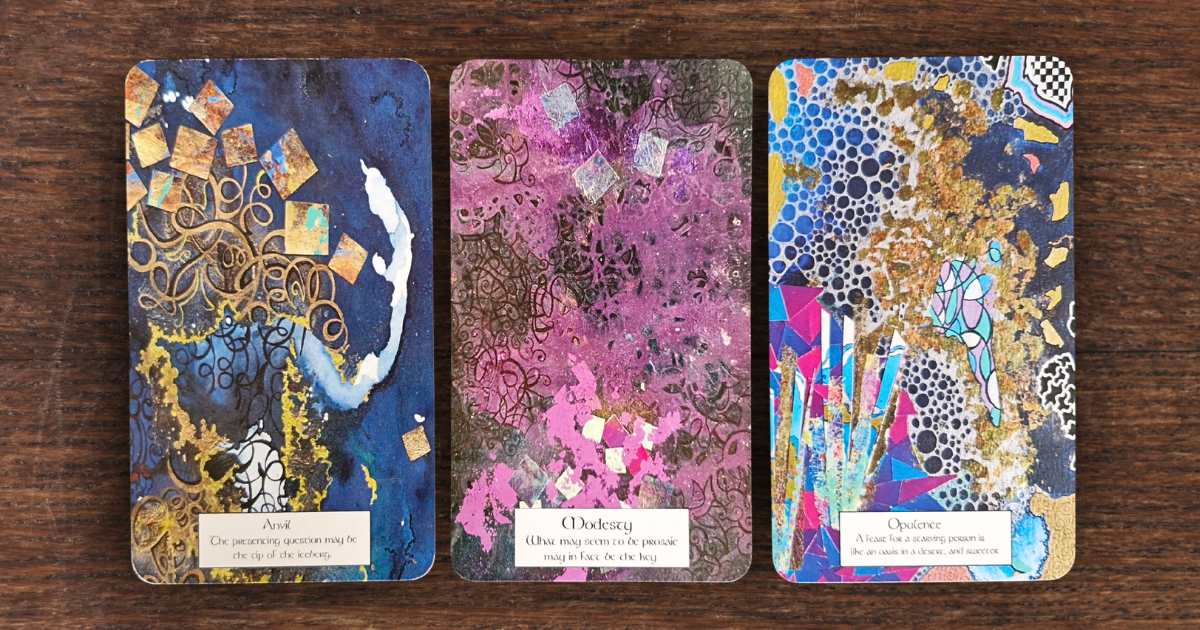
I began, in my head, to explain what I ‘saw’ in the cards. But then I caught myself. As someone who works with Tarot from the perspective of Qabalah, my habit is to immediately search the image for clues and symbols, and that involves breaking down the image into parts and shapes. Okay, there’s a triangle, that looks like a crystal … in other words, the very method that Stevens tells us is not part of how this deck works. So, I stopped and just sat with the cards. The messages I received stayed the same, but presented itself as a whole – an unfolding all at once as a confident impression.
It takes some adjustment because usually Oracle decks tell us what to think, what to look for. But in The Chalice Oracle, the prompts are helpful in a different way – they give you something to bounce off, rather than something to guide you. I would love to see the text on the card without the white box, or with some kind of change to it to make it less intrusive. I can see how this is one of those tricky choices deck creators make – where and how to include the cards’ titles – and I have no idea what to suggest as an alternative. But I did find myself covering up the title boxes with my fingers, to keep them from pulling me out of the art and back into my head … until I was ready.
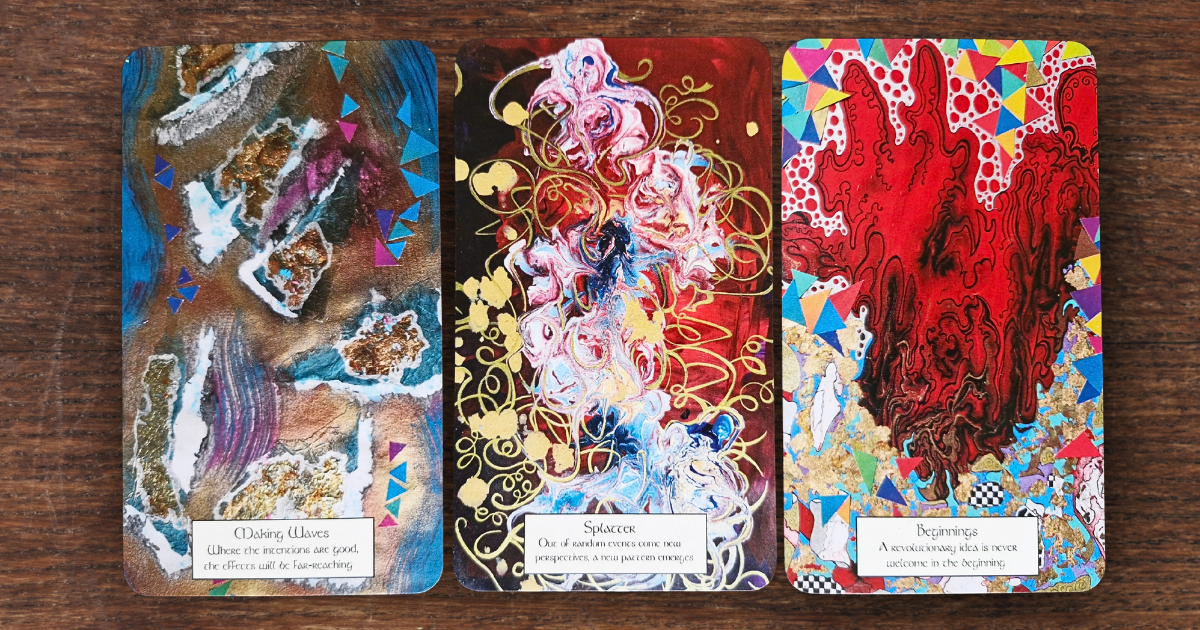
‘Making Waves’, with blue curves framing a gold centre, tells us that ‘Where the intentions are good, the effects will be far-reaching’. Which might be just what we need to see and hear at a time when we are hesitating to act because we’re afraid of being held responsible for the immediate outcome. And ‘Beginnings’, a glorious splash of red against a lighter background, reassures us that ‘A revolutionary idea is never welcome in the beginning’. Comfort at times when a great idea gets smartly knocked back, and advice: be patient.
Life unfolds in its own time, and this is a message that runs through the deck. Modern western culture wants us to always be pushing, and we get so used to it, we forget that not everything is under our control. Even when it is, it can be easy to miss all the options we have because we get so set in our ways. Especially our points of view, our habits. The Cascades Oracle offers a refreshing splash of water when our heads are stuck and overheating – and more than that, it reminds us that there are always other paths, if we can remember to look.
The Cascades Oracle is available from Gamecrafter: https://www.thegamecrafter.com/games/cascades-oracle-jumbo-size-with-booklet and Deckible: https://www.deckible.com/card-decks/23B-cascades-oracle-deck-cascades-oracle-lynda-rosemarie-stevens
Creator Bio:
Originally from the UK, Lynda Stevens has been living and working on a freelance basis in Budapest, Hungary since 2000, after first having worked there as a teacher in 1996. Nowadays her artwork consists of abstract mixed-media collage pieces, some on paper, using a bastardised marbling technique, onto which squares or triangles of other materials are added. [Her] aim is to create highly textured pieces that capture light through the interplay of opaque and reflective surfaces, so that many of her completed works will present a very different impression on the viewer, depending on how they are viewed. Even more recently, Stevens’s work has been focusing more on experimenting with paint alone, in which acrylic and enamel pours are used as a background for splatter techniques, to create works intended to evoke deep space, starry firmaments and nebulae.



Thsnk ypu for this brilliant and thoughtful review!
It was a pleasure to review! I meant every word. ~Gwen