Web Application Title: House of Obsidian – The Arcane Sanctuary
- Creator & Publisher: Emma Mitchell
- Date of Publication: First Public Release: July 2026
- House of Obsidian is now available as a subscription web application.
- RRP: GBP £15 per month subscription, with a 3-day free trial
- Launch Offers: The first 1,000 subscribers can currently lock in £10/month for life (normally £15/month) using the code: 10for1000. Once those 1,000 places have gone, TABI members will still be able to receive 25% off for life using: TABI2526
- Reviewed by: Ellie Element
As soon as I was given access to this website I knew I was going to have lots of fun entering cards and spreads and reviewing what came out of the other end. As someone who has kept spreadsheet records of cards pulled for over ten years, and who manipulates these to see patterns, frequencies and omissions within the cards, I could immediately see the potential for this website. It has the ability to pull together a range of tarot related associations to give an overview of what has been going on with my cards over a period of time, and to look at what’s not come up, or comes up rarely, all in one place. The site provides the information, then it’s up to me to interpret what I think it all means.
Created and published by TABI Member Emma Mitchell, this product is described as a place where tarot readers can organise, explore and better understand their own practice while keeping the relationship between the reader and the cards personal (it’s completely AI free). It links together the systems of astrology, Qabalah, numerology, crystals, herbs, and others to provide a overview of how tarot interacts with them.
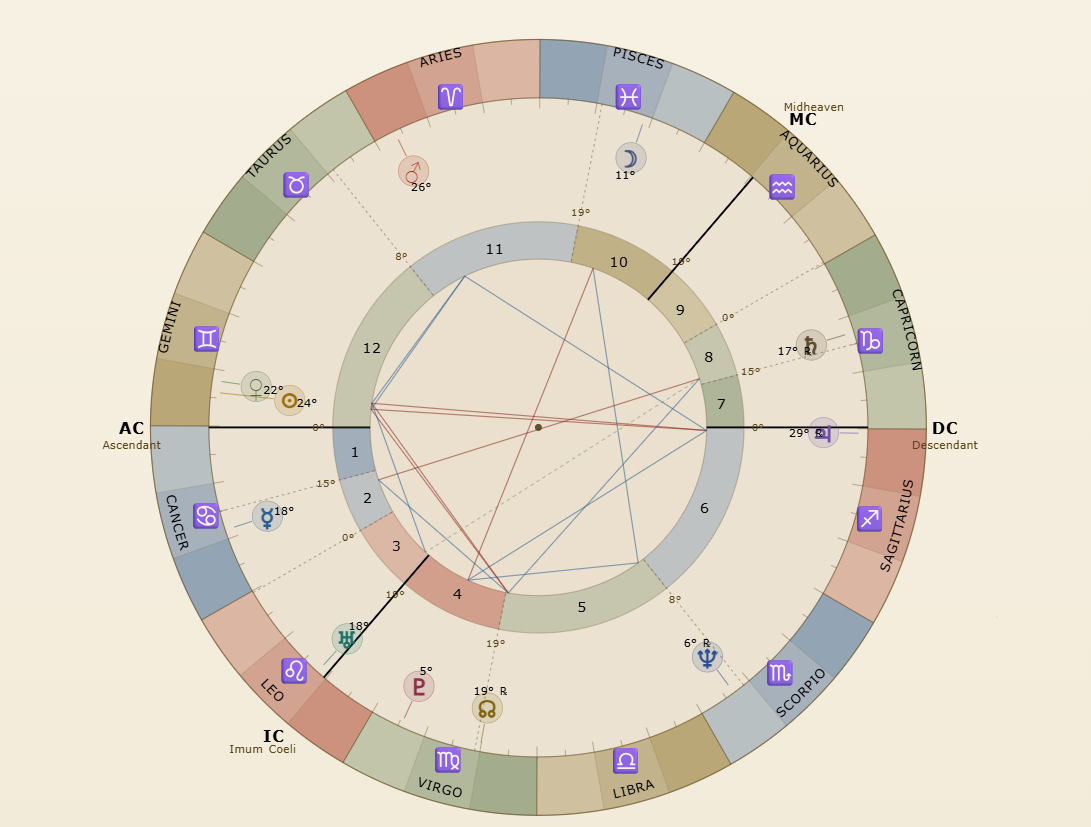
On first using the website you’re invited to enter details about your date, time and place of birth and an Astrological Wheel and Chart is created specifically for you. It shows the placements of the planets when you were born and which House they fall in. I spent an enjoyable evening clicking on the different Houses to find out more about them and what the various aspects mean. Not being someone who is deeply knowledgeable about astrology it was interesting to read about this, and more importantly, have it as a record to refer back to.
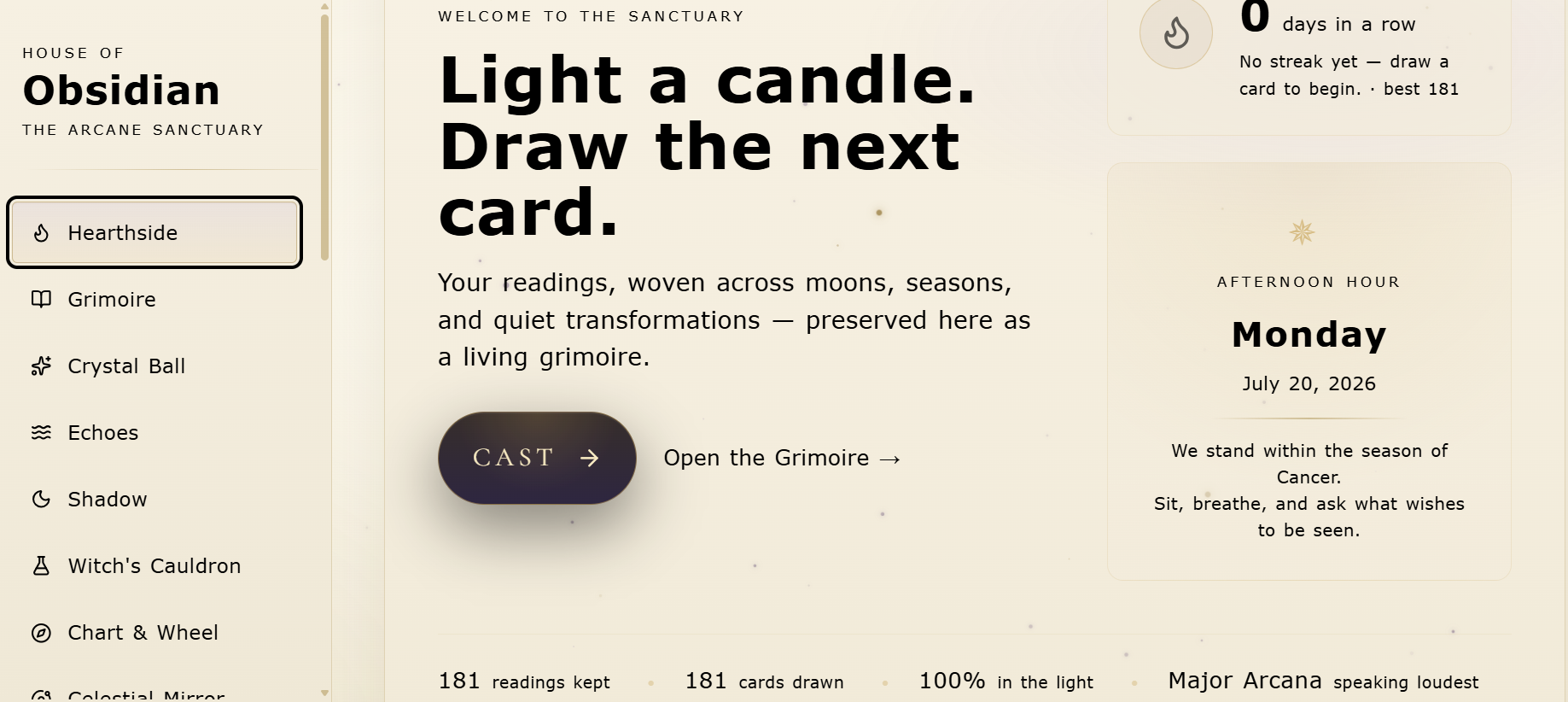
The front page (Hearthside), is welcoming and simply laid out. It shows the current date, a brief summary of the number of readings kept to date, how many cards have been drawn, the percentage that are upright/reversed (in the light), and which suit is “speaking the loudest” (has been drawn the most).
There is a large button inviting you to “Cast” and when you click on this it takes you to the Grimoire where you can enter details of the cards you’ve been working with. This is a very simple and intuitive process. You choose the number of cards or type of spread you want to add and then a list of cards with thumbnail pictures is given and you click on that image to add the first card and then subsequent cards.
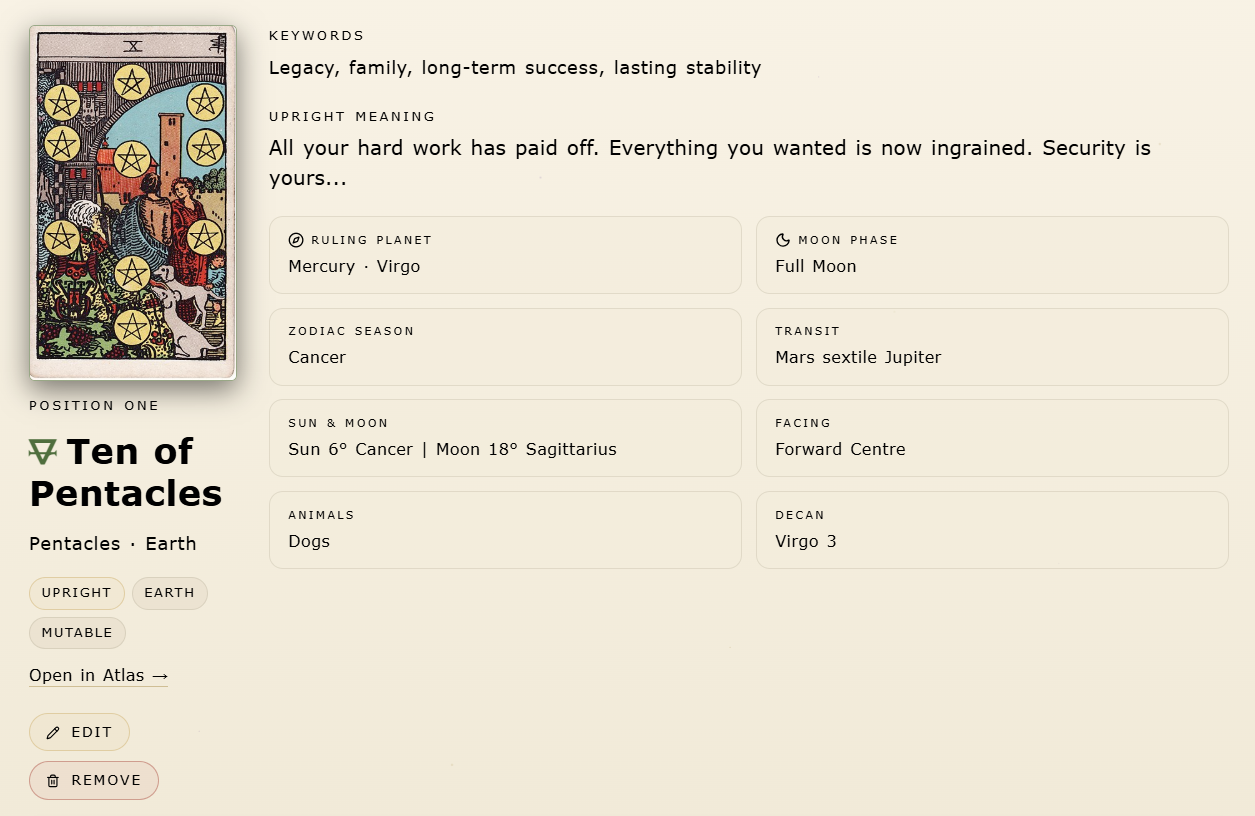
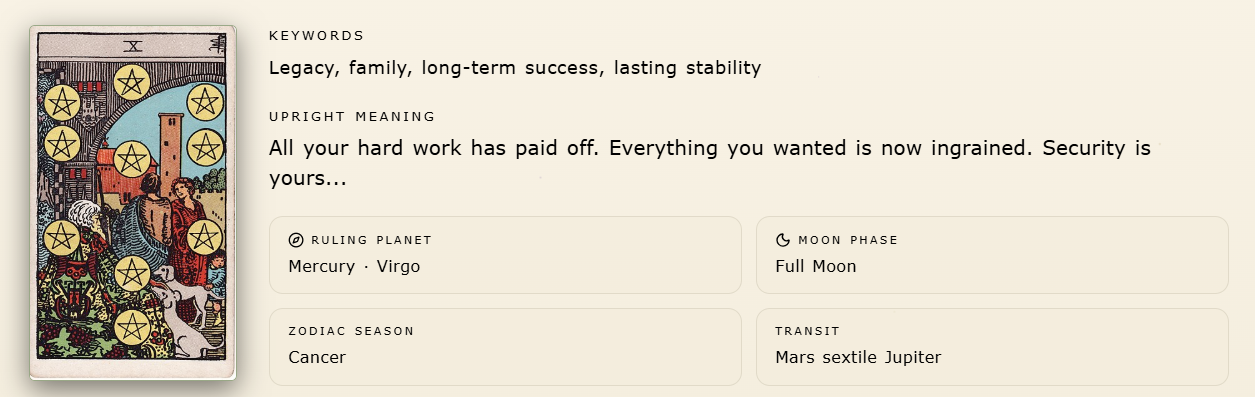
Once these have been entered, they remain in the Grimoire as a permanent record of the cards used along with the time and date you used them. If you click on the thumbnail further information about that card becomes available including keywords, its ruling planet, its zodiac season, its ruling moon phase, which way the figure is facing, and any associated animals that appear on the card. You can also see any notes you made about your thoughts about that card.
On the left of the page is a list of the different categories of investigation available. The list is always visible, making it easy to move around the site for different categories of information.
The categories are: Hearthside, Grimoire, Diary, Crystal Ball, Shadow, Observatory, Sparkles, Tree of Life, Chart & Wheel, Glossary, Atlas, Spread Ideas, Opening of the Key, Practice and finally, Profile. New sections are being added all the time, and now include Echoes, Witch’s Cauldron and Celestial Mirror as of this writing.
There’s too much information packed into these categories to go through each in detail, and I’ll focus on some of my findings and how I found the website useful.
To start with I had to decide what I wanted to record. Did I want to record all my readings, including those for myself, those for my friends and family and those for (my very few) paying clients? Did I want information about types of spread used, or frequency of different cards pulled? Eventually I decided to record details of my daily card of the day draws to get an overview of what was happening with them. I entered 181 cards drawn daily between January and June.
So, what did I learn?
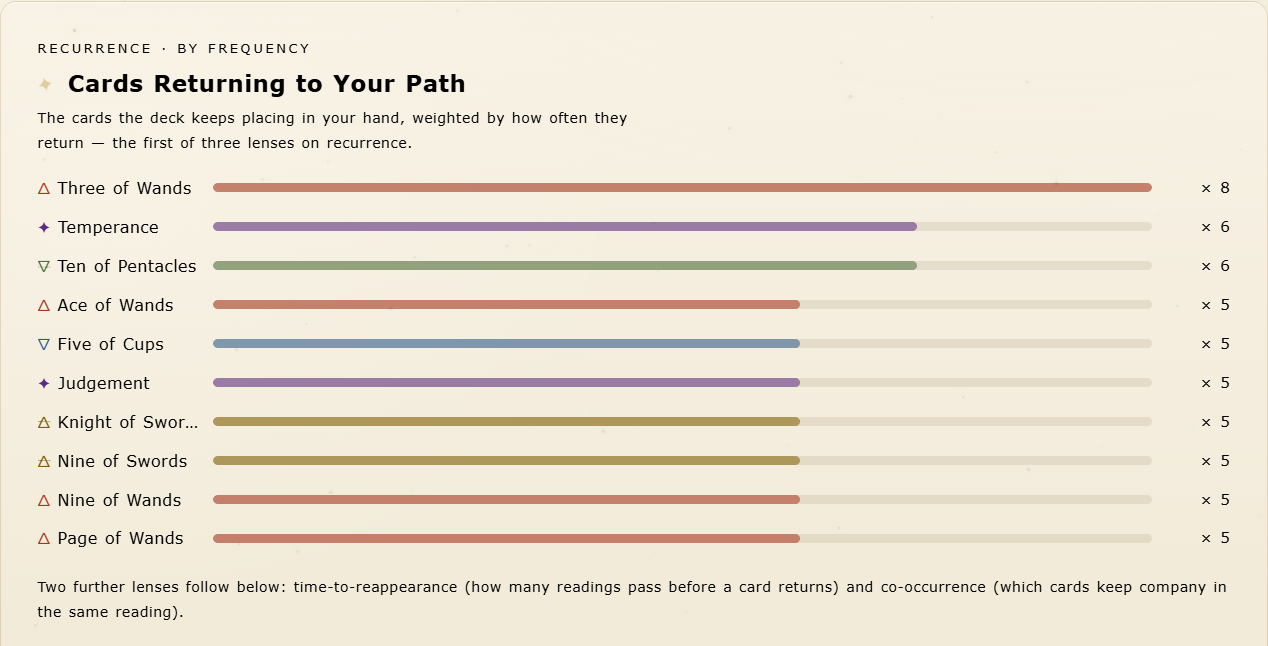
Each section gives a range of simple to follow tables and graphs. The Crystal Ball section shows me that of the 78 cards in the deck, 68 have been drawn so far, with 10 still waiting to be drawn. Thirteen percent of the deck is so far unseen this year. It shows number of cards drawn for each of the Major Arcana and the Suits, and gives a list of the cards still waiting to be pulled. It tells me about card return patterns as well as the recurring themes of those cards. For me, my top three recurring themes are curiosity, confidence and balance. In this section I can also see cards drawn by day and hour of the week, as well as the Year (to date) in Review. It also gives graphs and tables for Which Spread, Which Months, the Shape of Each Spread, and the cyclical trend of Cards Drawn Across the Months.
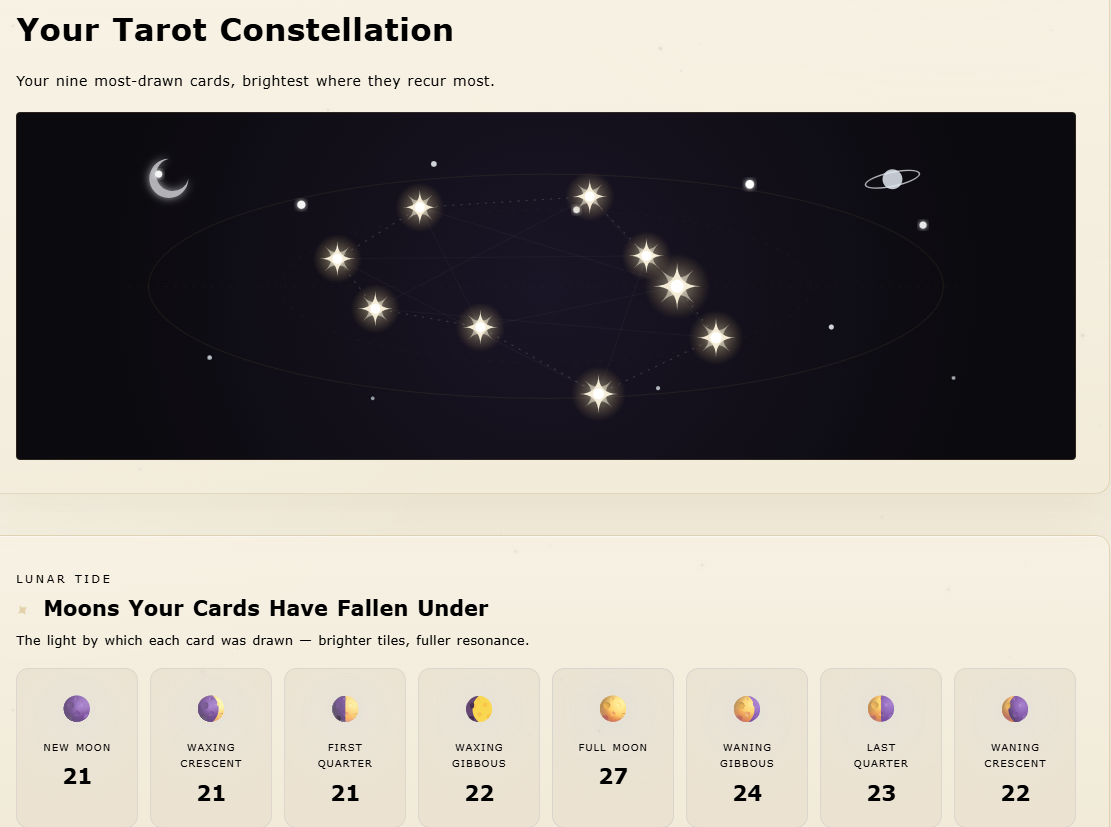
In the Observatory there’s information on moons and seasons, numbers, decans and elements. At the top of the page is a “Tarot Constellation” showing nine stars. These are the most drawn cards, and if you hover over a star it reveals what those cards are. For me these are Three of Wands, Temperance and Ten of Pentacles.
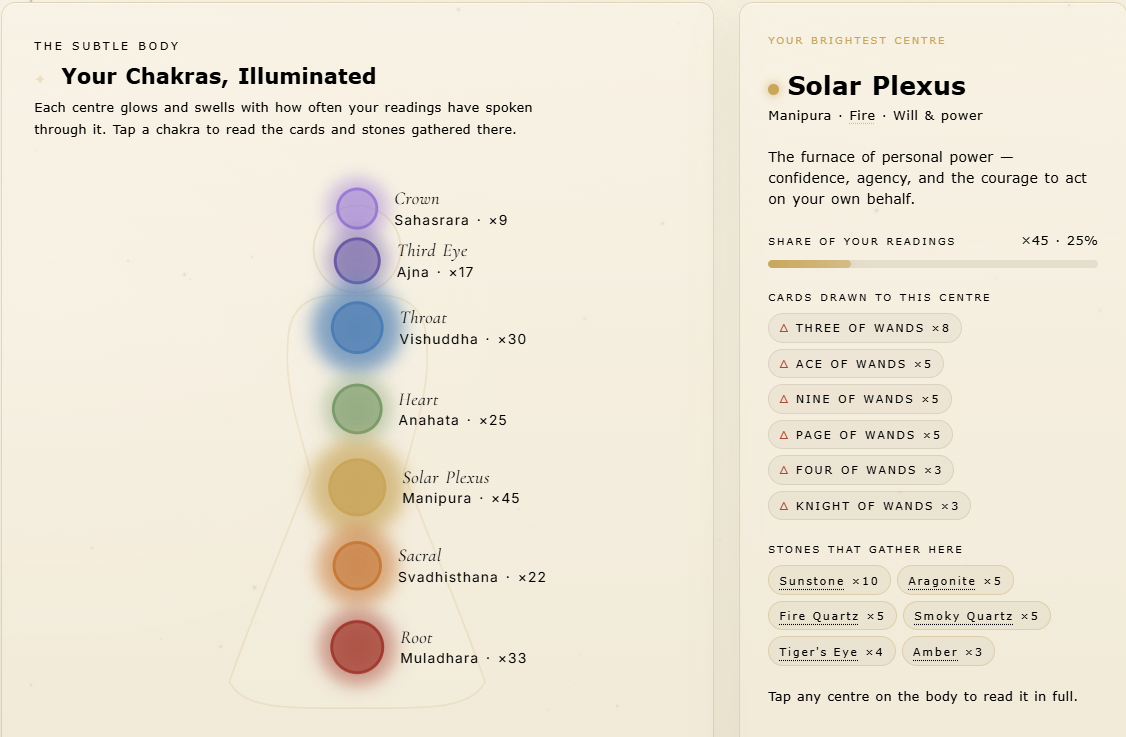
Sparkles includes an eclectic mix of information about Chakras, Herbal Correspondences, Ritual Applications, Crystals and the animals depicted on the cards. From this I learnt that of my Chakras my Solar Plexus, “the furnace of personal power — confidence, agency, and the courage to act on your own behalf,” is the most represented, and Clear Quartz is the crystal most drawn to my practice. Birds and horses are the animals that crop up most frequently on the cards I’ve drawn.
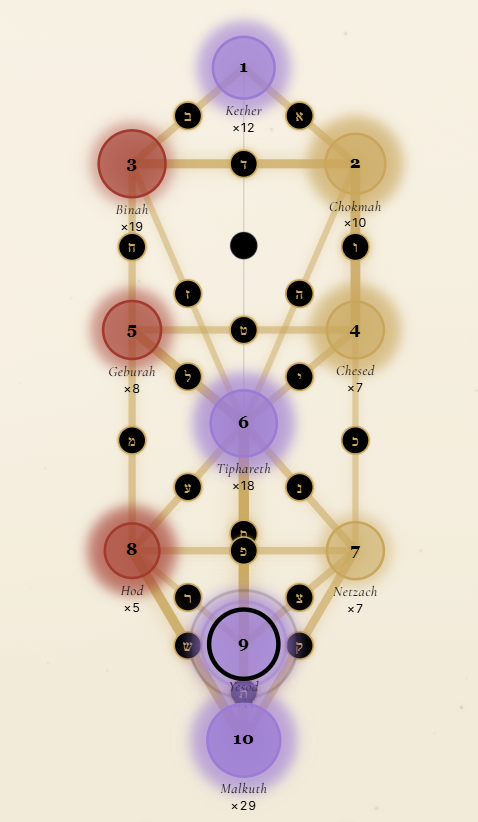
The Tree of Life section tells me that Malkuth is my brightest sphere, and Temperance my most walked path. Of the three Pillars in the Tree, the Pillar of Equilibrium shows up most frequently amongst the cards I’ve pulled. By tapping on each Sphere or Path more information pops up about their meaning.
I could write much more about this website, as each time I log-on there’s something new to explore. The section on Shadow work is very comprehensive, and some of the newly added sections allow you to upload photos of your spreads, record whether you feel the spread has “landed” and look at significators, clarifying cards, whether your spreads lean towards yes, no, or maybe.
There’s also a mock-up (not yet functional) of what a “Practice” section might look like. Here you can keep details of people you’ve read for, whether and how much you charged, how often you’ve read for them, and a diary of bookings.
I’m really looking forward to seeing what is developed next! Emma may describe herself as “still very much a student of tarot,” but this product is comprehensive, evolving and fun to use. I recommend you have a look at it – there’s bound to be something that catches your eye. A last word of warning – it’s addictive!
House of Obsidian is now available as a subscription web application.
Website details: www.houseofobsidian
Launch Offers: The first 1,000 subscribers can currently lock in £10/month for life (normally £15/month) using the code: 10for1000. Once those 1,000 places have gone, TABI members will still be able to receive 25% off for life using: TABI2526
About the Creator, Emma, in her own words:
I’m still very much a student of tarot, and I certainly don’t claim to have all the answers. Like many people, I started with the cards themselves and quickly discovered they opened the door to astrology, Qabalah, numerology, crystals, herbs, and countless other systems that all connect in different ways.
As I learned, I found myself constantly surrounded by books and trying to keep track of everything in spreadsheets. Eventually, I realised I could bring all of those connections together into one place. I basically made an Excel workbook look really pretty…and then it grew into something much bigger.
House of Obsidian was born from that journey.
My aim was never to build something that interprets tarot for people. I wanted to create a place where readers could organise, explore, and better understand their own practice while keeping the relationship between the reader and the cards completely personal. House of Obsidian is AI-free by design because I believe the insight should always come from the practitioner, never from a machine.