Book & Deck Review: Tarot, Magic, & Reason: The TOMAR In-Depth Beginner’s Guide to Tarot Theory and Practice + the TOMAR Tarot
- Creator: Deborah ‘Debs’ Allen
- Publisher: self-published
- Publication Date: April 2026
- RRP: Book-$45 USD (hardcover); $29 USD (paperback); Deck – £20
- ISBN: Hardcover – 9781807381691; Paperback – 9781807386856
- Review: Cadence (IG: @temperanceandtruth)

Tarot, Magic, & Reason, aka TOMAR, is a stunning book and deck combo created by the lovely ‘Debs’ (Deborah Allen). The subtitle reads: The TOMAR In-Depth Beginner’s Guide to Tarot Theory and Practice…but, to be clear, the ‘beginners’ part of the subtitle is referencing learning tarot theory, “exploring its traditional ideas in their modern context…[to] include Archetypal Astrology, Neoplatonism, Hermeticism, Kabbalah, Spiritual Alchemy, Theurgy, Astral Magic, and Jungianism.” So, given those advanced subjects, this is not a beginner’s guide per se, though this is exactly the book that beginners should use. Let me try to explain.

The TOMAR manual, truly more tome than manual, is comprised of five ‘Books’: Up and Running; The Major Arcana; The Minor Arcana; The Practical; and The 78 Tarot Card Meanings. Each book is chock full of incredible charts and tables and examples and images (using her own TOMAR tarot). The author works from the Golden Dawn tradition; therefore, we see a strong emphasis on astrological and planetary correspondences, the elements, and tarot numerology.

We begin with a basic introduction: de-mystifying tarot as a whole, the structure of a deck, and a brief discussion on using symbols and archetypical knowledge to tell a story within a spread. This is followed by a concise but very helpful history of tarot. The author includes a lot of key takeaways throughout the entire text, which function just as you’d hope a small summary would. We also begin to see the way that the author visually divides up sections, paragraphs, and images so that none of these subjects feel overwhelming, even for a beginner. This, coupled with the author’s welcoming, conversational tone and easy-to-digest way of explaining complex topics, makes for a great read for readers of any level.


Book Two delves into the Major Arcana as a system. One topic divides the cards into three groups of seven (removing The Fool) to discuss the three stages of understanding in the Fool’s Journey, examined as an archetypal journey. Following are brief introductions on divination and the Major Arcana within different practices, such as intuitive reading, mysticism, astrology, and the Kabbalah. One of my favorite sections is a side-bar: “Why could a tarot reading ‘work’?”. There is a great deal of information within Book Two on very dense subjects, though, again, the shorter length of the sections–and the way the author explains these subjects–make them accessible for all.


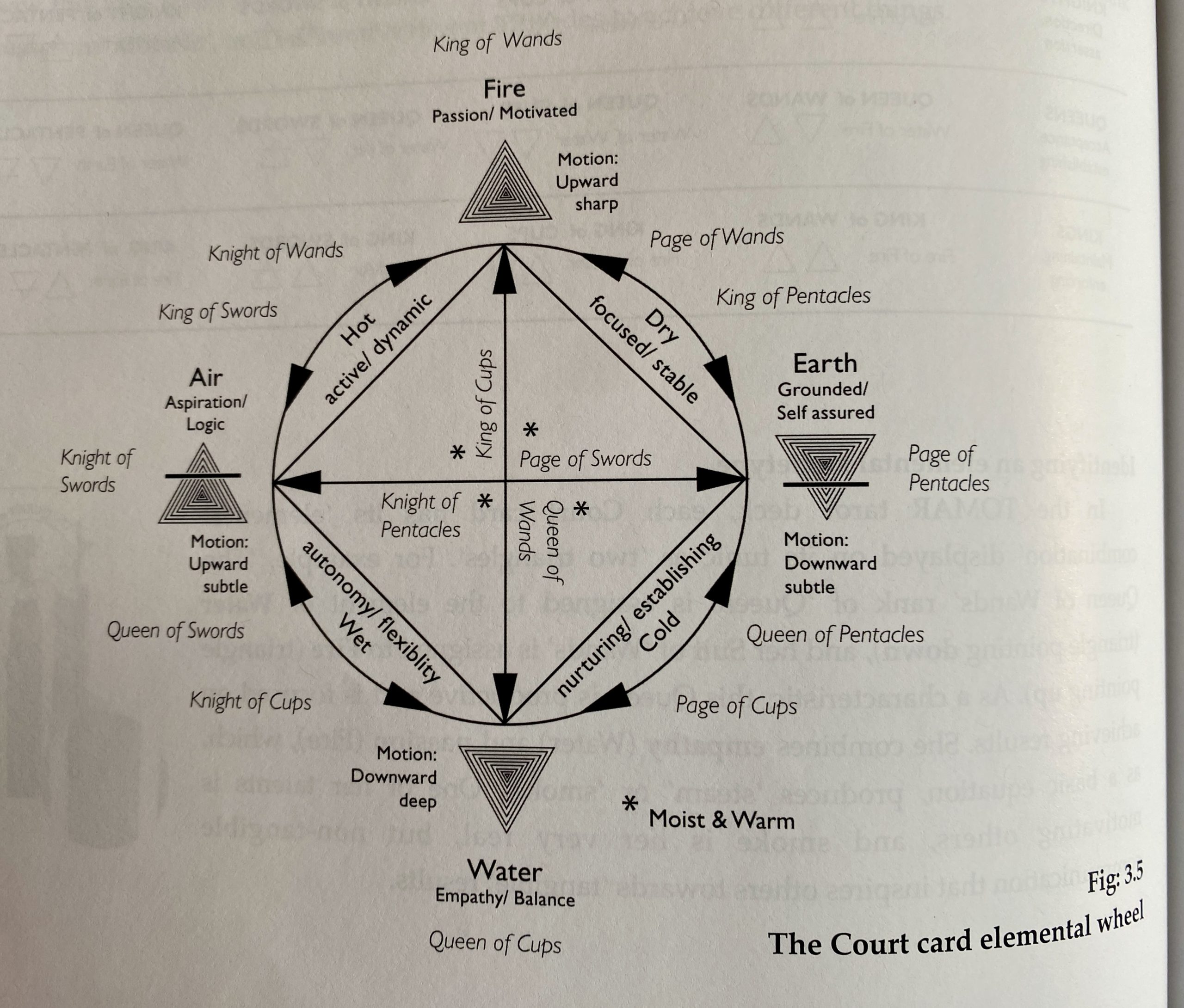
Book Three dives into the Minor Arcana. Beginners would be advised to pay particular attention to this under-discussed but essential area of tarot knowledge: the elemental suits, tarot numerology, and the court cards. ‘Decoding the Pip Cards’ discusses how using the ‘element + number’ equation results in different expressions in, for instance, the Three of Cups vs. the Three of Swords. Book Three also introduces readers to astrological correspondences and decans. The author discusses her inclusion of astrological correspondences on each TOMAR Tarot pip card, giving us a glimpse into one of the most fascinating aspects of the book (see Book Four below!). Another fantastic set of visuals are the Court Card Elemental Wheel and Court Card Astrological Wheel, as beautiful as they are useful. Lastly are sections covering an in-depth look at each suit.


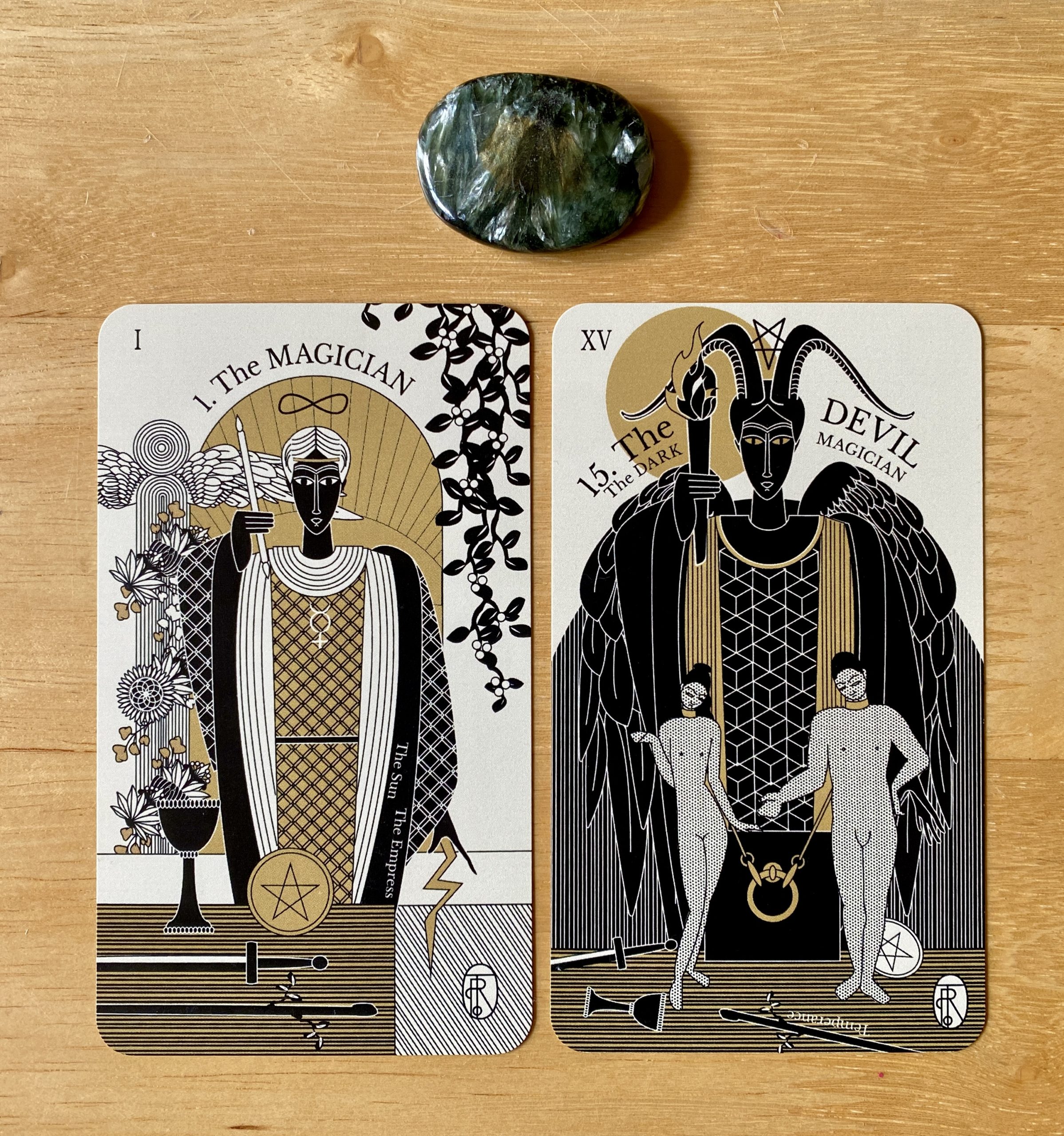
Book Four is called The Practical, which covers shuffling, selecting a deck, sample readings, and reversals. In the reversals section, we’re given an inauguration to a new concept, entirely unique to the author: Astrological Reversals. This is a complex topic and relates to planetary attributions, astrological decans, the elements, and modalities (Cardinal, Fixed, Mutable). I won’t attempt to recreate the discussion here, but we’ll look at one example as shown in the book and in the deck. In this example, a reversed Two of Pentacles returns us to the Ten of Wands. These two cards are adjacent in the decan wheel. In short, the author explains, “if we interpret the Two of Pentacles reversed as a difficulty, then it suggests feeling overwhelmed…a meaning that fits well with the card it reverses back to on the astrological wheel: the Ten of Wands, which shows someone who has taken on too much, burdened to the point of making no progress”. Neat, right?! The TOMAR Tarot Majors and Pips carry this concept in the art, with the reversed astrological correspondences depicted somewhere on each face. Your mileage may vary with this topic, but it is an interesting concept worth consideration.


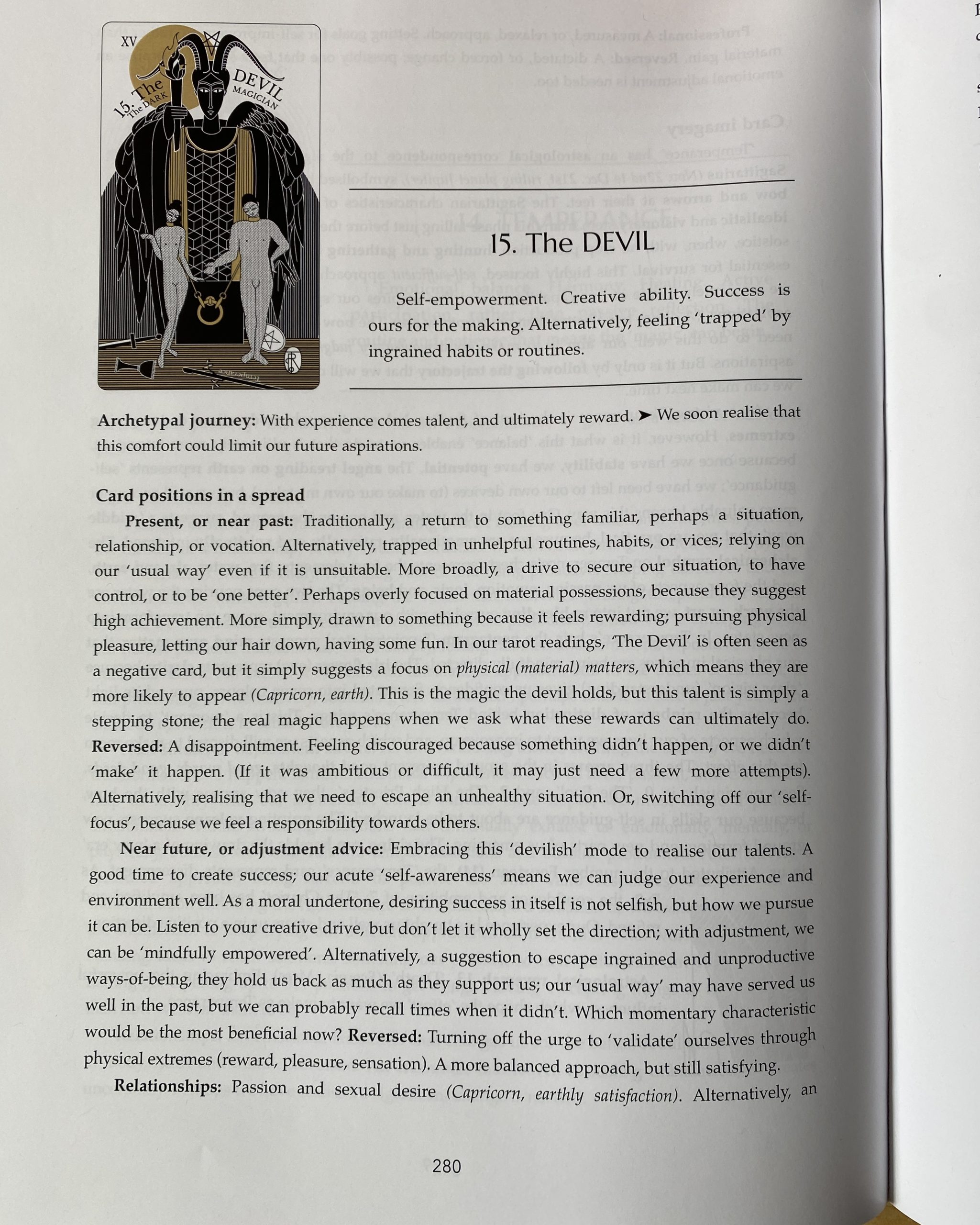
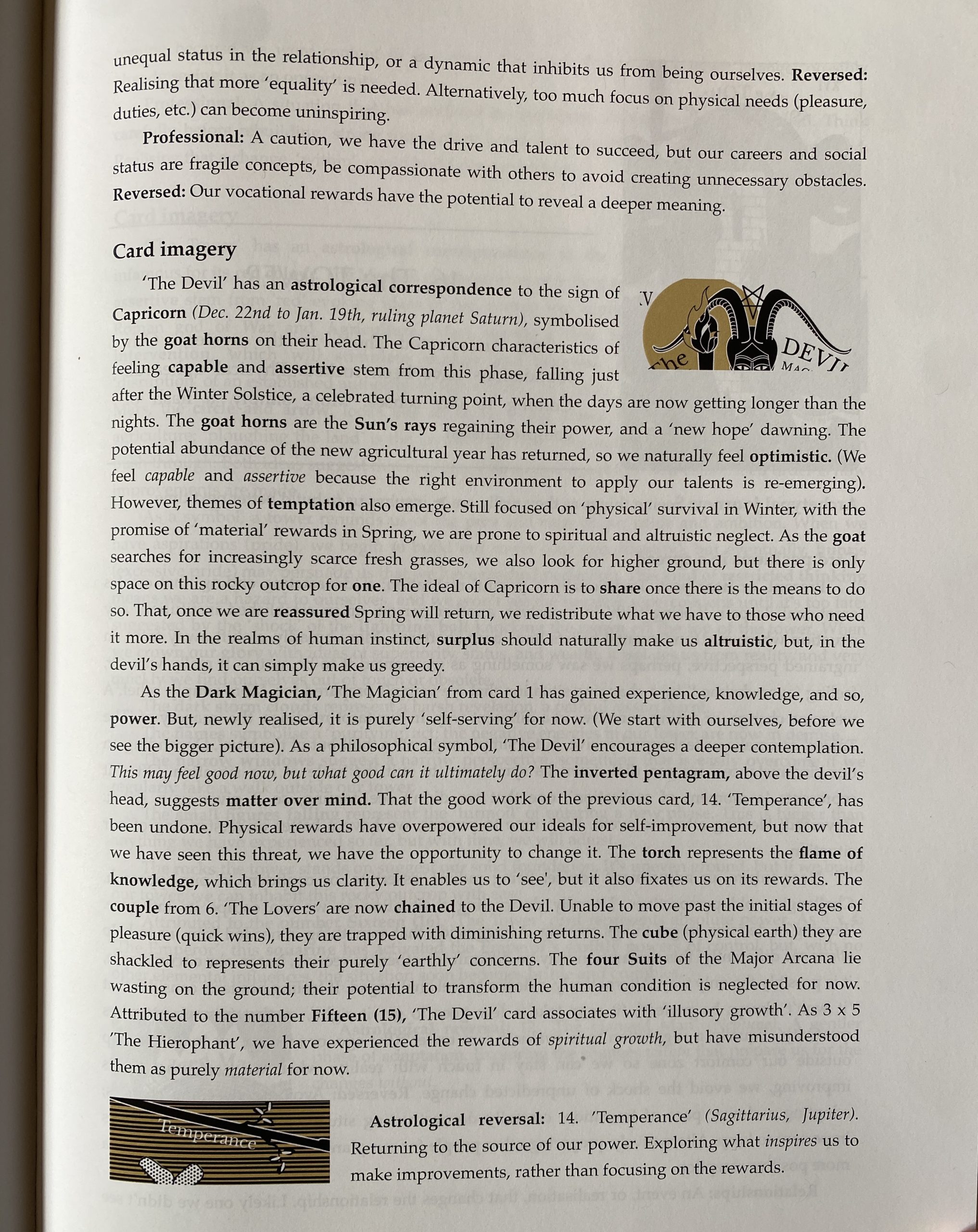
Lastly, Book Five takes us through each of the 78 cards individually. Each card is given two pages and includes: keywords, archetypal journey, upright and reversed meanings for different situations/positions (present, past, relationship, professional), card imagery, and correspondence information. I really like that the author includes both traditional and modern meanings. For instance, in the Tower, she notes that the traditional meaning is a painful realization or a devastating ending. The modern interpretations include moving away from an ingrained perspective or feeling overwhelmed by a changing situation for which we were unprepared. I have been religiously referring to Book Five in my readings as I really enjoy the author’s way of presenting modern and/or alternate meanings. This chapter concludes with quick references, a glossary, a bibliography, and an index.
I know this has been a long preview/review already, so I’ll just say in summary that I highly recommend Tarot, Magic, & Reason for all readers of all levels. This should be considered an essential text for everyone’s tarot library. I don’t know how long it took the author to write the manual, but to me, it feels like a life’s work. It is meticulously-researched and the production is fantastic. Amazingly and most-generously, the entire text is provided as a PDFs on Debs’ website so that you may view and read the book prior to purchase.

Usually, the cards take center stage, and the book is a backdrop. Not the case here. Having said that, the cards are gorgeous. They are art deco-inspired with a limited color palette that lends itself well to the creator’s fine linework. The cards have a smooth satin finish that shuffles and slides well and riffle-shuffles easily. The deck, which the creator considers a ‘sample run’, comes in a simple bag and is very affordable. While the book works with any deck, having the TOMAR Tarot enhances your experience, in my opinion.

Highly recommend! [sidenote: if you enjoy pairing tarot with oracle decks, the TOMAR tarot looks phenomenal with the Poesis Tarot!]
About the Author: Deborah Allen is a tarot reader and teacher based in London, offering tarot readings in-person or online. She is also a jewelry designer, which she considers her day job. Visit https://www.tarotmagicandreason.com/ or Instagram @tarot_magic_and_reason/ to learn more about Debs.