Deck Review: The Baddeley Tarot
- The Baddeley Tarot: A Journey of Wisdom, Truth and Transformation
- Author: Jake Baddeley
- Publisher: Blue Angel, Australia
- Published: October, 2025
- RRP: AUS $59.95 / GB £30.00
- ISBN: 978-1-922574-34-3
- Reviewed by: Kim Goldsmith – Cosmic Snail Tarot
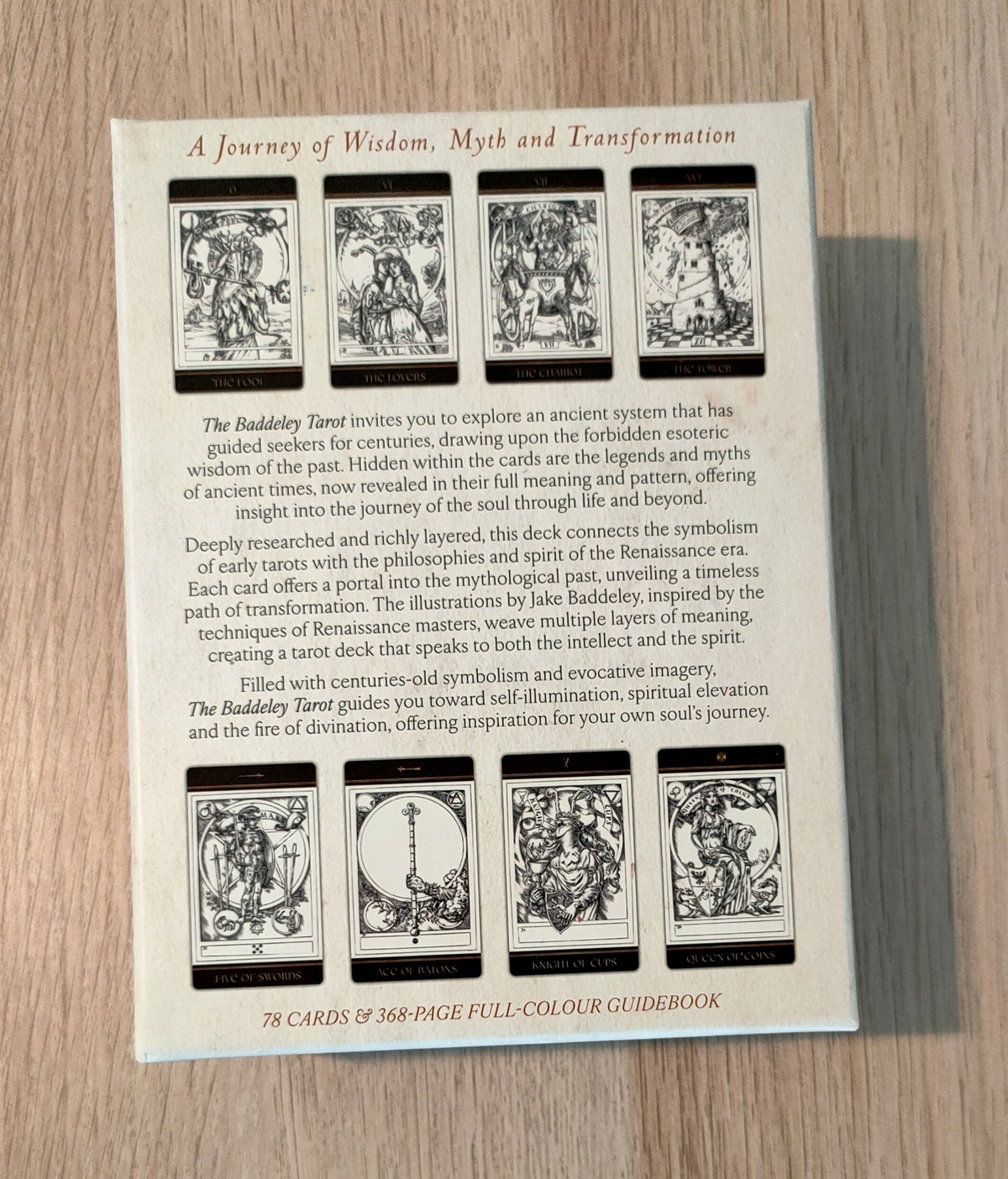
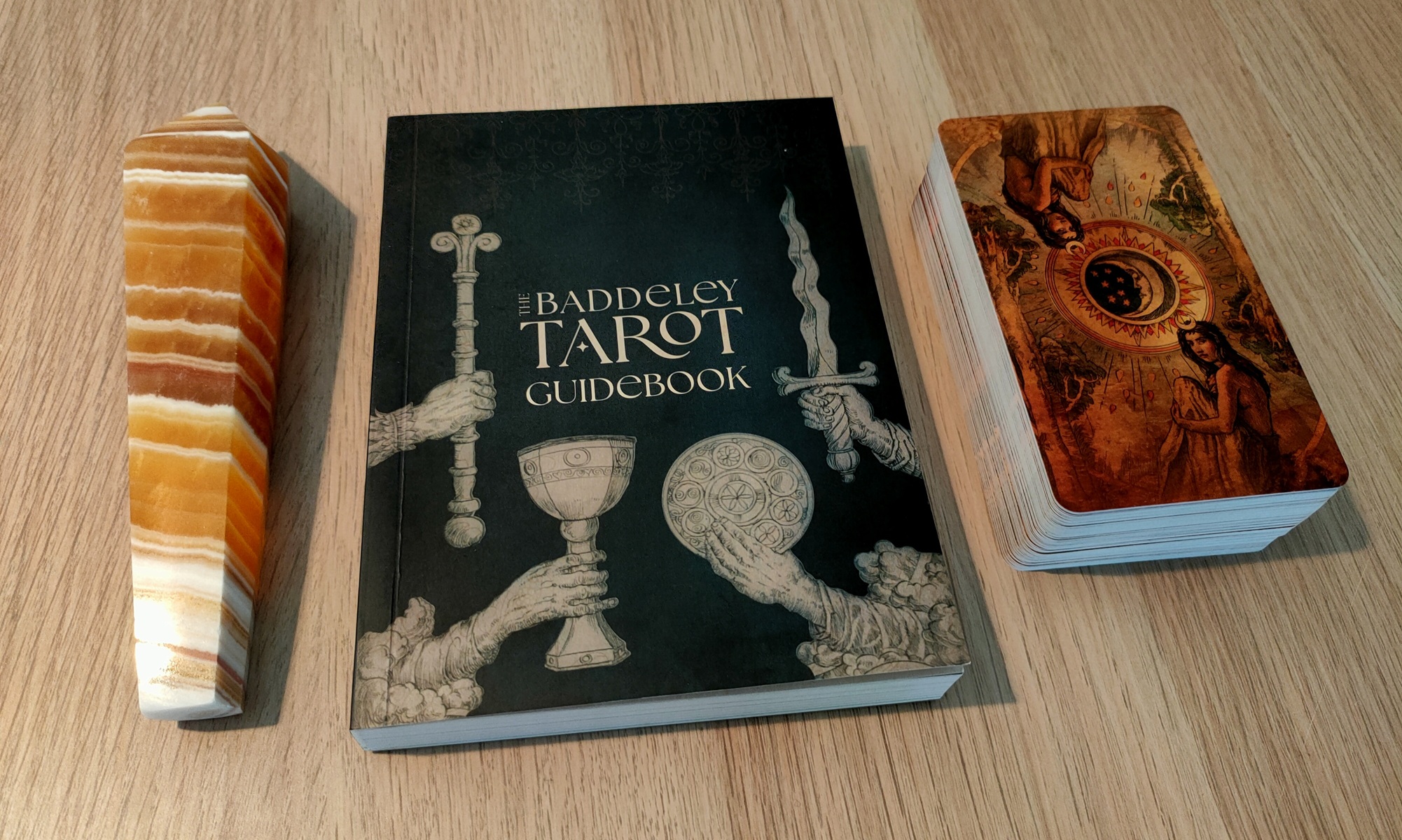
The Baddeley Tarot by Jake Baddeley, published by Blue Angel, is a unique and complex deck made in the style and philosophy of Renaissance art. He claims to have ‘discovered’ the original intention behind the tarot, connecting the cards to the ancient initiation rites of the Eleusinian mysteries (see video interview here) and dispels the idea of the Tarot as a mere ‘oracular’ tool. I can’t cover this topic in the scope of this review, but I am interested to hear if this raises any discussions within the tarot community.
The artwork is hand drawn, black, white and brown. Given that one of Baddeley’s inspirations for the deck were Giotto’s brilliantly coloured frescoes in the Scrovegni Chapel in Padua, Italy, I am wondering why he chose to work in flat line work. His back catalogue of paintings and oracle decks all include realistic rendered oil paintings and a strong sense of the three-dimensional, so the simplicity of the drawings in these cards seems a departure from his usual oeuvre.

Regarding the card stock and packaging, there are the standard 78 cards and a 368-page colour guidebook. Gold-foil borders embellish the front opening hardcover box, which is quite large to accommodate the thick book. Card stock is smooth but a little thick, so they are a bit stiff to shuffle. I would have preferred a card size closer to the typical Blue Angel oracle cards so I could appreciate the artwork more easily. The card edges are plain; a sepia tone would have improved the finished appearance, plus the backs depict oil paintings that do not connect with the artwork across the rest of the Baddeley Tarot. There are hand drawn numbers and borders as well as printed ones which reduces the size and visibility of the card images, and are distracting. The dots under each Minor Arcana ‘pip’ card look like an afterthought. These are briefly mentioned on p.16 of the guidebook as related to dice games popular in China and India circa 3000BCE, but there is no information on how to use these dots in a reading.

The guidebook is immense and introduces the source of inspiration and contextual research into Renaissance systems of thought that Baddeley used in making the deck. This is a bit dense and is sometimes unclear how Baddeley’s theories actually translate into the cards themselves or how to apply them in a tarot reading. There are a number of tables and chapters on the symbols used in the deck at the beginning of the book, but not on the card description pages which would have been more practical. The card pages include a general statement (good for a one card pull), Mystery, Message and Reversed card meanings. The Mystery is a breakdown of the imagery on the card, and any myths or philosophies connected to it. These messages are relatable and less abstract than the card images themselves.
There is also only a generic 3 card or Celtic cross spread in the guidebook. This seems like a wasted opportunity, so, I’d recommend you try making your own spread using some of these themes in the guidebook:
- Vices and Virtues
- The Ptolemaic Order
- The Ladder of the Soul
As for the Tarot System used, this is a tricky one. On p.15 of the guidebook Baddeley implies his deck is based on the Marseilles tradition. All I can say is that it is not a conventional RWS, Golden Dawn/Hermetic tarot or Traditional Marseilles deck. I have been comparing The Baddeley Tarot cards to decks from the early 1400s and I feel it is actually a hybrid, referencing multiple decks.
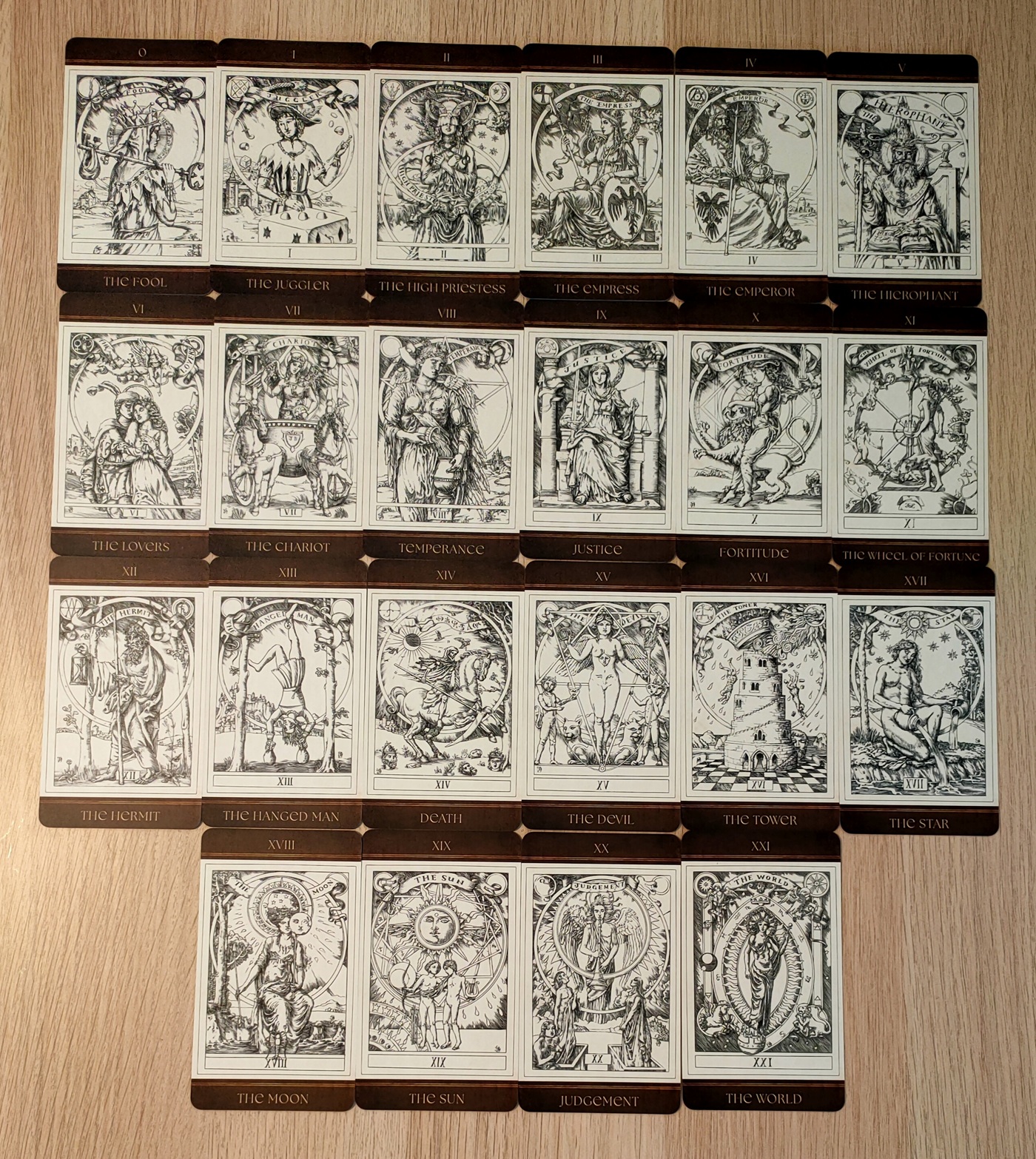
Looking at the Major Arcana, referred to as The Greater Mysteries: The Journey of the Soul, there are some differences in the number order for the Baddeley Tarot compared to both the Marseilles and RWS traditions. Key 1 is The Juggler instead of The Magician (RWS) or Le Mat (Marseilles). Key 8 is Temperance whereas it is typically Strength (RWS) or Justice (Marseilles). Key 10 is renamed Fortitude (Strength) replacing the Wheel of Fortune, which is now Key 11, and Key 9 is Justice instead of The Hermit (now Key 12). On pp. 42-43 in the guidebook, Baddeley claims the order is based on the Tarot Bolognese numbering, which is a card game that precedes the tarot system we know today. However, when I looked this system up, the numbers did not match with the Baddeley Tarot. I also looked to see if there was a correlation with the Minchiate tarot deck, a 97 card deck that includes 12 zodiac cards, 4 element cards, and 4 virtue cards, which I feel may be the most connected in appearance and style to Baddeley’s tarot, but alas, the numbering doesn’t match either.
Although Baddeley doesn’t clearly explain his rationale behind the number change, he has chosen to reorder the sequence of cards in accordance with his belief that the tarot is in fact based on the soul’s journey comprising of: The Social Hierarchy (0–5), The Virtues (6-10), Wheel of Fortune (11), The Adversities (12-16) and finally The Afterlife (17-21).
As for the Minor Arcana, Baddeley’s pips are unlike the RWS or Marseilles cards, and include symbols from the systems mentioned below.
Sacred Geometry and The Ptolemaic Order
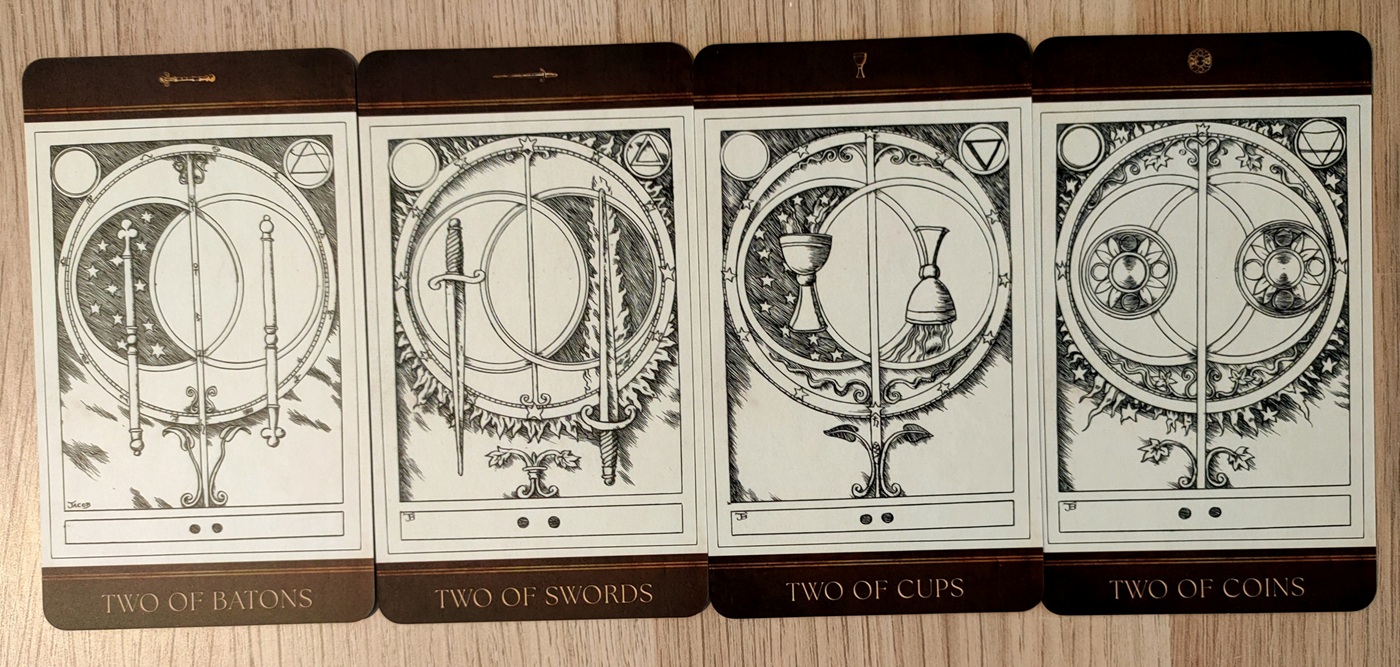
The overall background design of each pip card is a geometric symbol that correlates with a planetary sphere: 1 – The Elements, 2 – The Stars, 3 – Saturn, 4 – Jupiter, 5 – Mars, 6 – Sun, 7 – Venus, 8 – Mercury, 9 – Moon and 10 – Earth. This is the Ptolemaic order which describes the creation of the world from emptiness to Earth. For instance all 2s have two circles overlapping and all 10s have a ten pointed star.
Chakras
Pips 3-9 have corresponding chakra symbols at the bottom centre of the card. I find this a little at odds with the Renaissance concept behind the deck. Baddeley states that there is no contradiction in linking Yogic philosophy with Hermetic philosophy. Given most of the other philosophies embedded in the deck are related to Renaissance thought, I wonder if this system is just another add on.
Astrological Correspondences
Pips 3,4,5,7,8 also represent zodiac polarities at the bottom left and right, and planet in the top left of the card. For instance, upright 5 of cups is Mars in Scorpio but reversed it is Mars in Capricorn. Sol (Sun) has Leo only and Luna (Moon) has Scorpio.
Elements
The symbols for the elementsFire, Air, Water and Earth are encircled in the top right of every card. Fire is represented by swords instead of wands/batons as Baddeley associates it with a symbol of action, while Batons are air.
In summary, writing about this deck sent me down a rabbit hole, revisiting different books about the history of early tarot decks from Italy and France in the 1400s. The guidebook is an interesting documentation of the artist’s intellectual journey during the process of this deck’s creation. Although some of Baddeley’s ideas don’t visibly translate into the card artwork, I appreciate the artistry involved in producing such a complex deck. When it comes to personally using the Baddeley Tarot in a reading, I am completely in an analytical mindset, and find the flow of intuitive messages blocked by my constant need to refer to the guidebook.
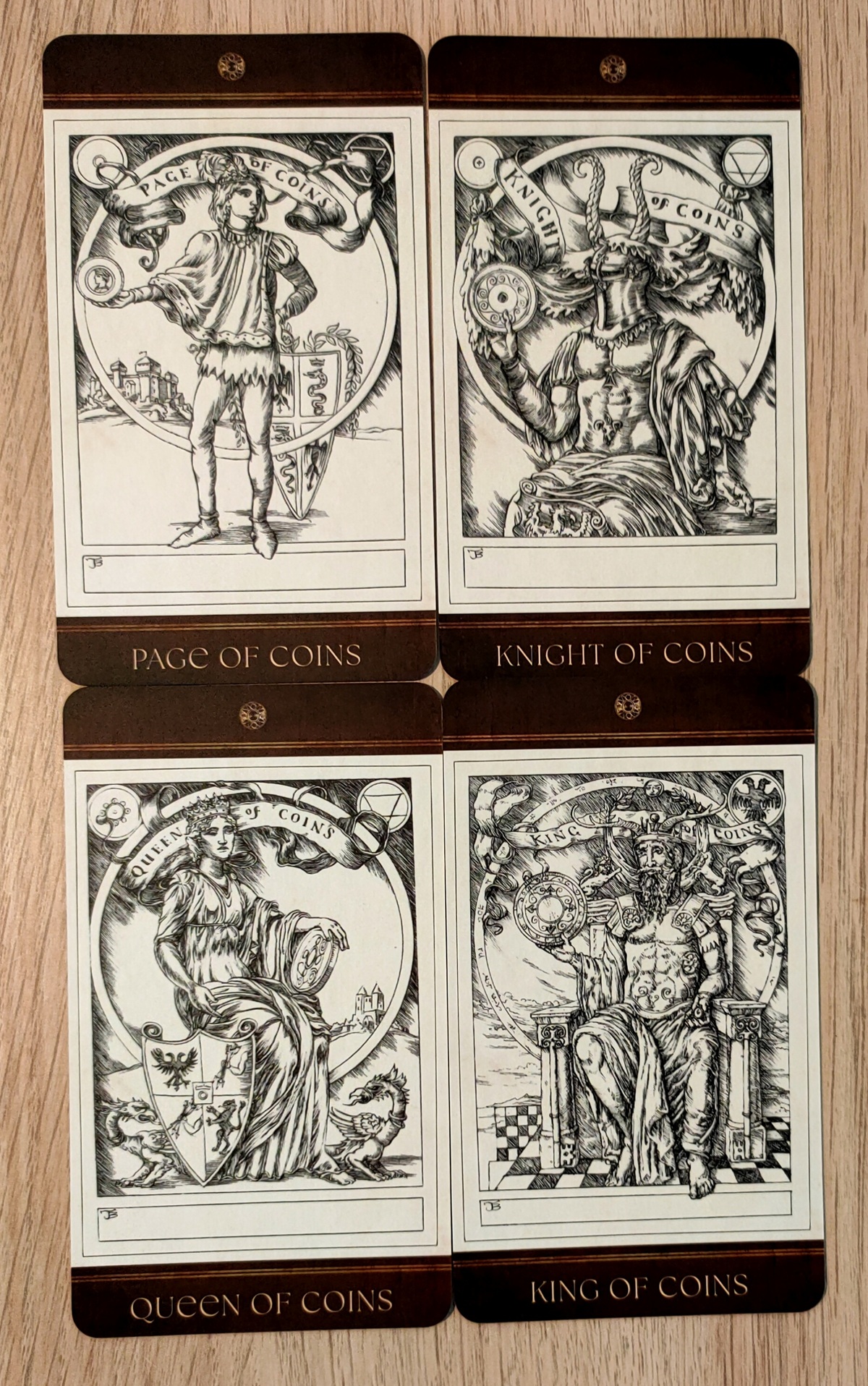
I would recommend this deck for experienced tarot readers who have a good grasp of tarot symbolism, numerology and astrology. Those of you who are interested in the Renaissance and are philosophically inclined will enjoy the challenge of understanding Baddeley’s vision of the tarot. If you are an intuitive reader or reliant on colour and texture for readings, this deck may not be for you.
About the Author: Jake Baddeley is a painter and sculptor from Nottingham UK, who studied Illustration at University of London. Inspired by Dutch painters he moved to the Netherlands after his studies and began painting in oil. He has created artwork for oracle and tarot decks including: The Mystical Healing Oracle, The Mystical Healing Reading Cards, The Great Goddess Oracle, Blessed by the Goddess Oracle, as well as three tarot journals published by Blue Angel. For more on Jake Baddeley, please visit: https://www.jakebaddeley.com/
To purchase The Baddeley Tarot, please visit the Blue Angel online site here:
Or any good online bookstores.