Book Review: Tarot For Sceptics: The Practical Usage of Divination for Psychic Results
- Author: Ari Freeman
- Publisher: Aeon Books
- Published: May 2025
- RRP: £19.99
- ISBN: 9781801521673
- Reviewed by: Parker Thorn

Tarot For Sceptics is a book that promises a lot. According to the back cover blurb, it guarantees a method of divination that will allow anyone – “sceptics, materialists and atheists” – to get incredible results within their first hour of studying the tarot.
Although there’s no doubt this book has some interesting content, I’m not sure it delivers on its premise.
Tarot For Sceptics positions itself as the book for the doubters, the “hard-nosed sceptic who has decided to give divination a go out of curiosity” (p.ix), and the introduction certainly intrigued me. One of my favourite parts of the entire book was the section where Freeman puts forward various explanations about why tarot readings work in the way they do. This was fascinating stuff, covering self-fulfilling prophecies, confirmation bias, animism, fate, and Carl Jung. I was looking forward to these concepts being discussed in much greater depth later on in the book.
But once the introduction was over, Tarot For Sceptics mostly left its unique premise behind, and turned into an everyday manual on how to read the cards with their meanings and symbolism. This wasn’t badly done, and I enjoyed a lot of the explanations given to the cards, especially the examples which included figures from history, pop culture, and folklore. I can see the descriptions of each card being useful for a novice or intermediate reader – but not for the book’s touted sceptic audience. The card breakdowns include details about Kabbalah, astrology, and religious traditions, which are all interesting enough, but if someone has picked up this book because they’re sceptical about tarot, I hardly think they’ll be open to other esoteric ideas. The book promises to take a practical approach to reading the cards, but I don’t see how knowing that the Two of Swords’ decan is the Moon in Libra and covers 23 September to 3 October furthers that goal – if the book’s intent is, as promised by the back cover blurb, to show a practical way to read the cards rooted in psychology and counselling, then it fails to deliver.
The book performs better when targeted to a less sceptical audience, but even here the goals are a little muddled. The descriptions of what tarot is and isn’t would suit a beginner reader, but Freeman also talks about the Tree of Life, Paths, Decans, and Letters without explaining those concepts in a way that would make sense to a novice.
Speaking from a personal point, I found Freeman’s approach to the cards heavily gendered in a way that I find off-putting. He talks about active and passive cards and links them, in the traditional way, to the masculine and feminine. Freeman seems to be aware that many modern readers will find this approach outdated, and is careful to state that “these concepts do not, in readings, generally refer to our bodies… everyone is understood to embody some combination of masculine and feminine qualities, regardless of their primary gender” (p8). But if this is what Freeman truly believes, why gender active and passive cards at all? I feel if he truly wished to not endorse that gendered reading, it would be sufficient to mention that although cards have traditionally been gendered in that way, there’s no reason for a modern reader to follow that method. This gendered approach continues in the card breakdowns, and is especially prevalent when Freeman discusses the court cards. A particularly egregious example comes in the breakdown of the Page of Wands where Freeman references Aleister Crowley’s vision of the card as “a symbol to either be lusted at from afar or else conquered, affirming the male drive to prove himself in sexual conquest” and then adds an author’s note that “some women have the same ‘masculine’ drive” (p225).

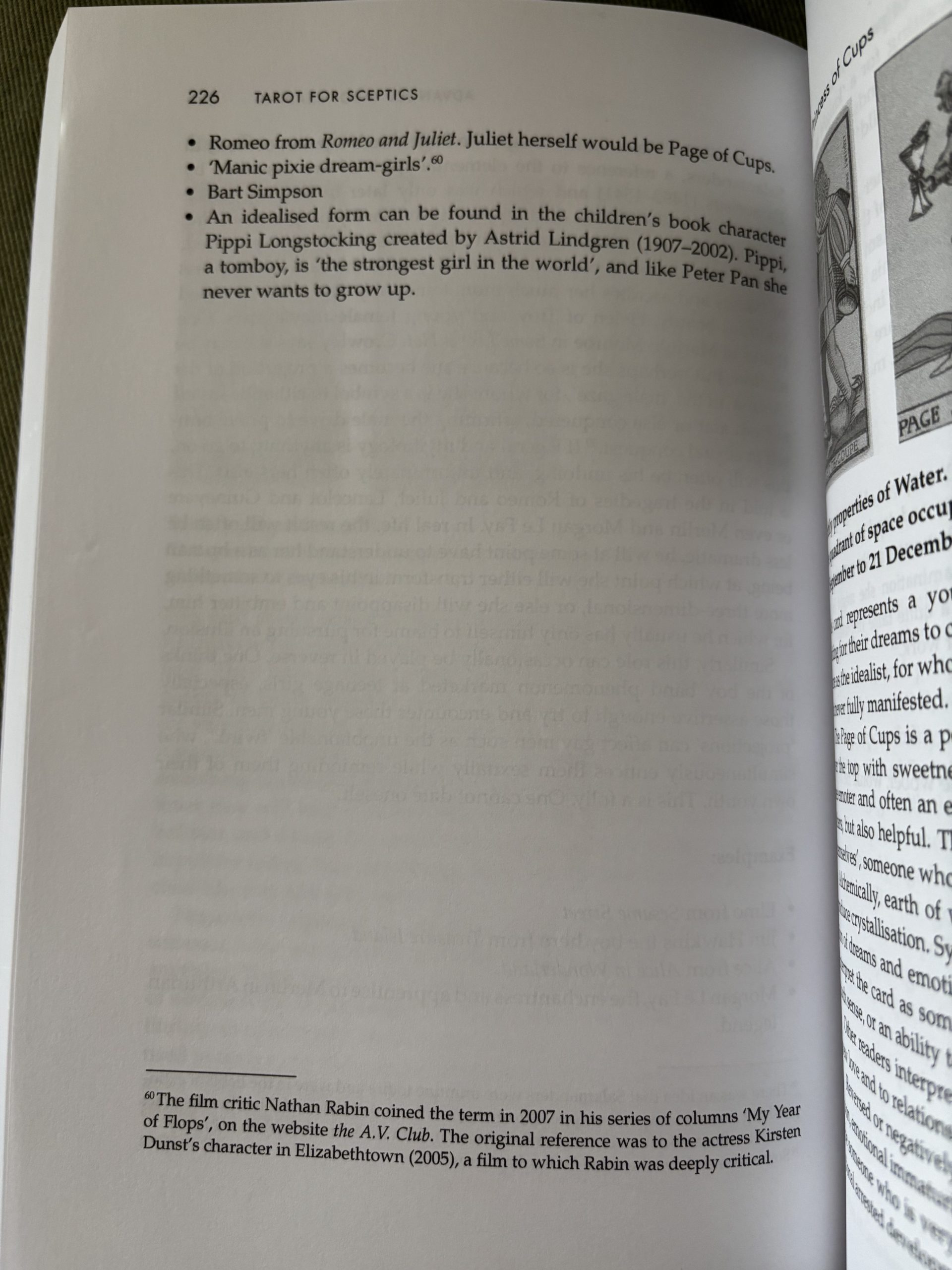
To me, this encapsulates the book’s problem with gendered cards: it presents a complex idea but fails to examine it further and offers that shallow reading as still applicable to the reader. To say the Page of Wands is an object of the male gaze and then not unpack the male gaze and its impact isn’t useful to anyone. In an attempt at fairness, the author’s note acknowledges that women also have harmful sexual urges, but completely ignores any wider context about social mores and pressures. The idea of being an object of lust doesn’t exist in a vacuum, so this falls very short of a nuanced understanding of both the male gaze and gender in the cards. Another instance arises on the very next page where Freeman gives Manic Pixie Dream Girls as an example of the Page of Wands in action; but Manic Pixie Dream Girls are a very specific phenomenon arising from the feminism of the early 2000s, the “not like other girls” trend, and the internalised misogyny that those assigned female at birth have to unlearn. It’s a complex image, and it can’t be boiled down to, as Freeman suggests, a figure of idealised female beauty – which is also an incredibly narrow reading of the card.
Gendering the cards is a complicated subject, and I feel that unless an author is prepared to approach the subject in a way that is respectful of transgender and non-binary identities, it’s a matter best avoided. I appreciated Freeman’s later section on bias (p335), so I feel this wasn’t done out of any prejudice, but it was still a shortcoming I noticed.
The last quarter of the book contains a history of the tarot, and explores its roots and development through history. This section is interesting, but suffers from the same problem as the card breakdowns where Freeman presents a new idea or references some esoterica but doesn’t explain it – for example, on p304 Freeman talks about a legend of a magical German lodge which “comes from the Theosophical idea of ‘the Ascended Masters’, which is itself inspired by the Buddhist ideas of the ‘Matreiya’ and the ‘Bodhisattva’” but fails to explain what the ‘Matreiya’ and the ‘Bodhisattva’ actually mean, so their inclusion in this sentence is pointless.
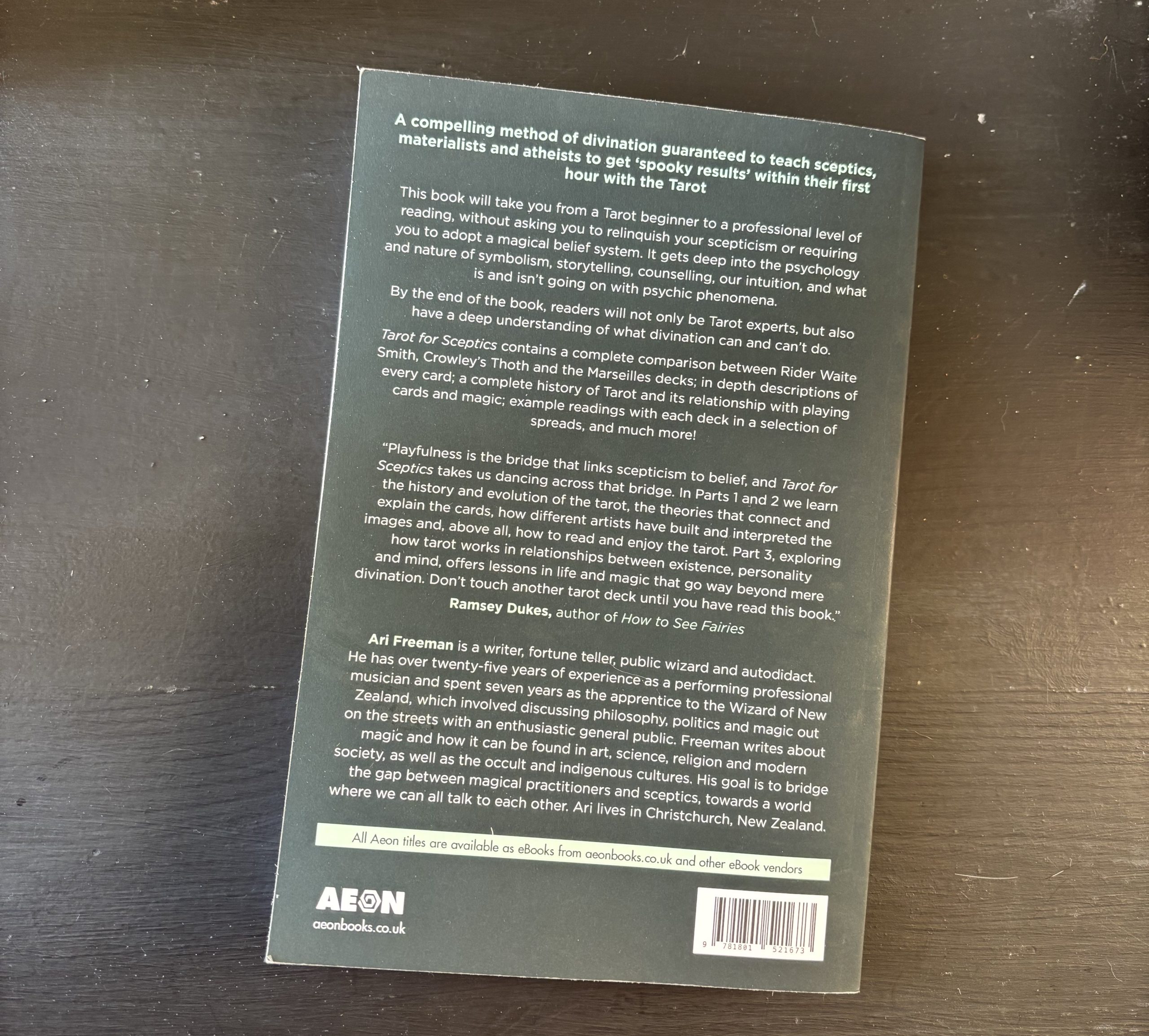
The very last part of the book, from p319 onwards, is a fascinating discussion of what could be at the heart of psychic phenomena, and ideas about tarot readings both as a magical and mundane exercise. This felt like a return to the premise as promised in the introduction, and I enjoyed reading it.
Ultimately, I found Tarot For Sceptics to be a very mixed bag. I think it would be an interesting addition to someone who wants to broaden their approach to tarot and is interested in collecting different card breakdowns, and although I was intrigued by many parts of the book, I’m not sure it entirely delivered on its premise. Like the curate’s egg, Tarot For Sceptics is good – in parts.
About the author:
Ari Freeman is a writer, fortune teller, public wizard and autodidact. He has over twenty years of experience as a performing professional musician, and spent seven years as the apprentice to the Wizard of New Zealand, which involved discussing philosophy, politics and magic out on the streets with an enthusiastic general public. Freeman writes about magic and how it can be found in art, science, religion, modern society, as well as the occult and indigenous cultures. His goal is to bridge the gap between magical practitioners and skeptics, towards a world where we can all talk to each other. Ari lives in Christchurch, New Zealand. You can read his writings at https://arifreemanwizard.substack.com/ and listen to his music at https://arifreeman.bandcamp.com/
Tarot For Sceptics is available to purchase from Aeon Books: https://spirit.aeonbooks.co.uk/product/tarot-for-sceptics/95332