Deck Review: Celtic Elemental Tarot
- Creator: Ayn Cates Sullivan
- Artist: Belle Crow duCray
- Published by: Findhorn Press (Inner Traditions, distributed by Simon and Schiffer)
- First published: USA, 2026
- RRP: £23.99 / $37.50
- ISBN: 9798888502808
- Reviewed by: May M.F. Swann
Ayn Cates Sullivan is an award-winning author who focuses on mythology and folklore in the modern age. She achieved a masters in Spiritual Psychology and in Creative Writing, and a doctorate in Anglo-Irish Literature. She is a Tarot reader and offers consultations, and has published over 20 books, including several in Celtic Mythology.
The artist, Belle Crow duCray is an American artist who loves teaching children’s art classes and has illustrated many award-winning children’s books. She has also illustrated the bestselling Legends of the Grail series for women who are interested in Celtic Myth and Legend.
The Celtic Elemental Tarot is designed as a quest for the Grail. It is a multilayered deck that weaves together Celtic, Pre-Celtic, and Arthurian myth with legend, folklore, fairytales, and elements of Hermeticism. While the author notes that her journey in creating the deck drew upon her studies of Christianity, Judaism, Hinduism, Buddhism, Psychology, and World Mythology, searching for the divine feminine, the deck remains firmly anchored in her Celtic roots.
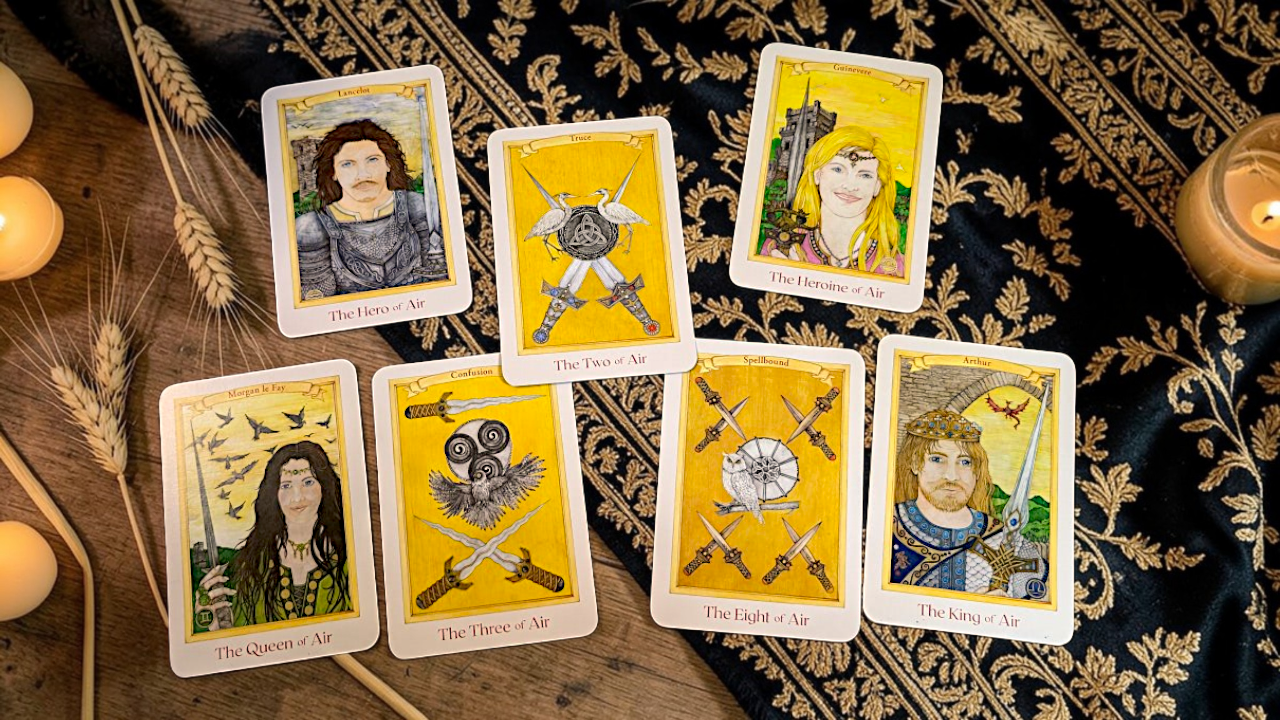
Structurally, the card names and keywords follow traditional Rider-Waite-Smith (RWS) definitions, though the imagery and symbolism are entirely original. The suits reflect the four elements traditionally associated with them, and the court cards are presented as Heroine, Hero, Queen, and King. The artwork is highly detailed, appearing to be created with a mixture of coloured pencils and sketching.
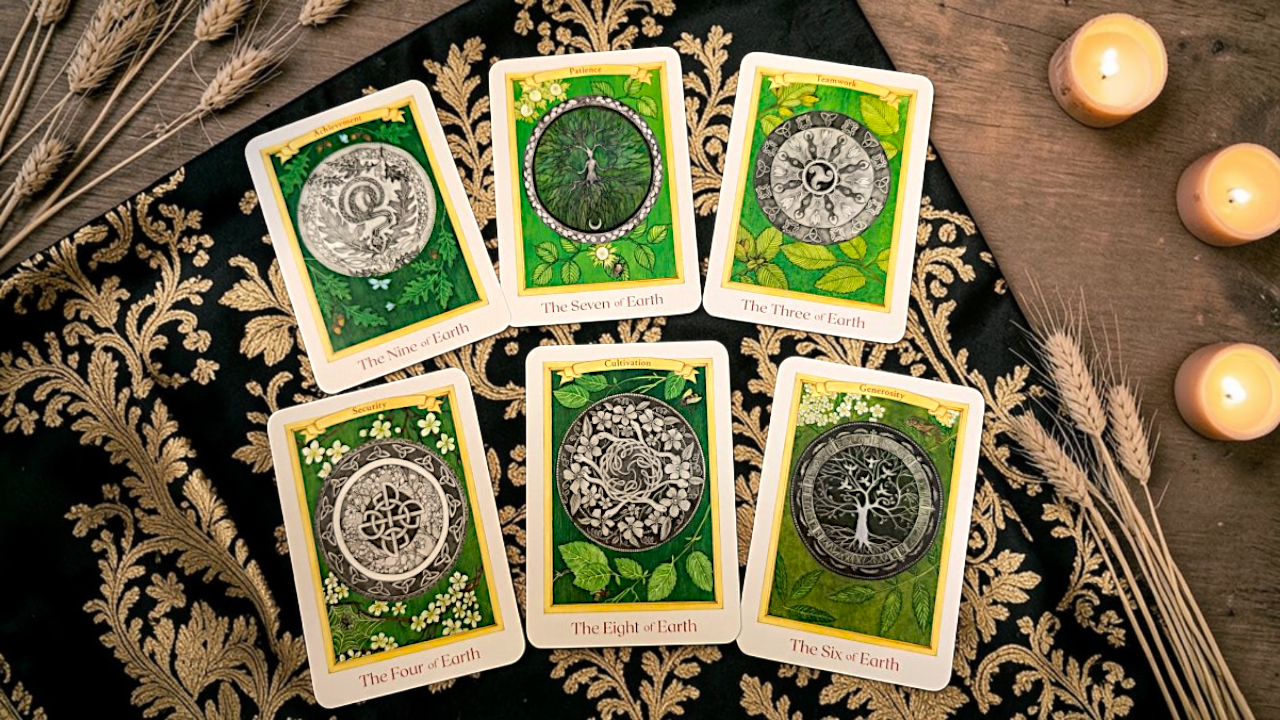
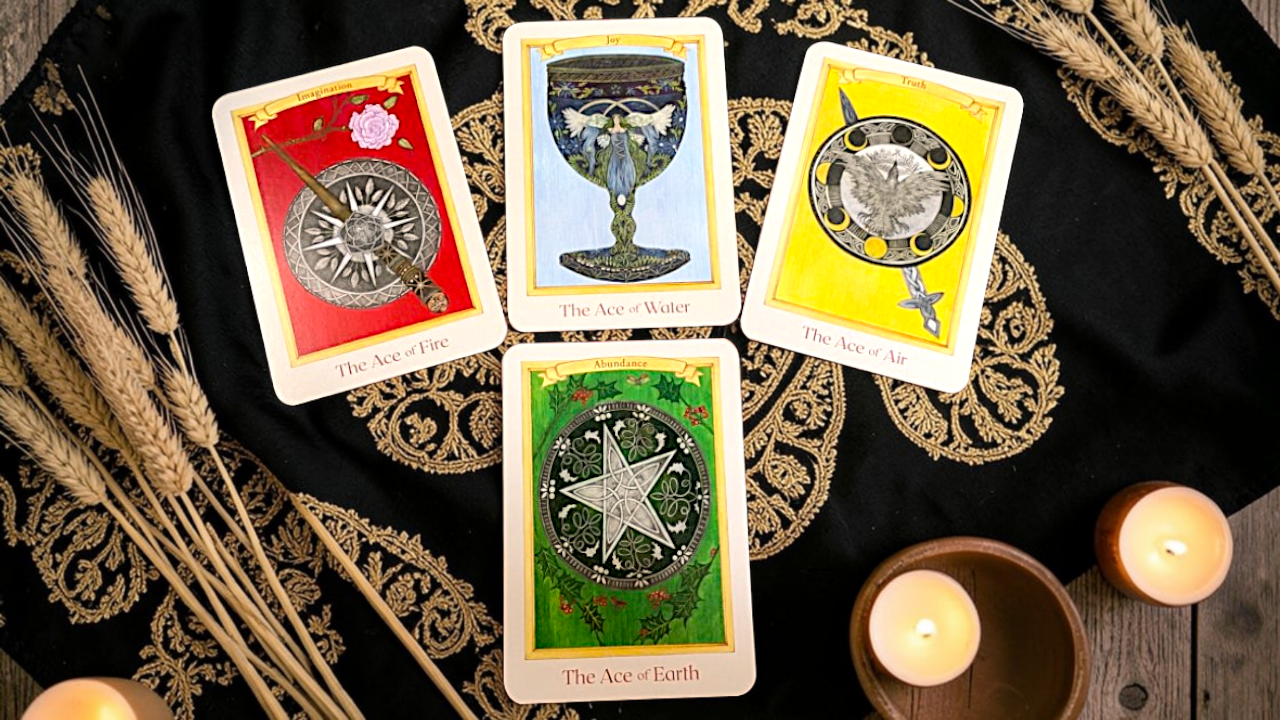
The Celtic Elemental Tarot is heavily centred on Celtic mythology, with all used symbology reflecting this theme. Each suit is distinguished by its own colour: Red for Fire, Yellow for Air, Blue for Water, and Green for Earth, as well as unique methods of illustration.
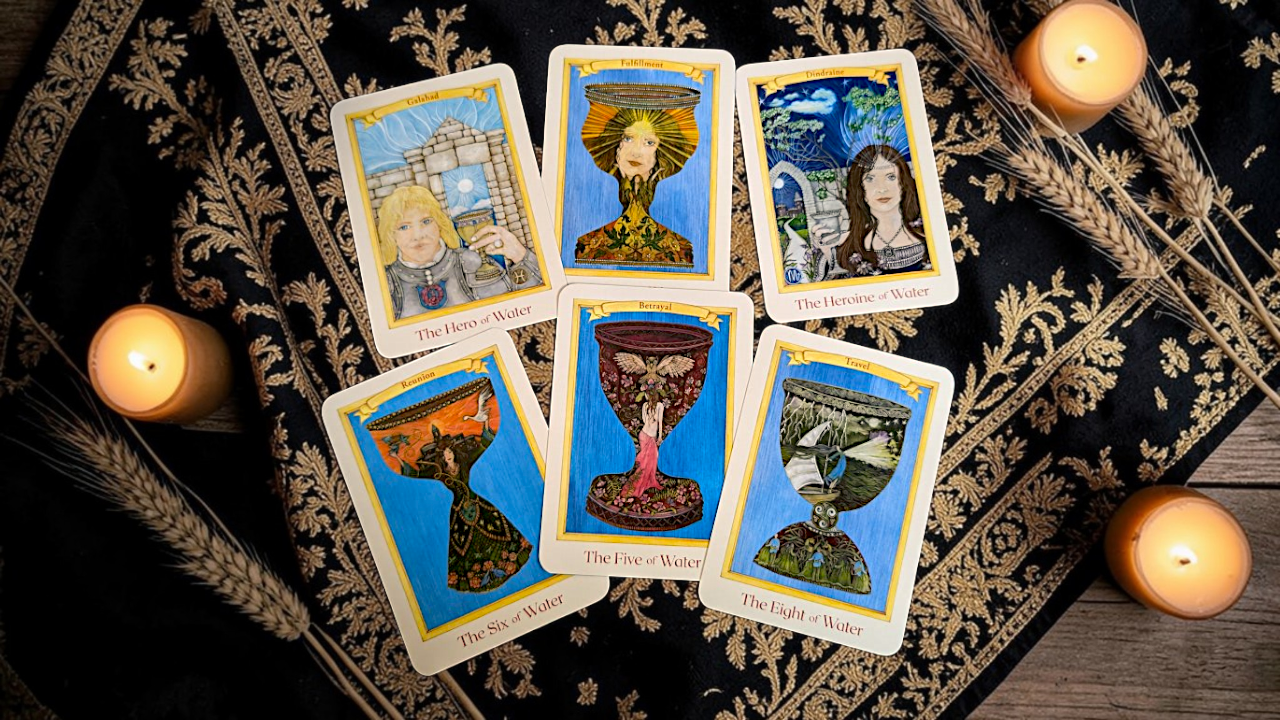
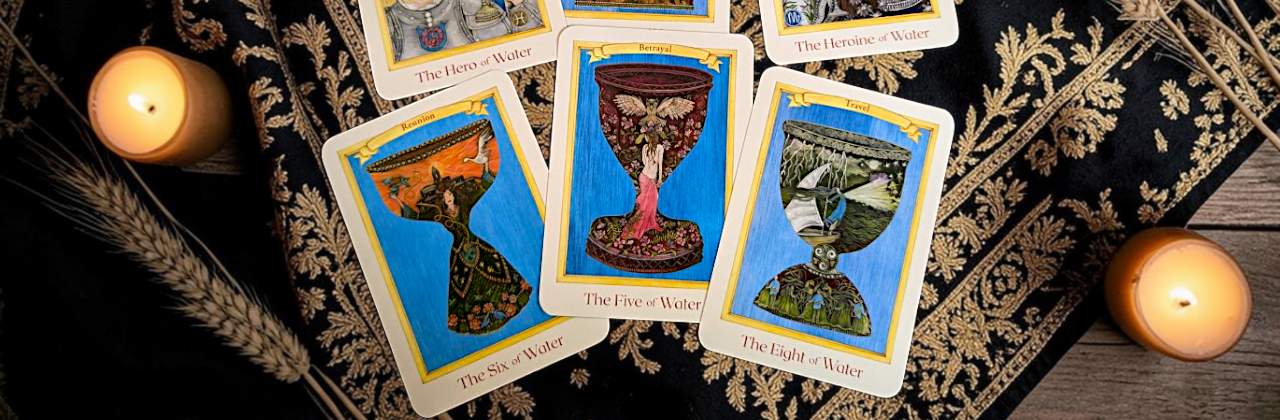
Fire cards show shields with animals in front of ceremonial wands and flowers. Air cards also feature shields and animals, primarily birds, surrounded by various daggers and Celtic knots. The Water suit is the most striking, with all illustrations depicted inside different ornamental chalices. Given that the deck is a search for the Grail, this suit feels particularly significant, showing moments or stories within the cups themselves. Earth is the most uniform suit, featuring large silver shields with Celtic motifs, animals, and branches from different trees.
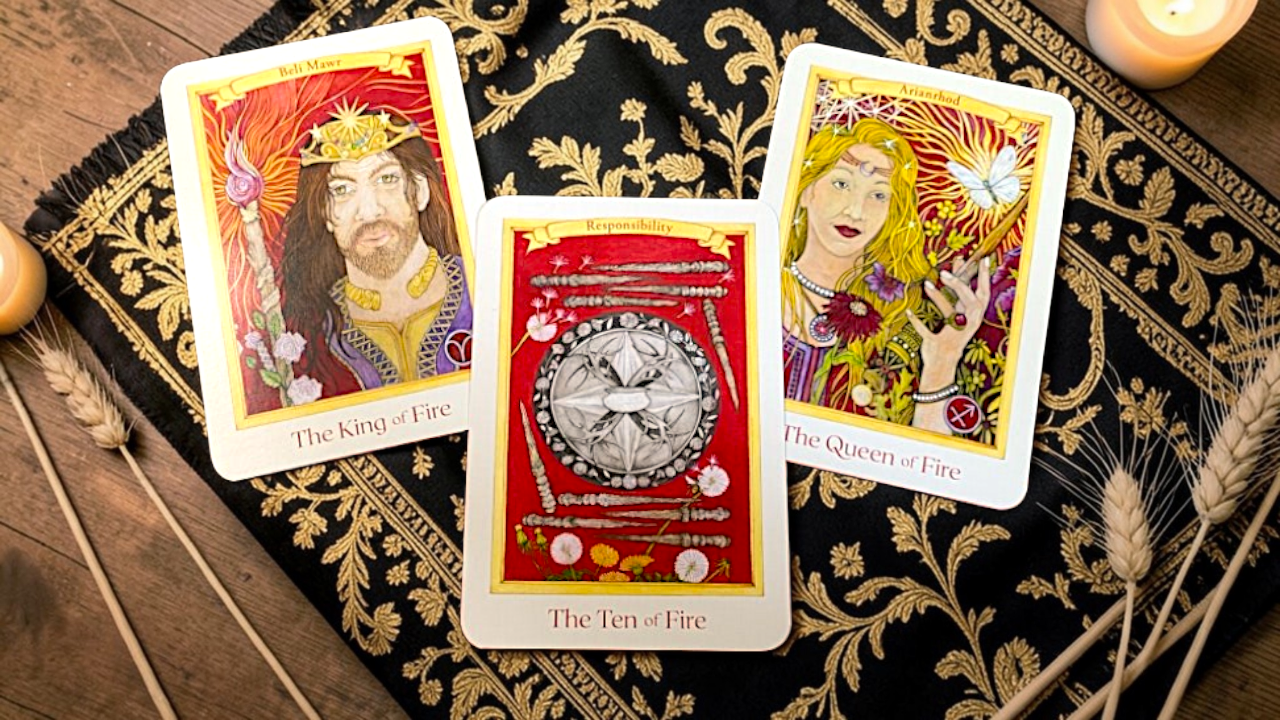
The court cards are more difficult to distinguish. If it were not for the titles and names, it would be a struggle to identify which character from Celtic mythology is being depicted. While there are symbols on the cards to represent each person’s characteristics and their suit, one would need to know their stories by heart to recognize them easily. However, the guidebook is helpful in this regard, describing the myths and personas in detail, so familiarity could be gained with practice.
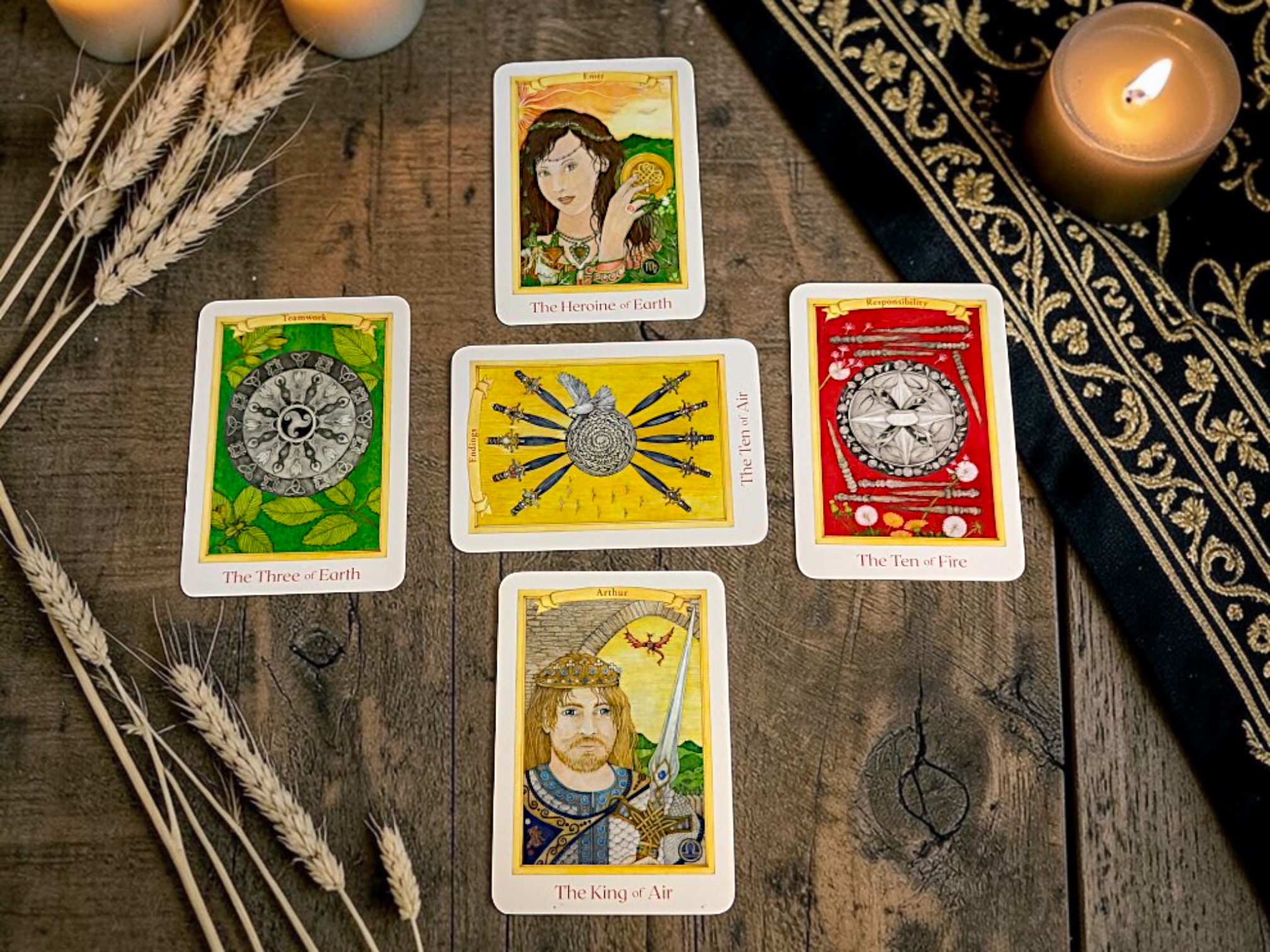
To truly understand the spirit of the Celtic Elemental Tarot, I conducted a five-card “Whispering Grove” interview. The cards were laid in a cross formation: the first card at the top, the second at the bottom, the third to the left, the fourth to the right, and the final card resting in the centre. This spread was designed to probe the deck’s personality, its strengths, and its limitations through its own mythological lens.
1. The Ancient Oak (The Deck’s Spirit)
Question: What is the core personality of this deck?
Card Drawn: Heroine of Earth (Emer)
My reading of the deck’s core personality, based on this draw and the accompanying text, suggests a spirit that is loyal but notably non-confrontational. The guidebook describes Emer as a figure who keeps life on the surface, looking away from challenging aspects to focus instead on beauty, artistic appreciation, and reflection. Most strikingly, the book describes her as an “excellent partner or wife” because she is agreeable, quiet, and avoids conflict. I find myself heartily disagreeing with the sentiment that being quiet and agreeable are the defining traits of a perfect wife; it feels like a very dated perspective for a modern deck.
This suggests the deck will act as a loyal companion that stands by the reader, but it may not offer the grounded, difficult truths or the “noise” needed to push one toward growth. It seems like a pretty deck to look at that is more likely to provide hopeful promises than to challenge the inquirer. However, I must note that this is my reading based solely on the card drawn and the initial text; it is entirely possible that Emer has more depth to bring to the table than can be realized in such a short period of time.
2. The Hidden Well (The Deck’s Depth)
Question: What kind of questions does this deck love to answer? Where does its wisdom run deepest?
Card Drawn: King of Air (Arthur)
The King of Air is the deck’s version of the King of Swords, representing the rational mind, order, and the power of intellect. According to the book, he represents the qualities needed for leadership and diplomacy, though he is often surrounded by discord and betrayal. Again, I noticed a very traditional, almost antiquated tone in the text: the book specifies he might appear as an “intelligent/scholarly man” or a “father”, but I’d rather not hold gender definitions to cards and instead focus on the traits being depicted. The book even notes that “women present a puzzle to him,” preferring the company and stories of his knights.
Despite the somewhat dated gendered language, this card indicates that the deck is fundamentally intellectual in a communicative kind of way. It is a tool that deals exceptionally well with diplomacy, communication, and interpersonal questions. It suggests its wisdom runs deepest when you are navigating leadership challenges or looking for ways to handle interpersonal adversity through a logical, principled, and strategic lens.
3. The Sharp Thorn (The Deck’s Limitation)
Question: Where does the deck struggle to see? What truths might it hide in the shadows?
Card Drawn: 3 of Earth (Teamwork)
The RWS traditionally sees this card as one of collaboration, but my impression is that the book focuses too much on that label without substance. Contrary to the other cards in this deck, where you get an in-depth view of the history behind the imagery, this one focuses on the keyword “teamwork,” yet when it approaches the actual symbology depicted on the card, the triskele, the mandala, the beech leaves, it makes no connection to teamwork whatsoever.
What this card suggests to me is that this deck might struggle with questions for situations that involve multiple people or a collective effort, such as how to work together to achieve a goal or the outcome of a sports team. As with the King of Air, it seems the deck’s wisdom shines on the individual effort, not the collective.
4. The Silver Branch (Our Connection)
Question: How will you and this deck work together? What is the rhythm of your partnership?
Card Drawn: 10 of Fire (Responsibility)
The book reframes “responsibility” as “response-ability”: the ability to respond. It notes that finishing an important project or creating a business requires intense focus and a great deal of concentration. It warns that while the load can overwhelm if you push too hard, taking full responsibility for your thoughts and actions is ultimately rewarding.
In terms of our partnership, this indicates that the Celtic Elemental Tarot is not an “easy” deck. Between Emer’s tendency to sweeten things to avoid conflict and Arthur’s lofty focus on “High Humanity” at the expense of teamwork, there is a lot of heavy lifting for the reader. The complex symbology and deep legends require a significant commitment to learn and master. However, it is precisely because of this unique perspective that the deck can reveal insights you might miss with more traditional RWS decks. It demands effort, but that “response-ability” makes the resulting insights all the more valuable.
5. The Standing Stone (The Final Omen)
Question: What is the most important lesson this deck has to teach right now?
Card Drawn: 10 of Air (Endings)
The guidebook’s description for this card is honestly a bit of a mess. It claims the 10 of Air is “the most ominous card in the deck,” which is debatable, and then it gets lost in strange tangents. It suggests a dove in the artwork might be “reminiscent of angels” and goes into an odd astronomical detail about the spiral of leaves drawing the dove “anti-clockwise, the direction of all the planets, except Venus and Uranus.” It’s the kind of information that leaves a reader wondering: so what?
Despite the confusing text, the core lesson here is clear. This deck is a powerful tool for navigating transitions and endings. Because Emer (the deck’s “spirit”) is so focused on beauty and reflection, the deck acts as a supportive ally during the grieving process. It helps to soften the blow of difficult transitions, making everyday endings feel less impactful. Specifically, I see this deck as being particularly good at helping a reader pick themselves up and find a way forward after romantic breakups, as Emer is particularly romantic.
This is likely not, however, the best deck for asking how to make a relationship work. A successful relationship requires the “Teamwork” we saw the deck struggles with in the 3 of Earth, and a gritty honesty that Emer tends to avoid, the deck is better suited for the healing that comes after the end than the maintenance required for the middle.
These impressions, drawn from the interview spread, suggest that if the reader is willing to put in the hard work of familiarizing themselves with the cards, this deck has enough depth and lore to make a good companion. It may appear as a “quiet” deck that speaks in riddles and dated prose, but for those ready to take on the “response-ability” of the 10 of Fire, it offers a unique, reflective perspective that traditional decks might miss. Of course, these are the cards’ own stories; to see how that lore is actually delivered to the reader, one must experience the deck for themselves.
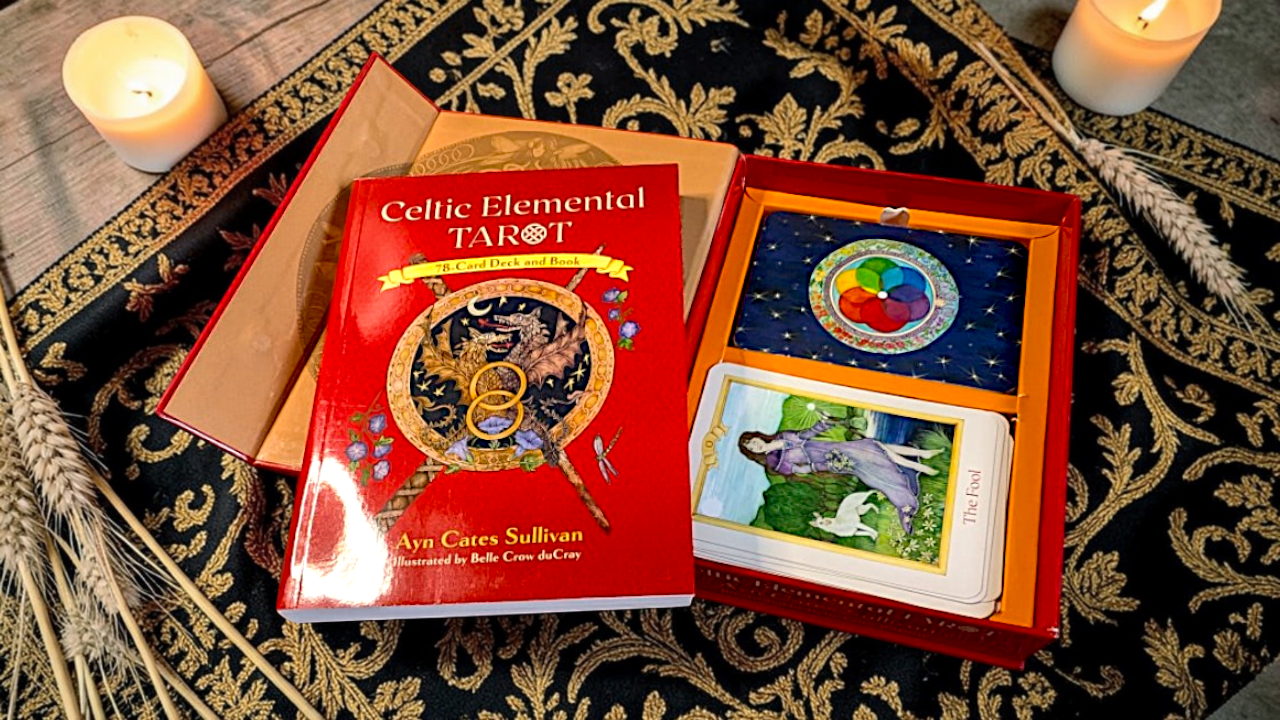
The guidebook is big and complete, made of good materials with black and white images and easy to handle. It has detailed information about each card, including a little catchphrase for the major arcana, keywords, reversed keywords, a “synthesis” for the major arcana, and a “drive” for the minor arcana. Each entry contains a long description of the meaning of the card and its meaning in divination, followed by a description of the reversed meaning. It also explores the symbology and lore present in the card, as well as “Grail Questions,” which are key questions the card has to ask you.
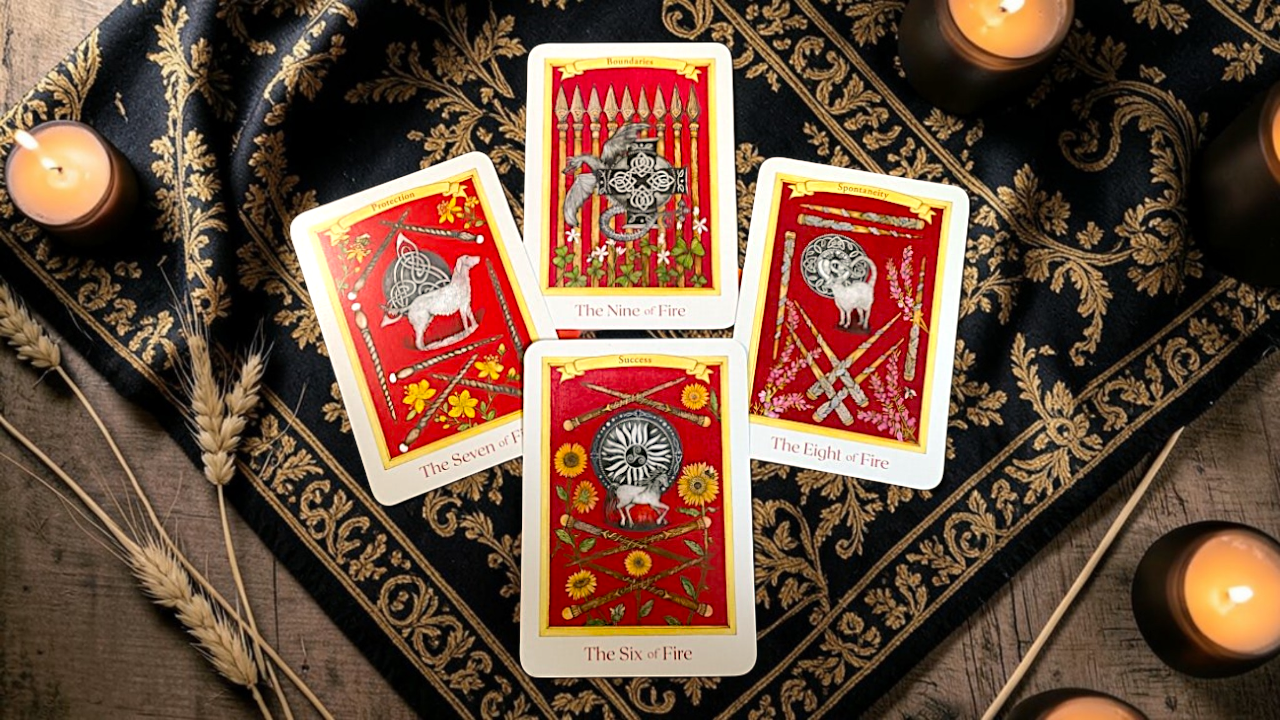
The art is very detailed, with the pencil work giving the images a more gritty, real feel that is so important in this age of AI images. It feels like every detail matters, and it probably does. The illustrations have so much to tell that I feel I would need a lot longer to decipher most of them. It is one of those decks where, every time you do a reading, a new detail from the card will jump out at you, increasing your repertoire when translating how that card fits in a given situation.
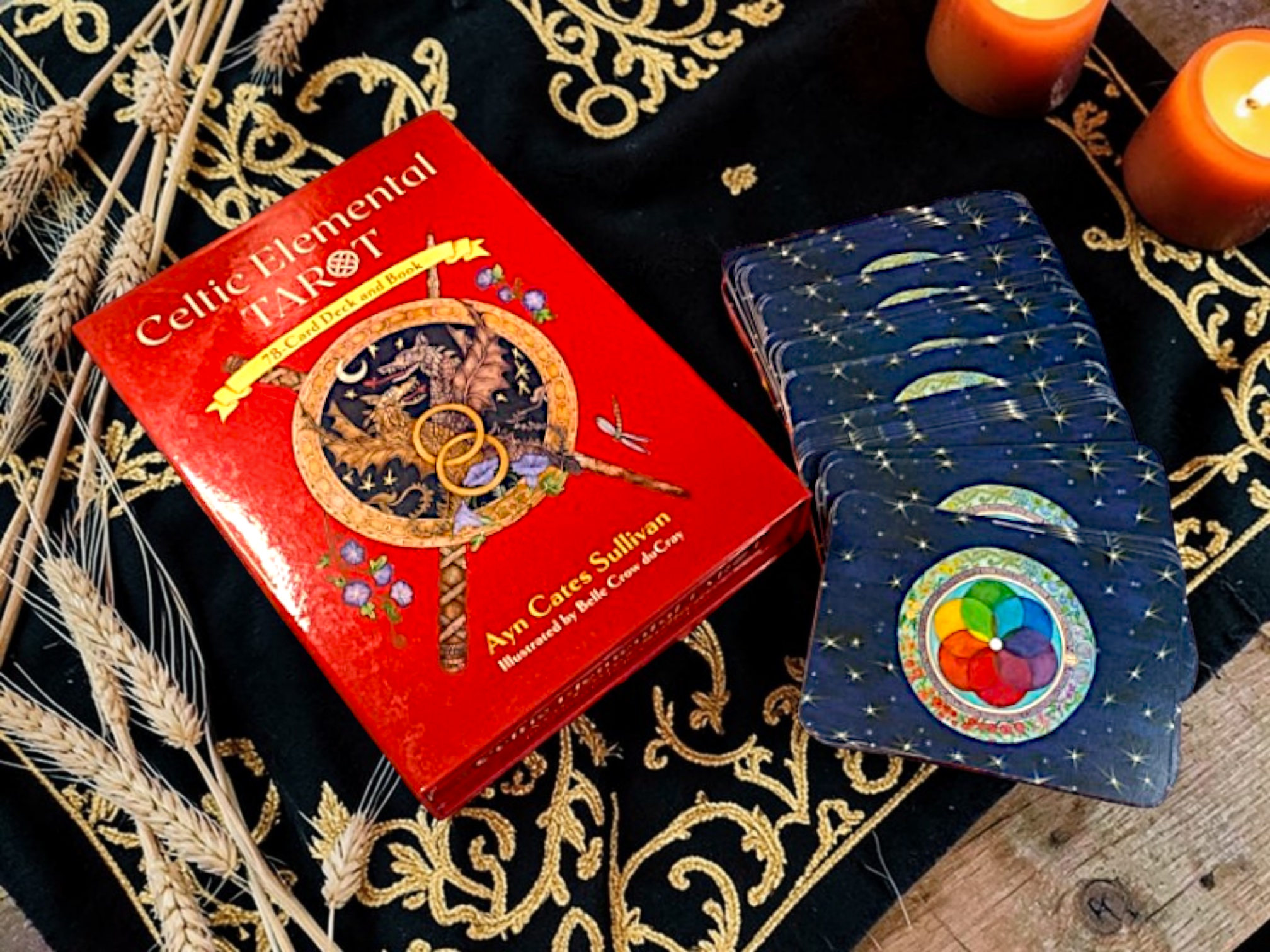
The cards are big and easy to handle, but quite thin, so riffle shuffling can bend them. Overhand shuffling is also not easy because of the size of the cards. Their finish is also plain, which suggests they are likely to lose color at the edges with continued use. For such detailed illustrations, the print quality sometimes feels a bit blurred. However, the case is solid with a magnetic clasp and it fits the cards and book neatly so they can be stored together. The format of the box is not my personal favorite, since the cards stay loose under the book and have to be split into two piles, but that is a personal preference.
This is an in-depth deck on Celtic Mythology and legend. It differs greatly symbolically from traditional RWS decks, but the meaning of the cards doesn’t change much, making it a deck that can be appreciated by new and experienced readers alike.
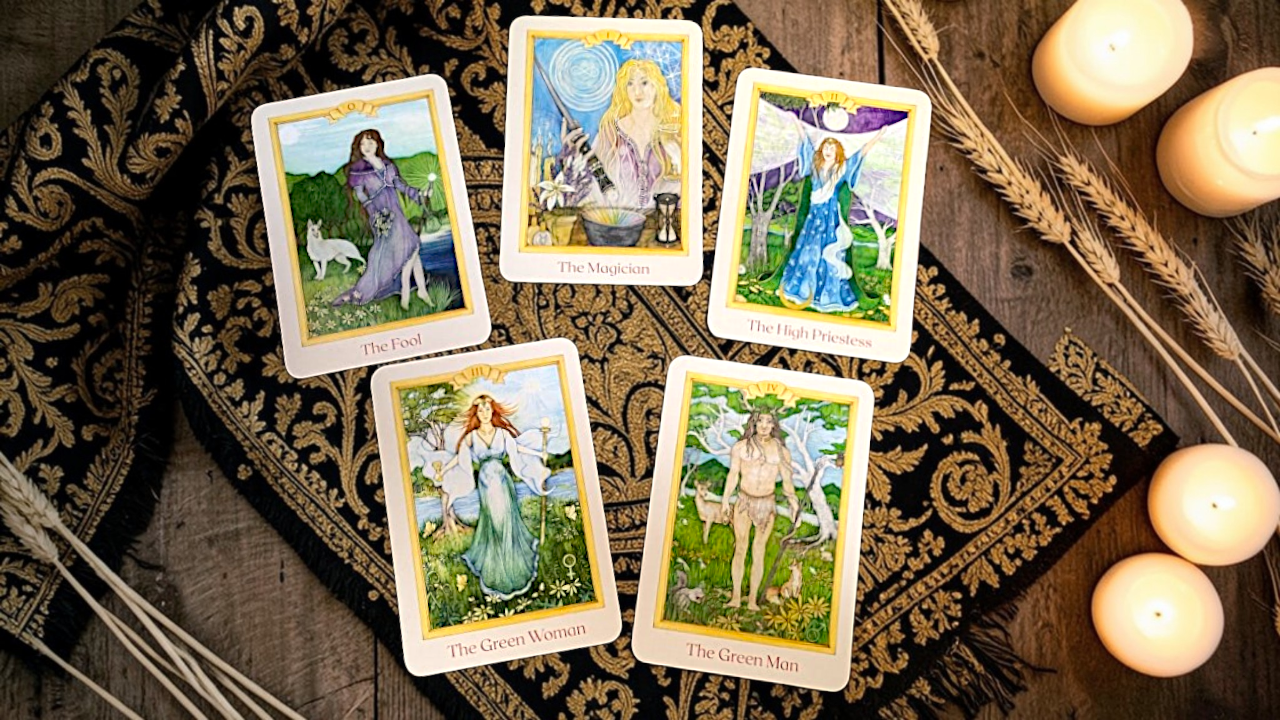
For new readers, however, it is important to understand that the ability to recognize the cards and their symbology may not be as transferable as if you started with a more traditional deck. Interestingly, this might actually make it easier for beginners to identify with the deck than experienced readers, who may find it difficult to get to grips with the different iconography when they are already so familiar with traditional cards.
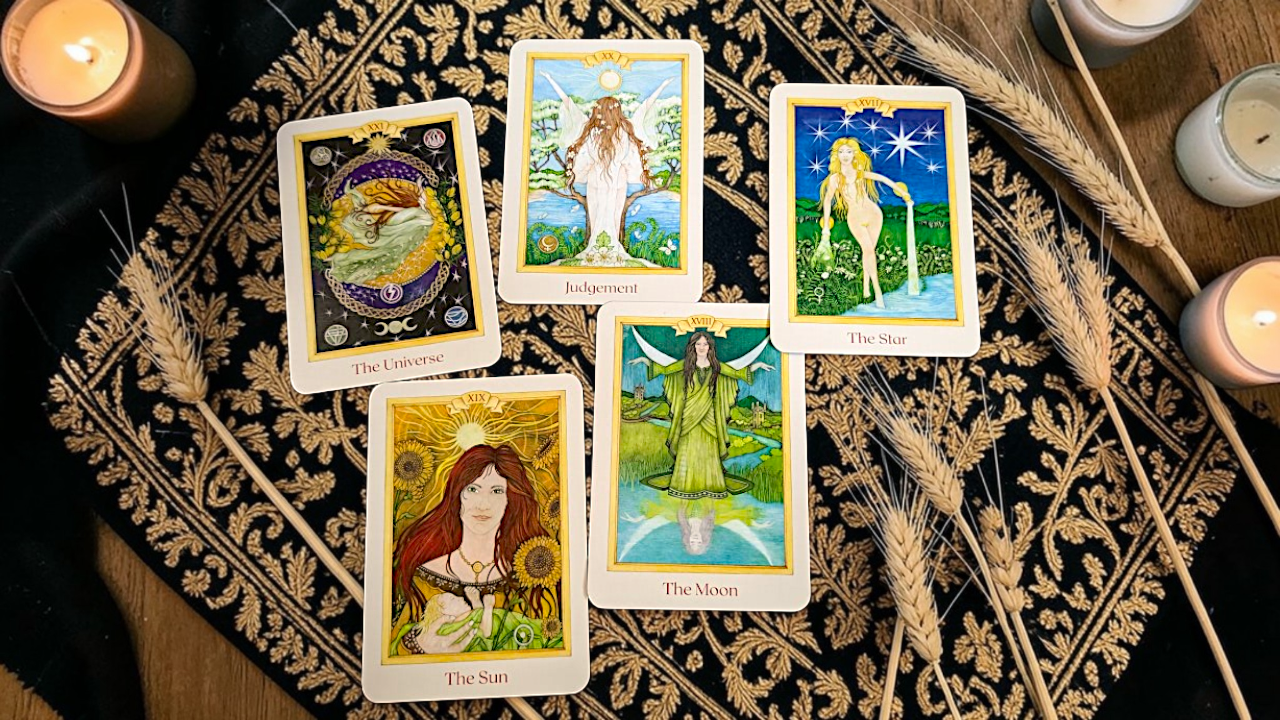
The Celtic Elemental Tarot is a dense, richly layered work that is ultimately rewarding in its uniqueness. While the numbered cards tend to stay closer to their RWS cousins, the Court cards and Major Arcana bring the reader significantly deeper into the heart of Celtic and Arthurian myth.
Regarding the guidebook, its occasionally antiquated way of thinking can be attributed to how true the deck stays to historical Celtic tradition, rather than just using the theme as a light aesthetic. This is a deck that refuses to be just another RWS clone; however, that refusal means it requires time and patience to get acquainted with its deeper nuances.
The Celtic Elemental Tarot is available from Findhorn Press, an imprint of Simon & Schuster.
You can watch a flip-through of the deck on TABI’s YouTube: