Deck Review: Crossed Destinies Tarot: A Marseilles Deck of Self-Discovery
- Author and Artist: Bobby Green
- Publisher: Rockpool Publishing
- RRP: AUD $32.99 / GBP £19.99 / USD $22.95
- ISBN: 9781922468093
- Publication Date: Apr/26 (AU/NZ) , May/26 (US) , May/26 (UK).
- Country of publication: Australia
- Reviewed by: Kim Goldsmith Cosmic Snail Tarot
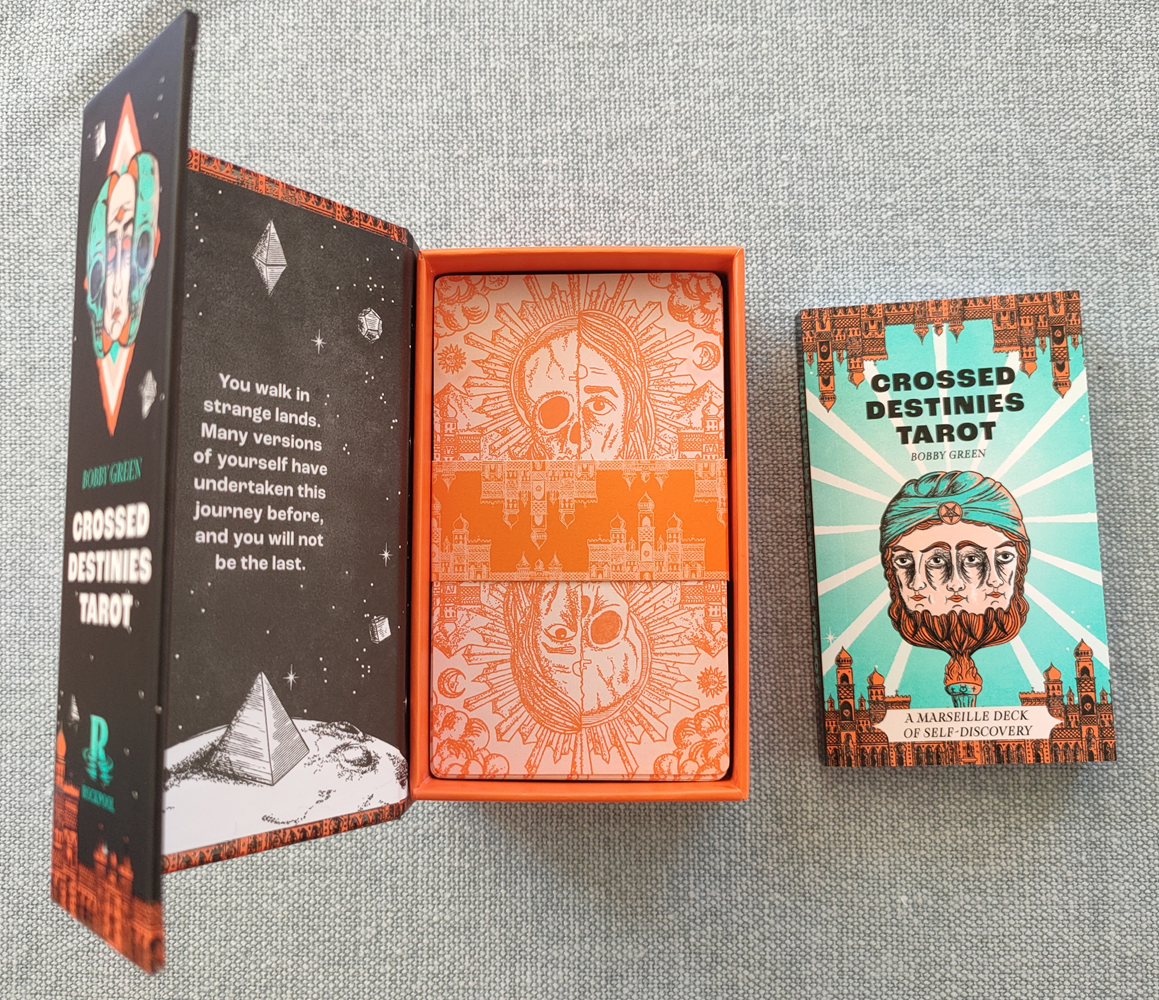
“You walk through strange lands” states the opening line in the guidebook to Bobby Green’s Crossed Destinies Tarot. This deck feels like a map to an alternate universe. The first thing I wondered when shuffling through the deck was about the name. What does it mean? What is the connection between the weird alien/God/beast characters in the deck and the title? Perhaps it refers to the idea that tarot offers an alternative lens through which to look at your life via a variety of possible future pathways – just like a choose-your-own-adventure book. Now, if you are an avid reader of classic literature, you will be shaking your head at me. I googled the title and of course Italo Calvino’s 1973 two part novel, “The Castle of Crossed Destinies” popped up. That got me excited. The book is about travelling strangers who lose their voices while walking through a forest and can only tell their tales through the use of a tarot deck. Part One uses the Visconti-Sforza deck and Part Two, the Tarot of Marseilles. So cool. I have to read this book, which is an exploration of how meaning is created through symbols and words. Bobby Green has a website dedicated to his Crossed Destinies Deck and I was dying to read about the artist’s process of creation and more about the inspiration for the deck. However, it just contains images of all the cards and their meanings. Is this intentional? Perhaps so. I like to think that this is a silent message from the artist to make your own meaning from this deck, using it to examine and reflect your own stories as you travel through life.
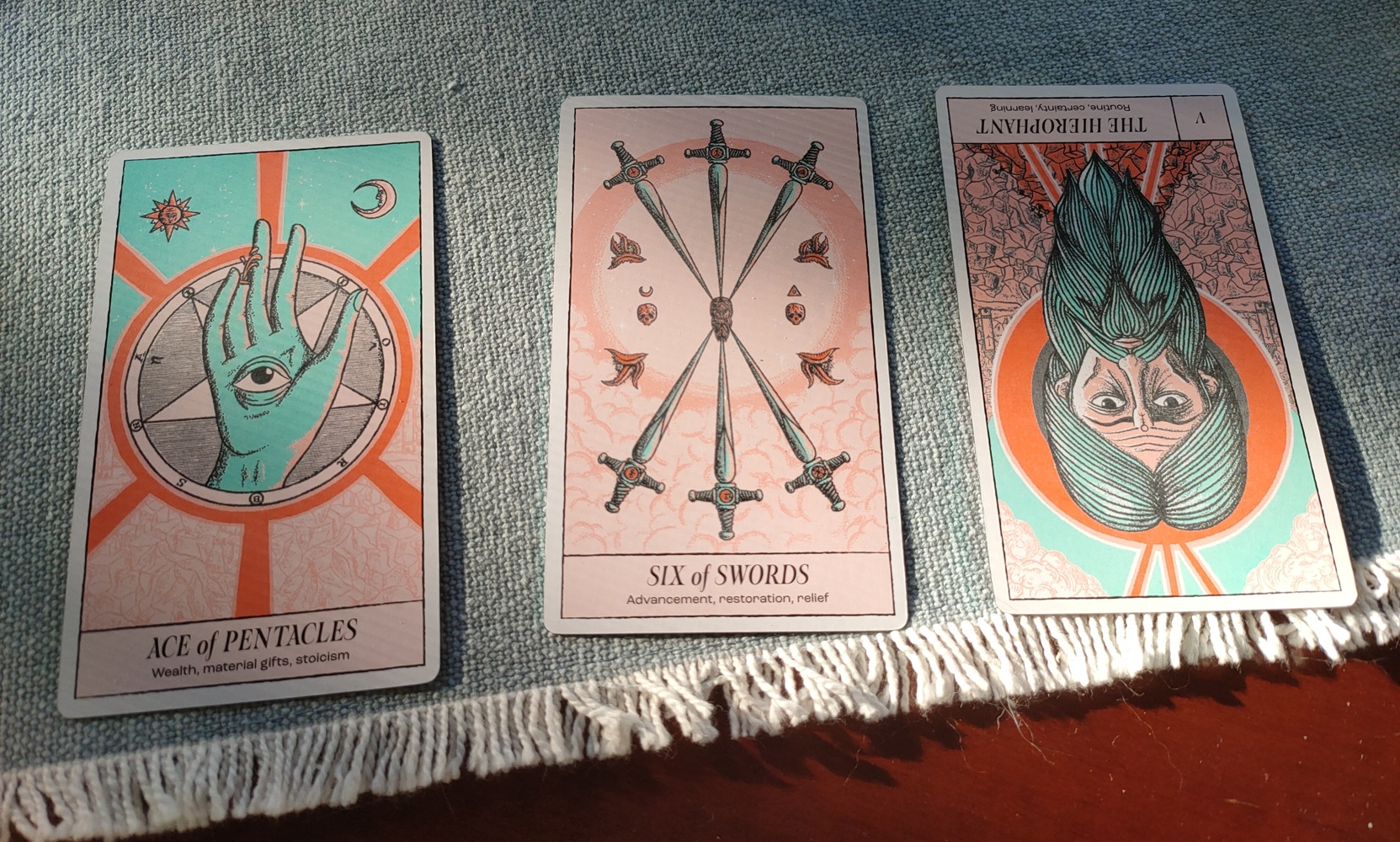
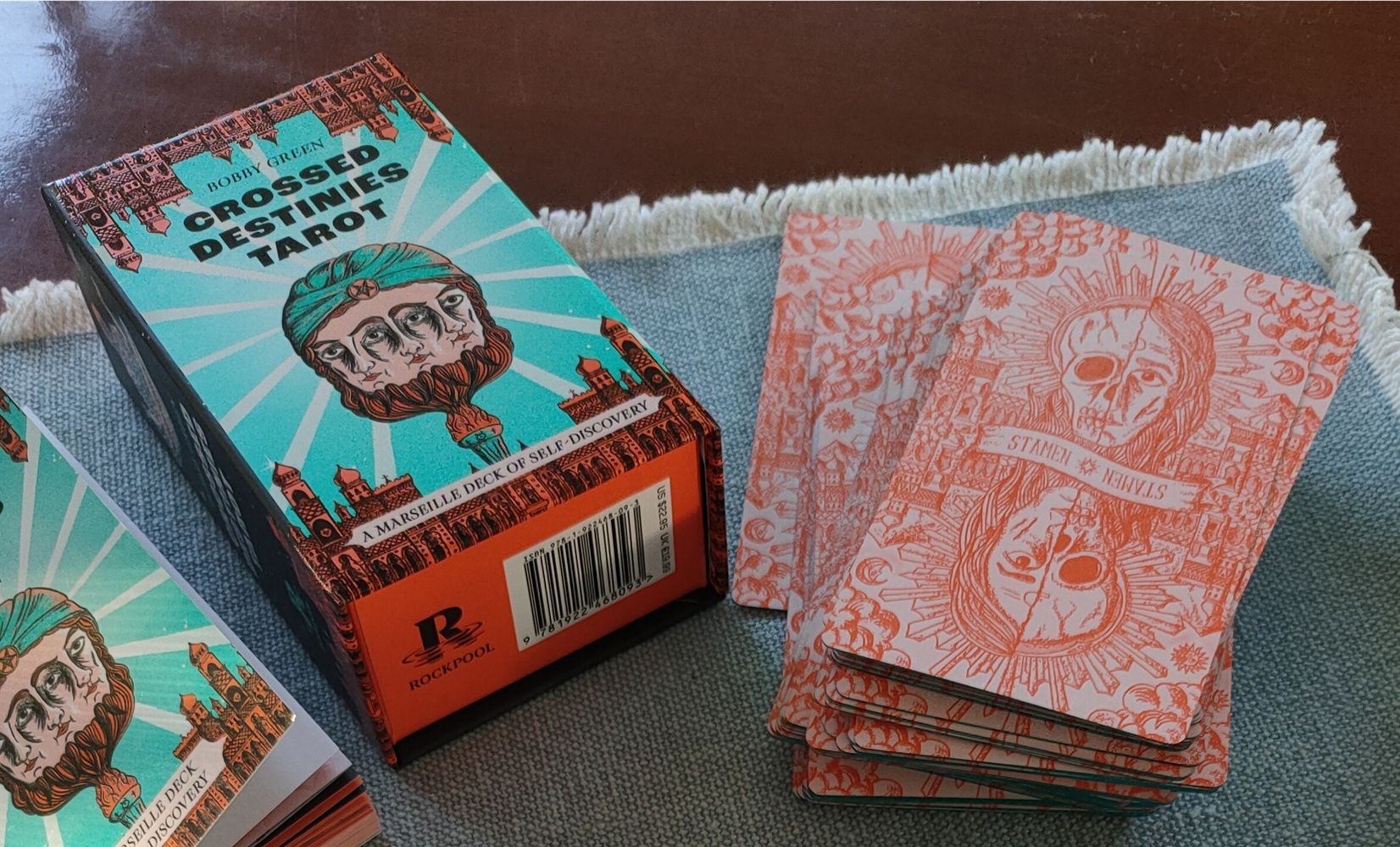
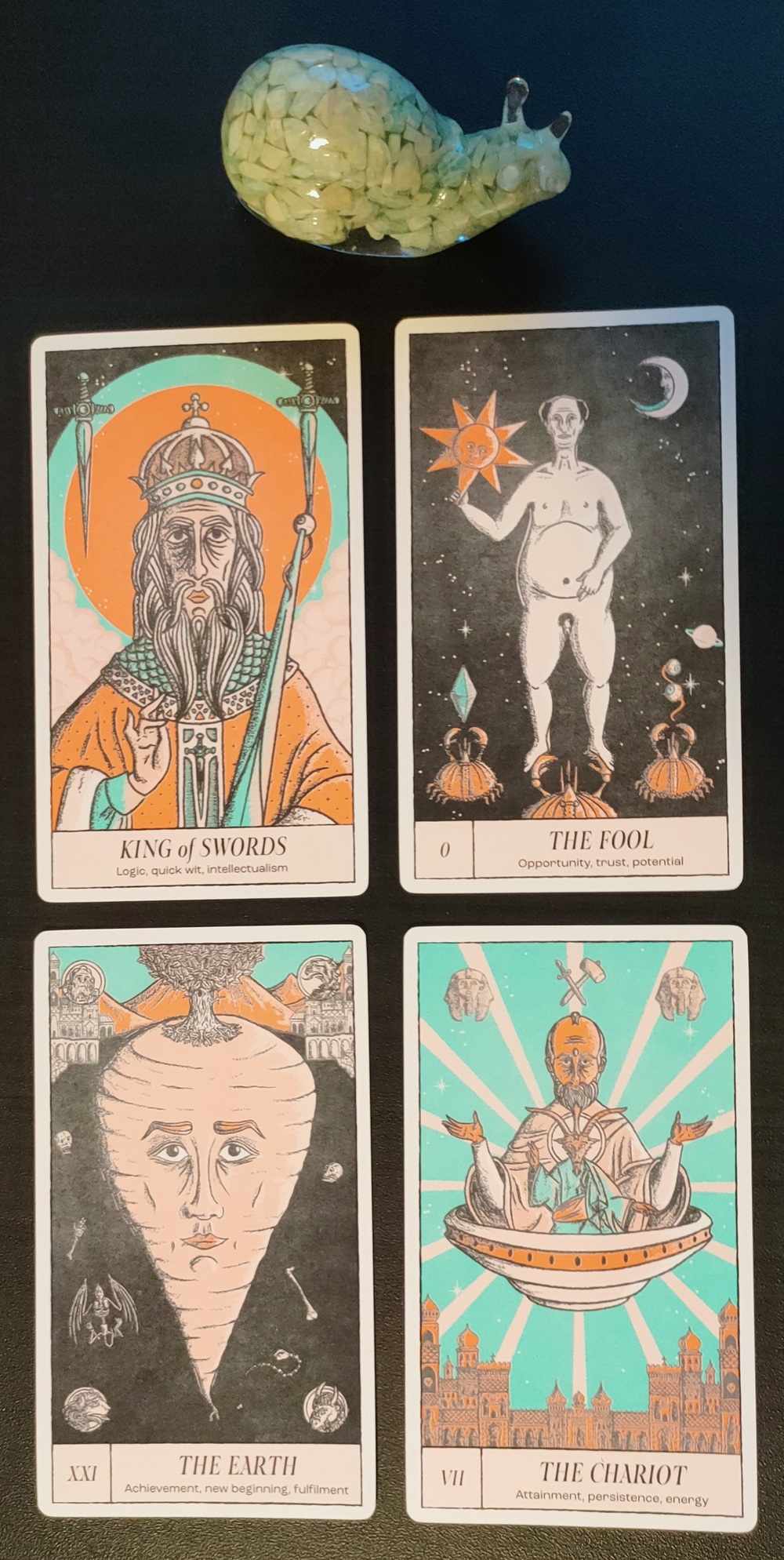
Intriguing and mysterious, the artwork Green has created hints at environments described in the guidebook as “shadowed valleys”, “ancient forests”, “desiccated plains” and “dark harbours”. Inhabiting these spaces are different kinds of kooky characters, some beast like, some alien, some gods, and some plainly human. It has a really faded old comic book or ‘zine’ feel to the printing. The deck is bi-colour – just aqua and orange in various tones, tints and hues, black outlines, and white space. The drawings look like they are produced by hand with pens, and coloured digitally. I like the flat, graphic quality of the art which is very reminiscent of old-school printed newspaper comic strips. Some of the cards really crack me up. O – The Fool is a chubby naked little man standing on what I choose to call space crabs, holding on to an unimpressed sun as the moon sniggers in the background. VII – The Chariot is an upside down flying saucer hovering over a city, its navigator a meditating guru of sorts, with a mini human-goat pal. XXI – The Earth is a giant carrot (naturally?!) with a face buried deep underground and a large tree bursting from his head towards the surface and sky. The artwork is imaginative, and the overall design and formatting of the deck packaging, cards and guidebook is cartoonish yet sophisticated.
The subtitle for the deck is “A Marseilles Deck of Self-Discovery”. Now here is the age old question – is every deck without illustrations on the pips a TdM deck? I find that there seems to be a big allowance in the tarot community for artists to create RWS decks which deviate from the traditional symbols and imagery quite a lot. But with TdM decks there is still a lot of resistance. In the last year or so I have been gravitating a lot more towards Marseilles decks in my tarot practice, using mainly the CBD Tarot De Marseilles. I find that the language of these decks relies on subtle body language in the court cards, and directionality of the figures, which builds a story between the cards. I like to use Dr. Yoav Ben-Dov’s open reading method where there is no set spread and I am looking at the interconnection and placement of the cards. I have tried this method with the Crossed Destinies Tarot and I think it works very well with the court and major cards, but with the minor cards I am relying more on my pre-existing knowledge of their traditional meanings as well as numerology. Another thing to note is there is no introduction to the tradition of Marseilles decks and reading in the guidebook, which makes the suggestion that it is a TdM deck on the box feel like an afterthought. I actually wonder if the artist or publisher felt compelled to add that it is a Marseilles deck so people aren’t surprised or disappointed when they find the unillustrated minor cards.
The Minor Cards are very plainly illustrated and don’t have the subtle elements like foliage and flowers, which would be used in traditional Marseilles decks to suggest growth or decay, abundance or scarcity. I think strict Marseilles Tarot readers may not agree that it is a Marseilles deck, but they will find it easy to use. RWS readers familiar with reading playing cards or who are comfortable with unillustrated pips will no doubt enjoy the potential stories this deck can produce in a tarot reading.
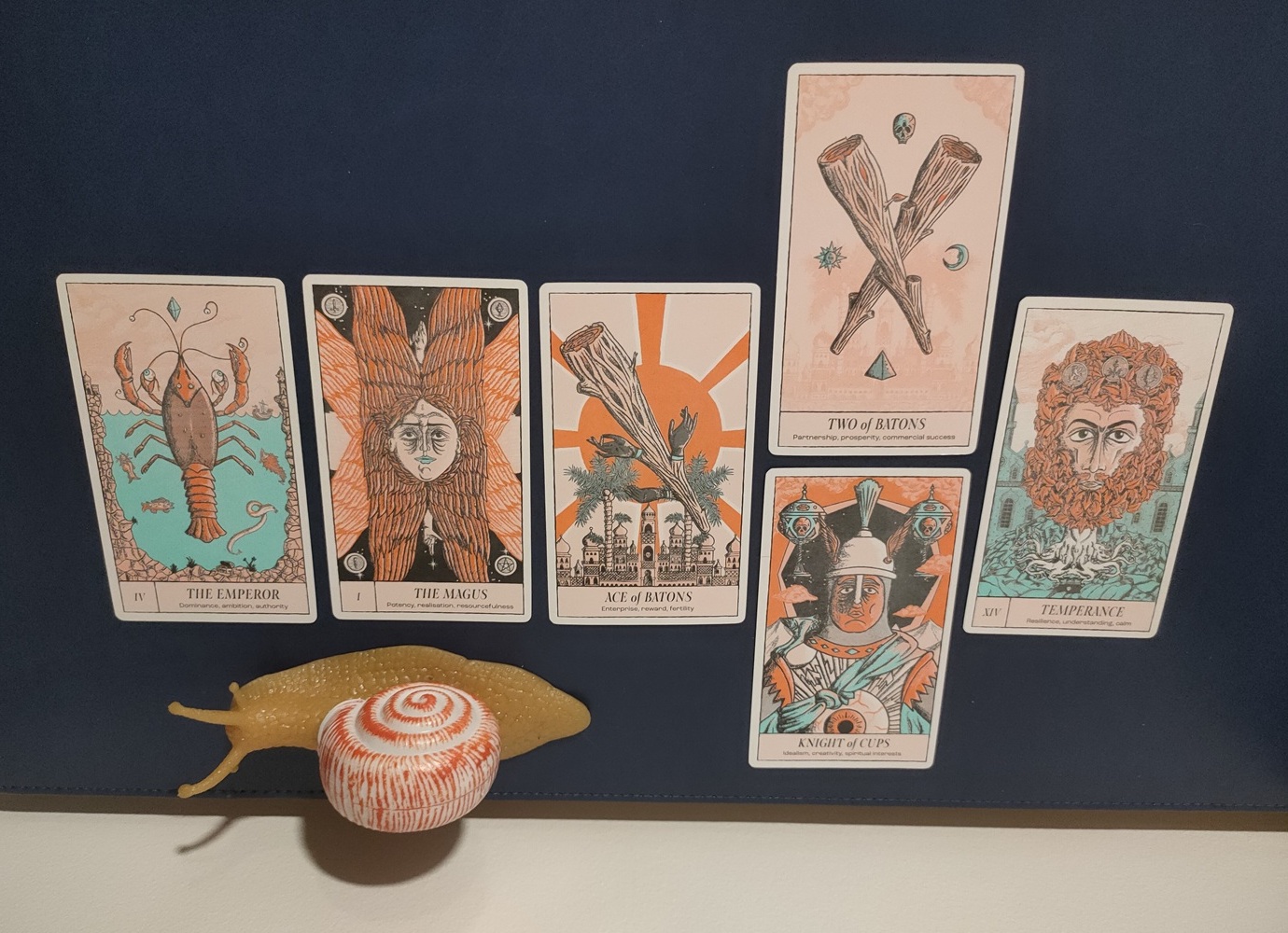
I like the feel of the smooth card stock when shuffling. The cards have a metallic aqua blue edging which gives the deck an outer planetary feel, and there are very discreet white borders on all cards with a title, number and keywords under the card artwork. Card backs are orange and white and reversible. The word ‘Stamen’ is written twice on some banners. I am not sure why that is significant. Maybe I need to read that Calvino novel…
The deck is contained in a compact magnetic box which includes a small guidebook that does not have images of the cards, but has some illustrations from the deck. There are three meaningful and unique spreads included in the guidebook which emphasize tarot as a guide or road map for your personal journey. The language of the guidebook is quite mysterious, but the messages can be quite pointed too. The King of Swords Inverted meaning goes like this: “[He] uses his silver tongue to wreak destruction. Words are a knife to pry open cracks of uncertainty and division, and you may find yourself easily outwitted. Interrogate contracts carefully, whether written or spoken, for they are ridden with pitfalls and their author is malicious. Be on your guard”. Both practical, yet abstract, each guidebook card entry leaves space open to your interpretation in the context of a reading.
I really like using this deck and find the messages really dark at times, but they stir up a lot of creative contemplation. The artwork is sparse, leaving room for your own imagination to implant itself in the deck’s unique landscape. If you love quirky decks grab yourself a copy of The Crossed Destinies Tarot. It won’t disappoint.