
Deck Review: The Eigengrau Oracle
- Creator: Michael Setteducati
- Publisher: Self-published | Somnambulant Visuals https://www.mikesette.com/the-eigengrau-oracle-deck
- Publication Date: 2024
- RRP: USD $44.99
- Country of origin: US
- Reviewed by: Gwen Enstam @goldenpomt on IG
eigengrau n. The dark grey color seen by the eyes in perfect darkness as a result of signals from the optic nerves
Obviously, I had to try it out. I put on a sleep mask, tucking it in around my nose so that there was no light edging in, closed my eyes for a minute to let them adjust, then opened them. What I expected was something like a screen of grey, from side to side and top to bottom. What I saw was a curving abstract grey shape against a dark background, which somehow made more sense and was also quite uncanny because you know that you’re not really ‘seeing’ anything.
[S]o-called opposites, such as light and darkness, sound and silence, solid and space, on and off, inside and outside, appearing and disappearing, cause and effect, are poles or aspects of the same thing.*
We tend to think of the world in black and white, and even if we allow for shades of grey, we think of that grey as excluding the black and the white. The Eigengrau Oracle asks us to expand this way of looking – to include and also surpass the duality that we’re used to – to sit with the uncanny that arises when what we assume are solid divisions start to loosen and what then appears is not two separate things at all, but two aspects of one.
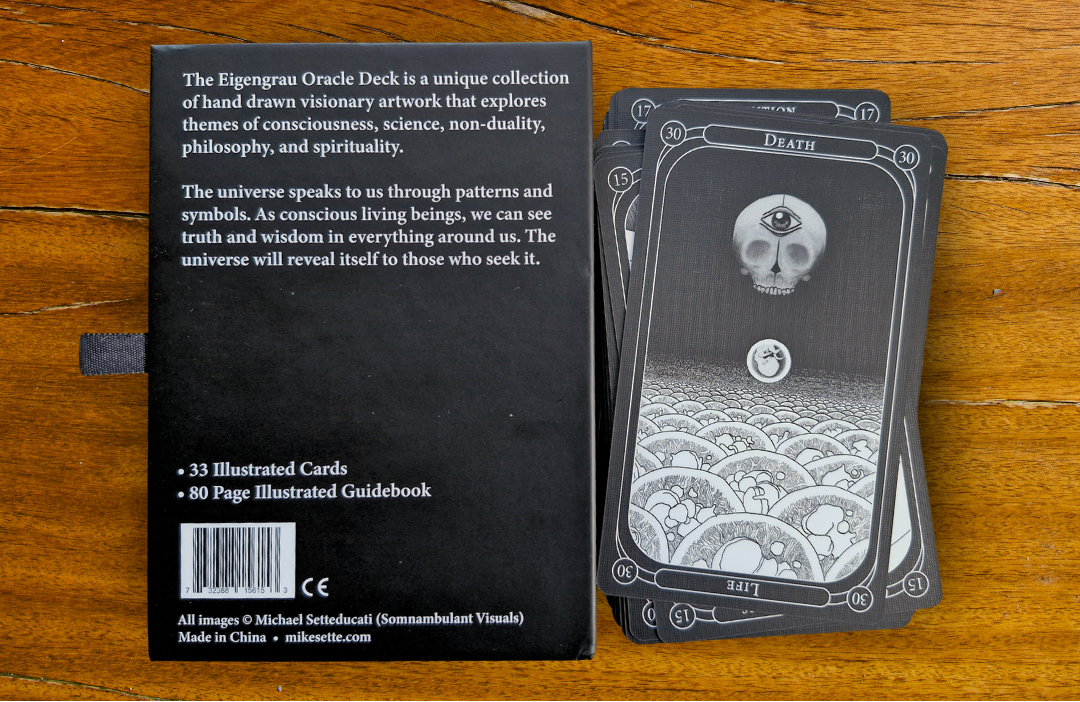
The Eigengrau Oracle is a deck of 33 cards. Each card has two images that reflect each other, and which we can read in a few ways: looking at the image at the top, which is upright; looking at the image at the bottom, which is upside-down; and blending the two – looking for how and why they belong together, and what larger message that offers us. I tried all three methods. Reading across the top or the bottom (or, as is also suggested, reading l-r along the top and then r-l the bottom) works well. But what I really loved was exploring how the images fit together, how the ‘seemingly opposing sides are, in fact, completely interconnected.’
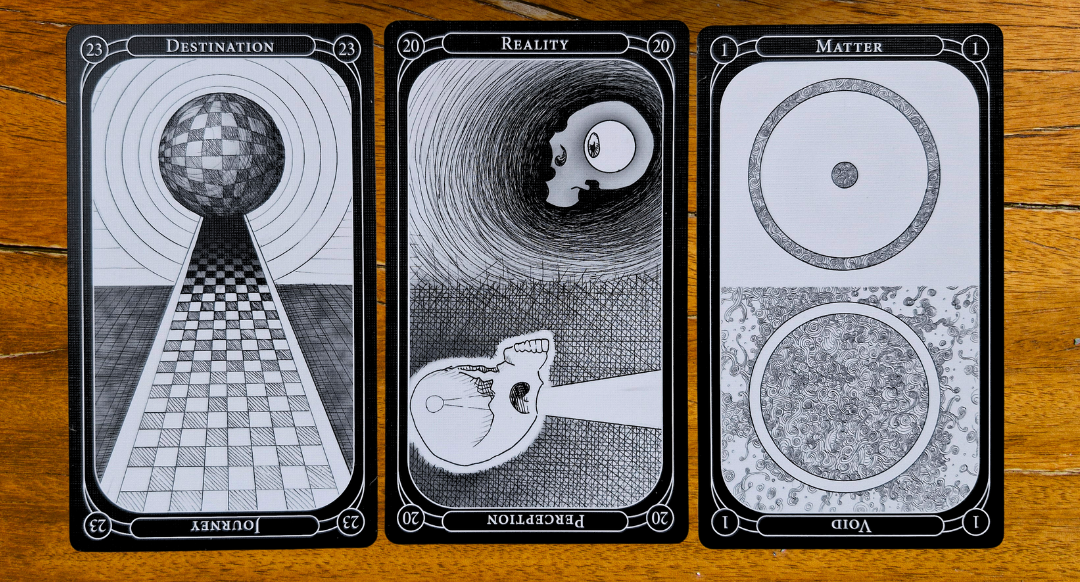
The Eigengrau Oracle challenges our mindset. Are concepts we have accepted exactly what we think? For Journey and Destination, for example, since I’m so used to being told “It’s the journey that matters! Not the destination!” they feel like opposites. Choose one, not the other. But on this card, one exists within the other. If we draw Journey at the top and that is what we choose to read, then checking in with Destination underneath might make us wonder if a good aimless wander is what we need, or conversely, do we need to remember what we started a particular project for. There is a lot of room for manoeuvre in these cards.
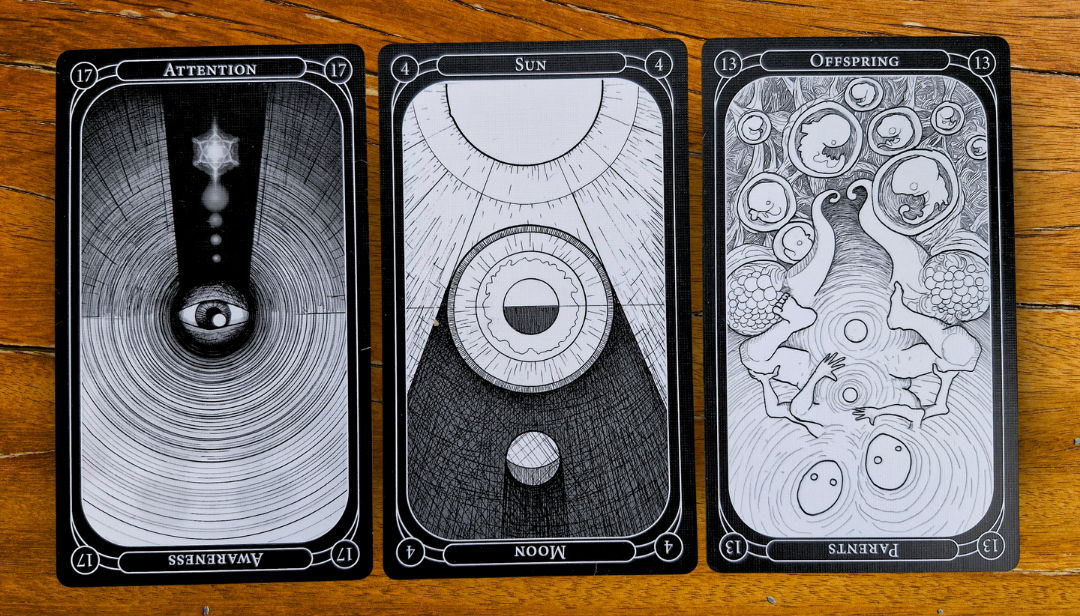
The first card I drew for myself from The Eigengrau Oracle was Attention/Awareness. I asked the deck, “What do I need to know now?” and the card is so relevant to my person situation, I had that tingling feeling you get when a message has been dropped into your consciousness like a penny falling into a glass of water. Atom/Bond is a fascinating nod to the physics behind it all – you knew we were getting to physics eventually! – and reminds us that while everything looks and feels so solid, there is actually more space in Reality than any ‘thing’ else.
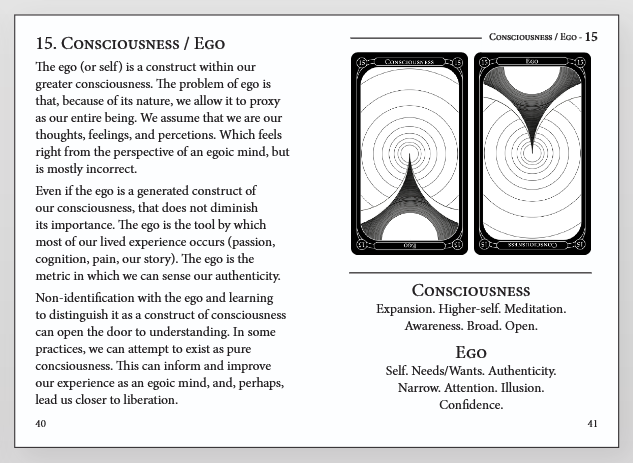
If this is all starting to sound a little heavy, that’s my fault. Setteducati asks us to ‘approach the deck with an attitude of curiosity and playfulness.’ ‘Creativity,’ he says, ‘is an expression of divinity’ and The Eigengrau Oracle is his ‘love letter to the universe.’ His delight in expression is there in every card, every illustration, and in the definitions of the cards. For the Flower of Life/Metatron card, he explains:
Sacred geometry is the study of shapes and patterns that symbolize the divine. The shapes appear in and/or reflect nature. They contain fractal, layered concepts that open the mind to the nature of reality. The Flower of Life represents the genesis of all creation and the interconnectedness of life. One cell divides into many. […] The symbol represents organic life as it is.
The Neophyte/Sage card reminds us that:
We are in a constant state of learning. Along the way, we may have the honor to impart what we have learned to others. […] The transmission of knowledge is a sacred cornerstone of humanity. The Neophyte and Sage card represents this profound continuum of learning and should be received with great care.
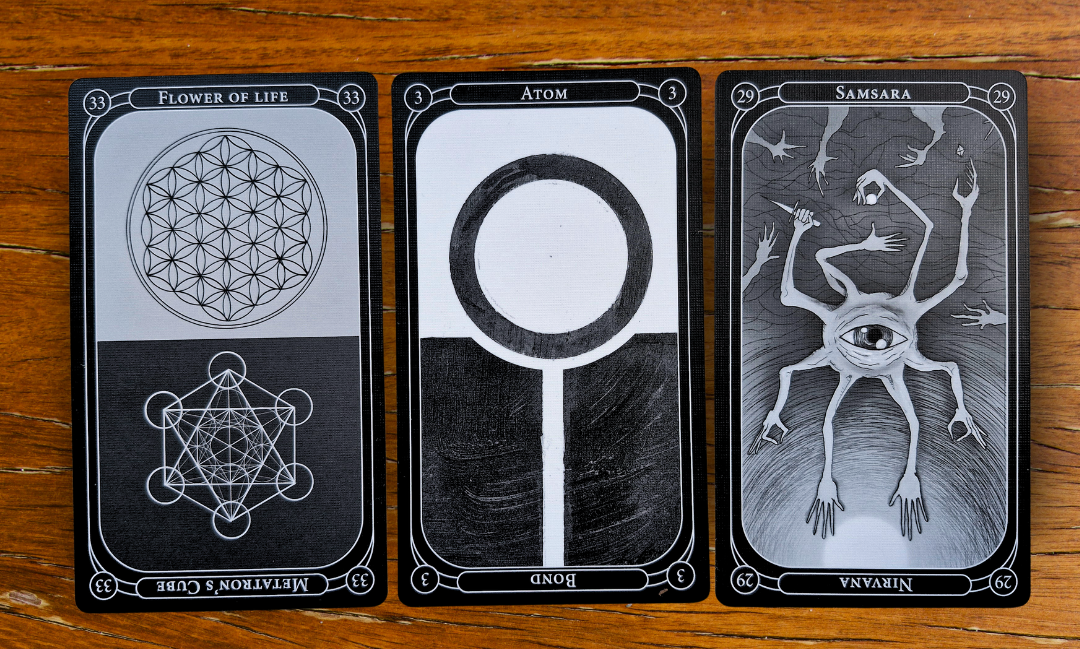
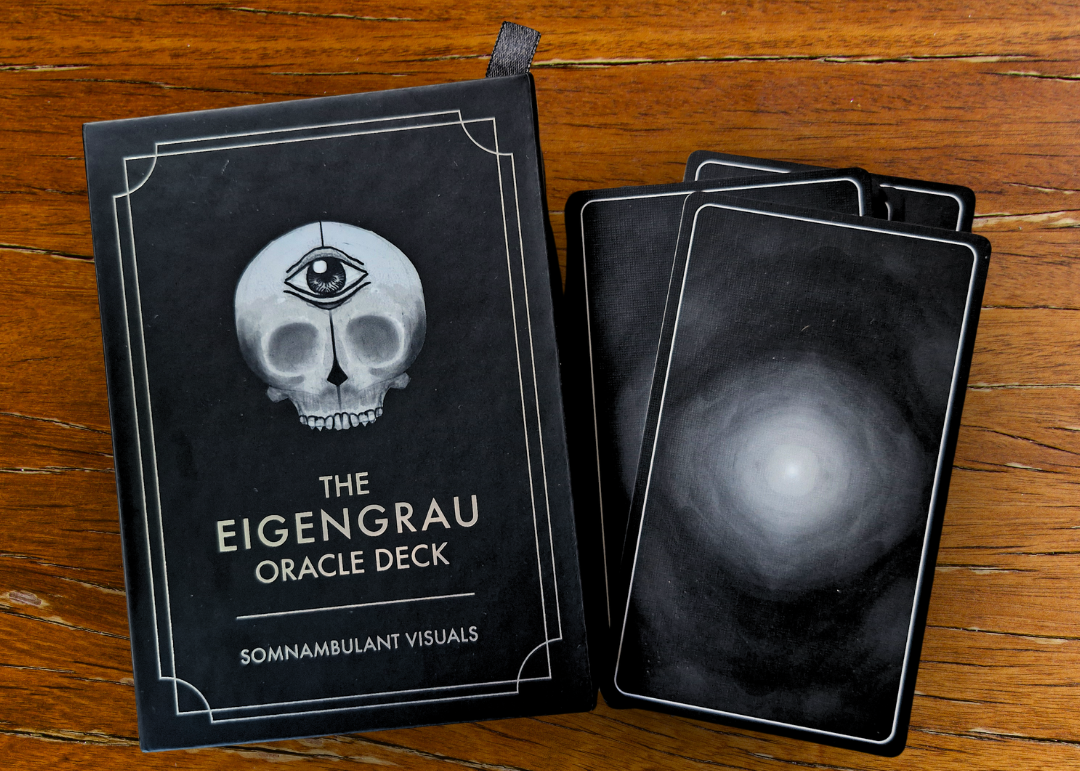
The illustrations are stunning. There is a link at the bottom of this review to Michael Setteducati’s website, and I hope that you will have a look at the cards there – I have included photos here, but because the images are black and white and I don’t have studio lighting, they don’t do the artwork justice. The card weight is perfect for shuffling and the finish is beautiful. The cards come in a box with a magnetic closure and the title and text on the cover is a lightly reflective silver.
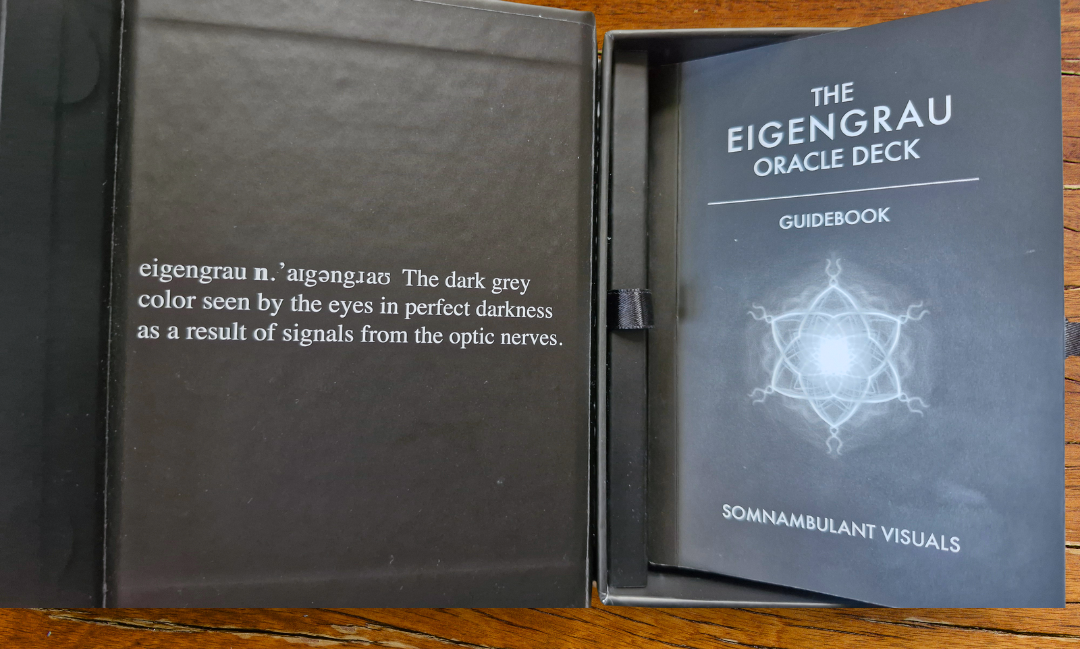
For a deck like this, it’s important that the guidebook clearly explain the principle behind it and how we can use it, which this guidebook does very well. The 11-page introduction also includes suggestions for three different spreads to get us started but also says that the ‘deck is meant to be discovered and interpreted by the viewer. There is no single meaning to each card. There is no wrong meaning to each card.’ Setteducati encourages us to use our intuition – to let the cards speak to us based on our own experience, and what the images and the card titles mean to us.
The Eigengrau Oracle will appeal to Oracle and Tarot readers (it works well in a reading that uses both) who are curious about how we perceive our personal situation in relation to the world around us. These are cards to sit with, to spend time pondering while looking out the window. There are so many ideas for journalling. They are also cards that will inspire you to set off and research entirely new concepts – there is an irrepressible joy in this deck that leads you gently along your path. The Journey and Destination, though, and how you approach them, are entirely up to you.
About the Author/Creator
Michael Setteducati is a visionary artist. His art is meditation, spiritual practice, and praise in equal measure. In his work, he explores the inextricable link between creativity and spirituality. His goal is to enlighten and entertain his audience with compelling visuals and powerful themes. Sette has worked as a graphic designer for over fifteen years, and he has experience in publishing, product design, layout, production design, variable data-based design, social media, motion graphics, animation, and more. https://www.mikesette.com/about
You can see more card images and purchase The Eigengrau Oracle Deck on Etsy: https://www.etsy.com/uk/listing/4376789041/the-eigengrau-oracle-deck?ref=shop_home_feat_1&bes=1&sts=1&logging_key=95c6eb6823c35d721c8c20b350e7d0c2eff911ce%3A4376789041
*“The Game of Black and White” in The Taboo Against Knowing Who You Are by Alan Watts