Deck Review: Tarot Emblemata
- Deck name: Tarot Emblemata: Decoding Magical Symbolism
- Author and artist: Nitasia Roland, foreword by Laetitia Barbier.
- Publisher: Red Wheel Weiser
- Publishing Date: 05-Aug-2025
- RRP: USD 29.95 / GBP 26.99
- ISBN: 978-1-57863-896-3
- Reviewed By: Caitlín Matthews – www.hallowquest.org.uk;
https://substack.com/@caitlinmatthewstigerna
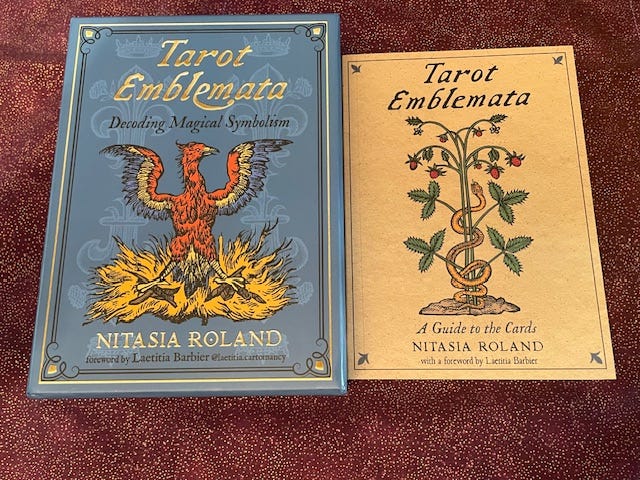
In the wake of the Renaissance, a deeper interest in the encoded wisdom of the ancient world swept through Europe. Turning their backs on the clerical expositions of Christianity in favour of the lore of Classical antiquity, scholars now strove to make its magical symbolism their guide and watchword. Emblem books, showing devices or emblematic drawings, each with a Latin tag, provided a method of deeply considering the meaning and embodiment of the Latin motto. These allegorical designs, which could be both secular and religious, became a very popular way of educating young people, improving their minds and aspirations, as well as providing inspiration for adult readers.
Among the many emblem books that arose at this time, was that of the Frenchman, Claude Paradin (1510-1573). In his Devises Heroïques (1567) he dwelt upon the emblems of the Kings of France and their honourable history, creating a popular mythos that elevated French royalty to celebrity attention, while simultaneously revealing an idealised contemplation of their qualities. These devices were often already associated with the kings in question as heraldic achievements, marks of ownership, or else associated with works and crafts that they had sponsored.
In Tarot Emblemata, Nitasia Roland has taken these devices a step further, drawing upon Paladin’s emblems to create a tarot. She self-confessedly explains how she has arranged the ascription of each device to a tarot card, often drawing upon other Latin tags appearing in the explanatory text of the original emblem book, the better to associate the emblem with the tarot card.
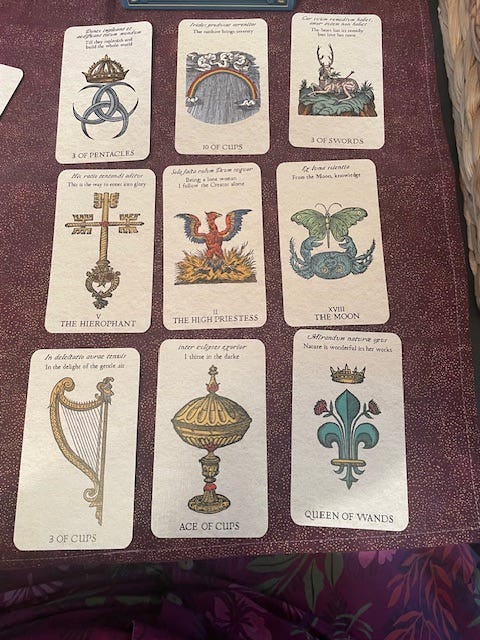
Those who are unacquainted with emblem books might ask, does it work as a tarot? Take the Ace of Wands which depicts a hand issuing from a cloud, holding a flowering branch with the tag, ‘Semine ab aethereo,’ or ‘from the heavenly seed.’ Yes, this a recognizable Ace of Wands and works as such. But when we look at the Chariot, it shows a flaming chariot with much smoke issuing from it, with ‘Qua proceres abiere pii,’ as its motto, or ‘Which way our pious forefathers have gone.’ But the text does no more than hint at the Classical chariot driven by Helios, nor does it speak of the fiery chariot of Elijah, though it does echo the Indo-European concern, stretching from India to Greece and into Ireland, about the necessity for driving your chariot well. The ordinary reader might be bemused by the chariot’s being engulfed in smoke and flames, as indeed might their querent.
Each card is given a page and half of text, but no reversals are suggested, which is a feature of pre-19th century tarots in general. There is no ‘quick consult’ of any card meanings given, and the reader has to read the whole entry to gain understanding.
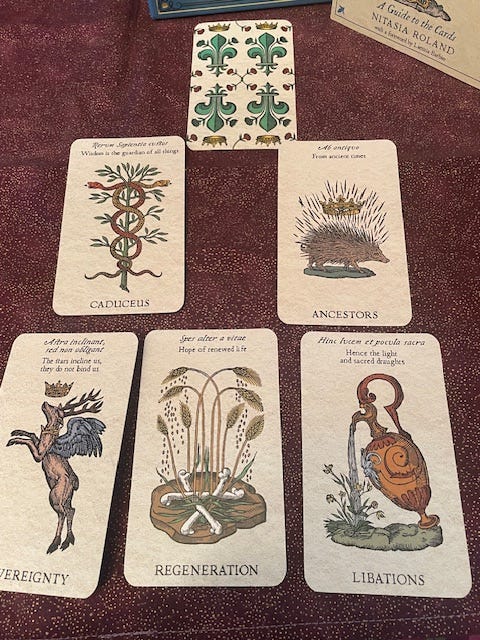
In addition to the 78 cards, there are 5 extra oracle cards, whose powerful images enhance a reading. The quality of the cards is excellently flexible, and the paperback book is well-designed, well bound, and easily consultable for a smaller hand, though the print is small. All in all, this is a tarot that works as such, and which will probably stretch the reader’s reach: a very good thing in an era where everything tarot has tended to become boringly easy and homogenous in style to suit the beginner.
Given that Devises Heroïques with its woodcuts by Bernard Saloman, was published just a hundred years ahead of the Marseilles Tarot, it seems a shame that the tarot tradition to which the author has turned to make her comparisons is the Waite-Smith tarot of 1909, and not any older tarot lying nearer to the emblem book’s original inspiration. France was becoming alive to tarot in the mid-16th century, and the Tarot de Paris (c. 1559) might have furnished a nearer comparison.
Likewise, the three accompanying suggestions for reading are drawn from modern tradition: a three-card spread, a Celtic Cross, and a relationship spread. These might have been the space to explore some older methods of reading that fitted with these august mottos and their often startling emblems, for line reading would work very well with these emblems.
Everything else about the packaging of the tarot is consonant with the 16th century style of Paradin’s work. It just seems a lost opportunity in a work of such scholarly intent.
Nevertheless, I have enjoyed seeing the emblems used in this way, as it is clear that the invention of the printed book and the developments of woodcut block illustrations such as the emblemata, helped to pave the way for tarot to gain a wider reach around Europe.
Tarot Emblemata brings a 16th century powerhouse of images into the 21st century, providing us with ways to extend our divinatory skills in our own time with timeless wisdom.
About the Author:
Nitasia Roland is a writer, digital artist, and independent publisher of esoterica. She has an interdisciplinary master’s degree in English, poetry, printmaking, and design, along with an extensive background in handmade textiles, and book arts. She practices magic/theurgy and divination, and is an avid tarot card reader and astrology enthusiast.
For deck purchases, please follow the link below:
https://redwheelweiser.com/book/tarot-emblemata-9781578638963/