
Deck Review: The Othrysian Tarot
- Designed by: Michael Ezzell (https://mezzell.com/shop/vermilio/othrysian-tarot-deck)
- Published by: Shuffled Ink (USA)
- Published: 2025
- RRP: US$50 (mezzell.com) / GBP£55 (parigotte.com)
- ISBN: n/a
- Review by: Harandayl
One of the advantages of being a tarot de Marseille reader is that I’m not being bankrupted by the plethora of beautiful RWS based tarot decks that are published every year. But when I saw The Othrysian Tarot it was time to blow the dust off the wallet (well, the Paypal account) to purchase this splendid and unusual 78 card tarot deck.
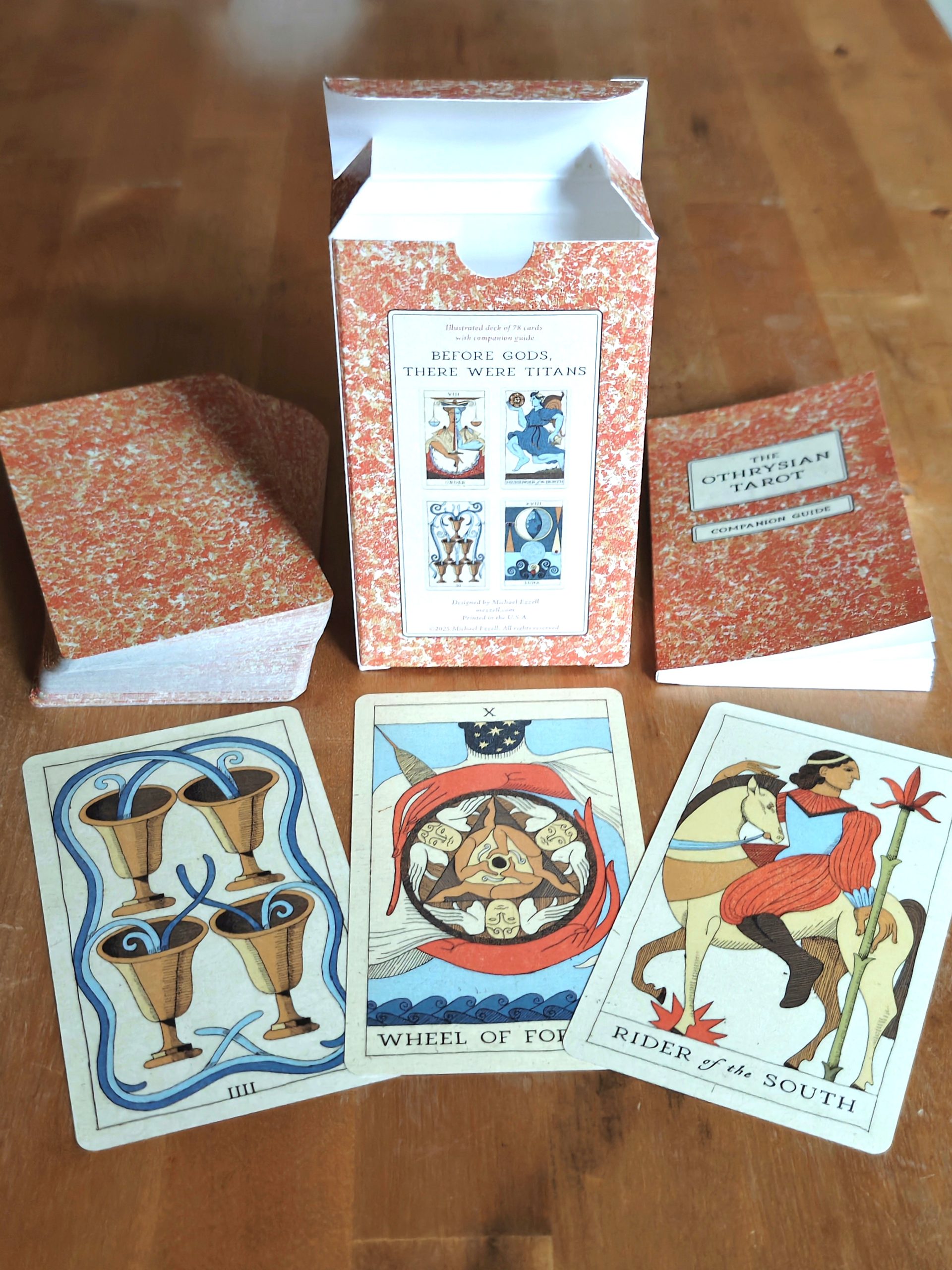
An indie deck created by US based artist and printmaker Michael Ezzell, it uses copperplate etchings to create a vibrant and unique tarot which is very much its own beast. The Othrysian Tarot showcases the pantheon of deities that preceded the Olympians in Greek mythology – the Titans.
Michael Ezzell’s website explains how his art,
… explores esoteric symbolism and mysticism, weaving characters and icons reminiscent of Greek and Roman myths into new narratives and worlds. Ezzell’s work presents a window through time and reality; an escape into realms of fantasy and wonder that mix and merge into one another, inviting us to question what is real and what is make believe.
mezzell.com
The Titan mythology in this deck is featured throughout the major arcana and court cards. The majors are very cleverly reinterpreted with each arcanum depicting a mythological figure but one that fits well with the traditional tarot archetype for that number. Some have the same card title as a traditional tarot deck, such as The Chariot and Strength, most however don’t, for example, Order for Justice and Typhon for The Tower.
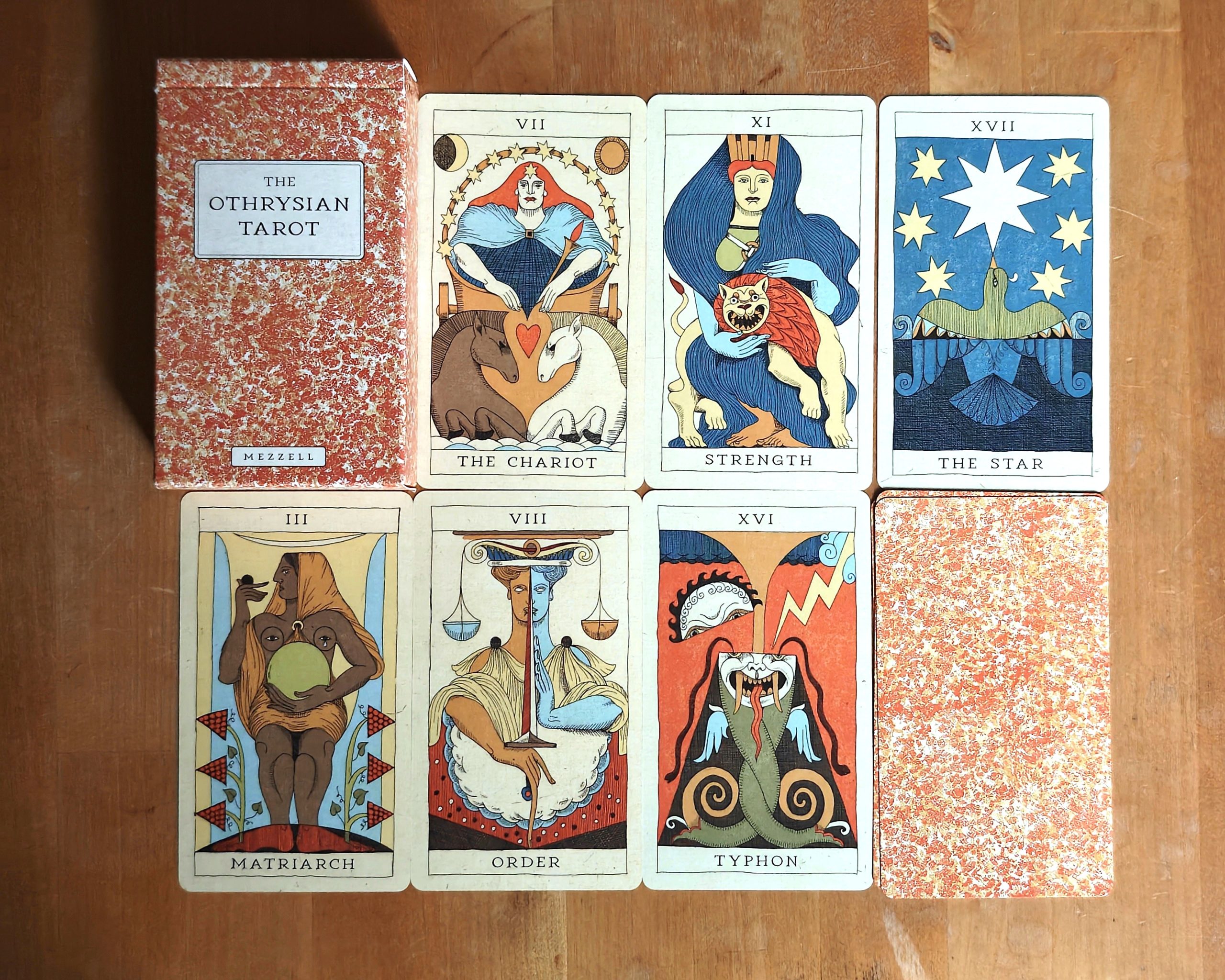
In most major arcana cards the design references traditional tarot imagery and the companion guide explains what you’re looking at so you never feel too far removed from a traditional tarot deck. It’s more that you’re viewing these familiar archetypes through a Titanic lens.
This is not a beginners deck though. The mythological overlay provides a fresh perspective but wouldn’t be an easy introduction to the tarot for a new reader.
Each of the suits corresponds with a cardinal compass direction – Coins (North), Wands (South), Swords (West) and Cups (East), this becomes most explicit in the names of the court cards.
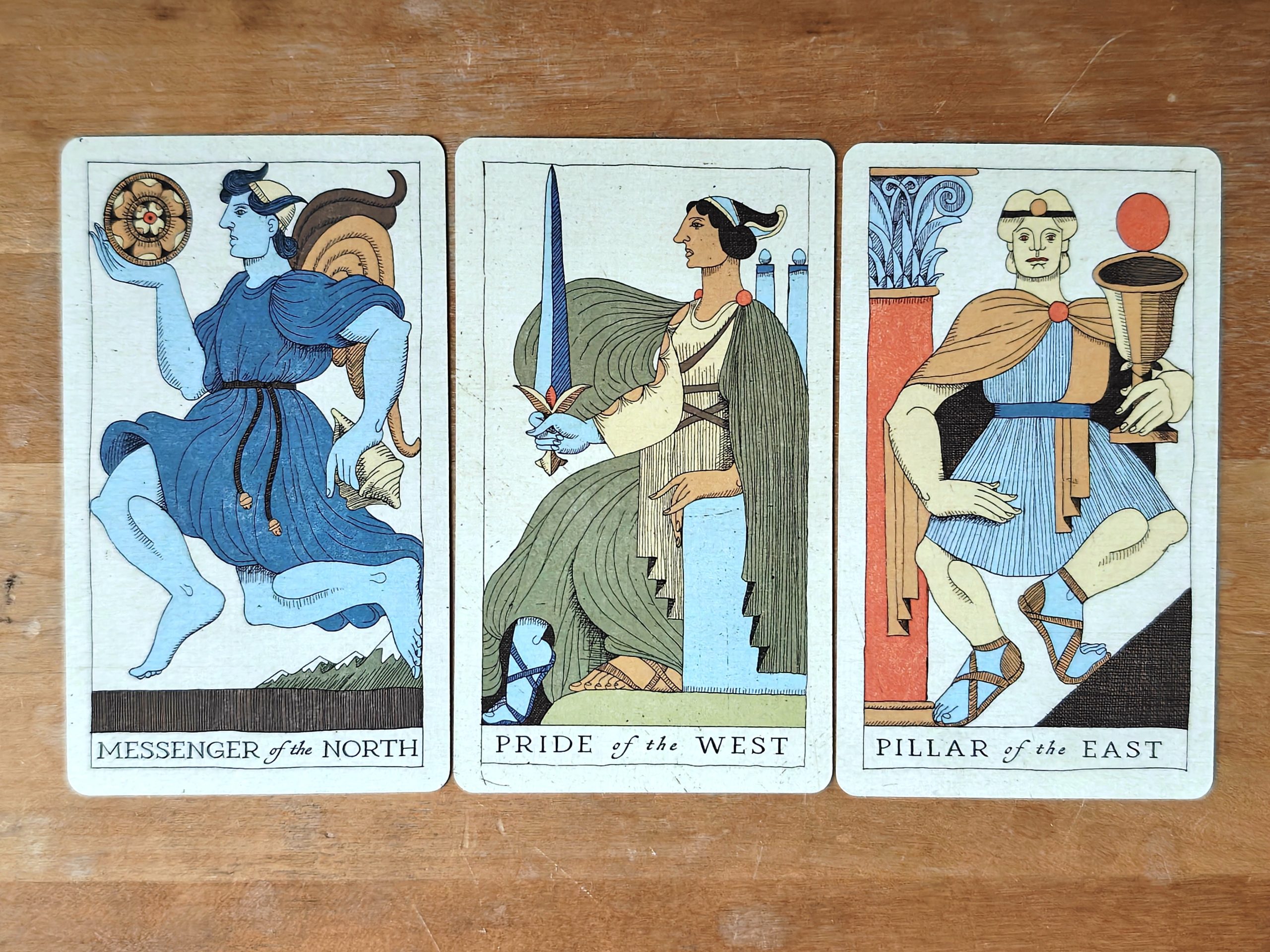
And the approach to the courts is a fascinating one. The pages/valets become ‘Messengers’ and represent the four cardinal winds of Greek myth, so for example the Page of Coins becomes Messenger of the North, Boreas – god of the northern winds.
The Queens are collectively referred to as Vessels with each having a unique title such as Pride of the West (represented as Clymene) who would equate to the Queen of Swords. The Kings are all Pillars of their suit such as Pillar of East (Hyperion) as the King of Cups.
The Knights are ‘Riders’ and, in the deck as it arrives and in the companion guide, they follow after the Kings/Pillars. There’s no explanation as to why this choice was made. Two Riders represent male deities and two female deities.
The copperplate etching technique used creates striking imagery which feels both modern and ancient at the same time. This is helped by a creamy coloured background to the images and a vibrant, but never garish, colour palette.
The guide book describes the structure of the deck as being most similar to the tarot de Marseille and I think I’d agree, although I wouldn’t go as far as calling this a Marseille deck. The etching technique and colouration creates similarities to the tarot de Marseille style. Some artwork in the majors and courts references Marseille equivalents and Order (Justice) is at VIII with Strength at XI. The suits, however, are a tale of two halves.
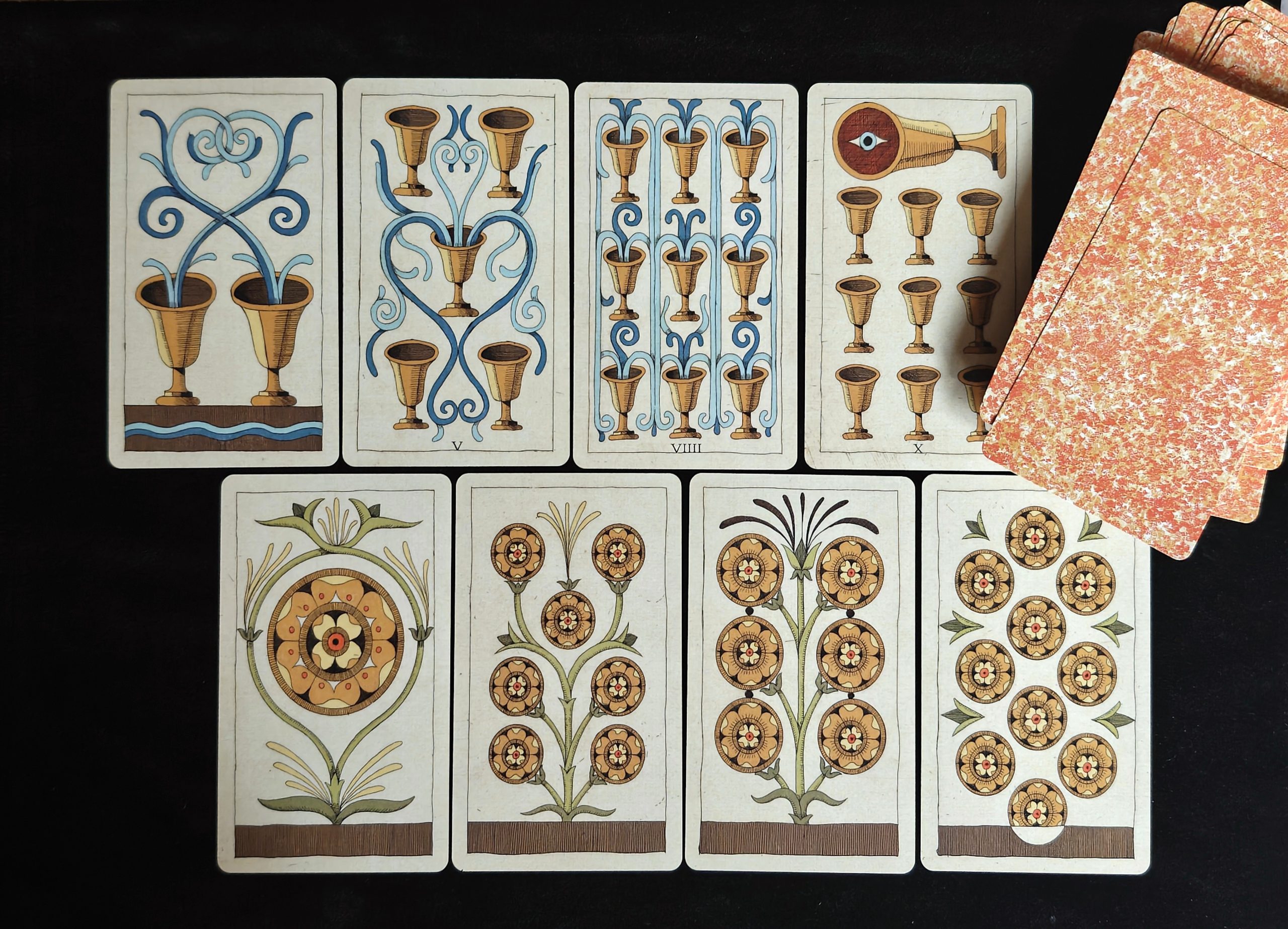
Two of the minor suits – Cups and Coins, follow the Marseille pattern reasonably closely (though certainly not entirely). Swords and Wands, however, differ from Marseille patterns – crossing swords are adorned with ribbons whilst the Wands show designs of interlacing plant growth.
Each suit has its own colour palette and structure. Coins are not numbered, the Cups and Wands have roman numerals at the base whilst the Swords have them at the sides. I appreciate this lack of uniformity which is similar to older Marseille decks where some suits were numbered and others weren’t. Each suit certainly has its own character.
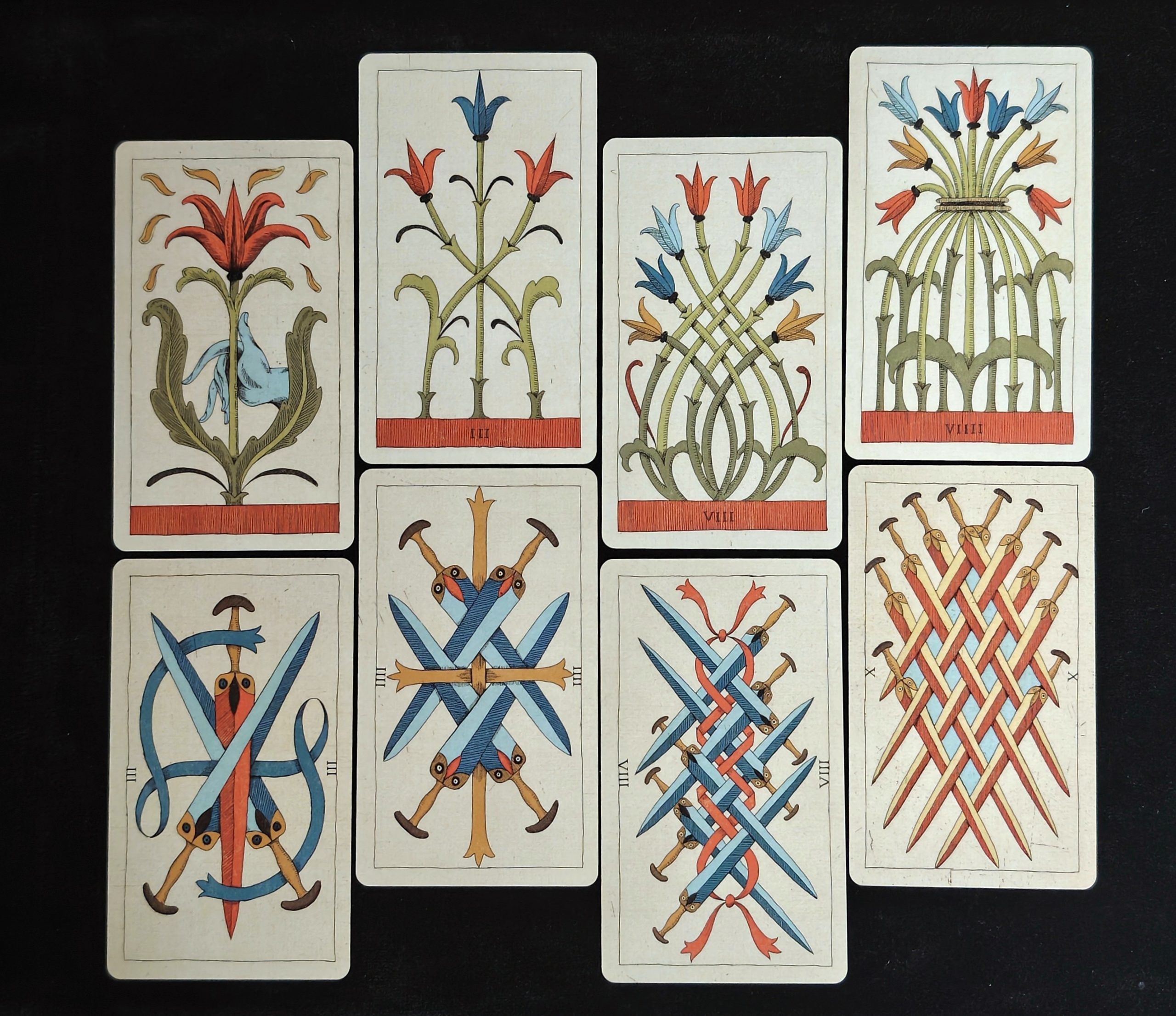
There are patterns and details surrounding the suit symbols which, although very different, provide an equivalent visual experience to traditional tarot de Marseille designs. All in all it means that, whilst not explicitly referencing the mythology that structures the rest of the deck, the pips do not feel like an afterthought. They are well considered, interesting images providing a wealth of intuitive ‘ways in’ beyond number and suit, for those who are familiar with reading non-scenic tarot cards.
This is absolutely a ‘pip deck’ but one which I would say is clearly Marseille influenced.
The cardstock is fine, it’s not thick (310gsm) but has a nice finish which is fairly matte. They are standard tarot card size and easy to shuffle. It’s a solid enough tuck box featuring the same design as the card backs – a mottled orange effect.
There’s one element I’m a little less impressed with – the companion guide. This is very much a traditional little white book (LWB) in size and in simply being text with no images – a page on each of the major arcana, with each pip number getting two pages to cover all four suits. Likewise each court rank gets two pages for all four suits.
Most disappointingly the introduction is just a page. This was where I really wanted more on the approach, techniques used, design choices and mythological context within which the individual deities of each card exist. Of course the mythology is something easily researched separately but one short page just doesn’t feel like enough of an introduction to the deck.
That said, the guide provides information about the figures represented on the cards which is clear and gives enough detail to understand the images.
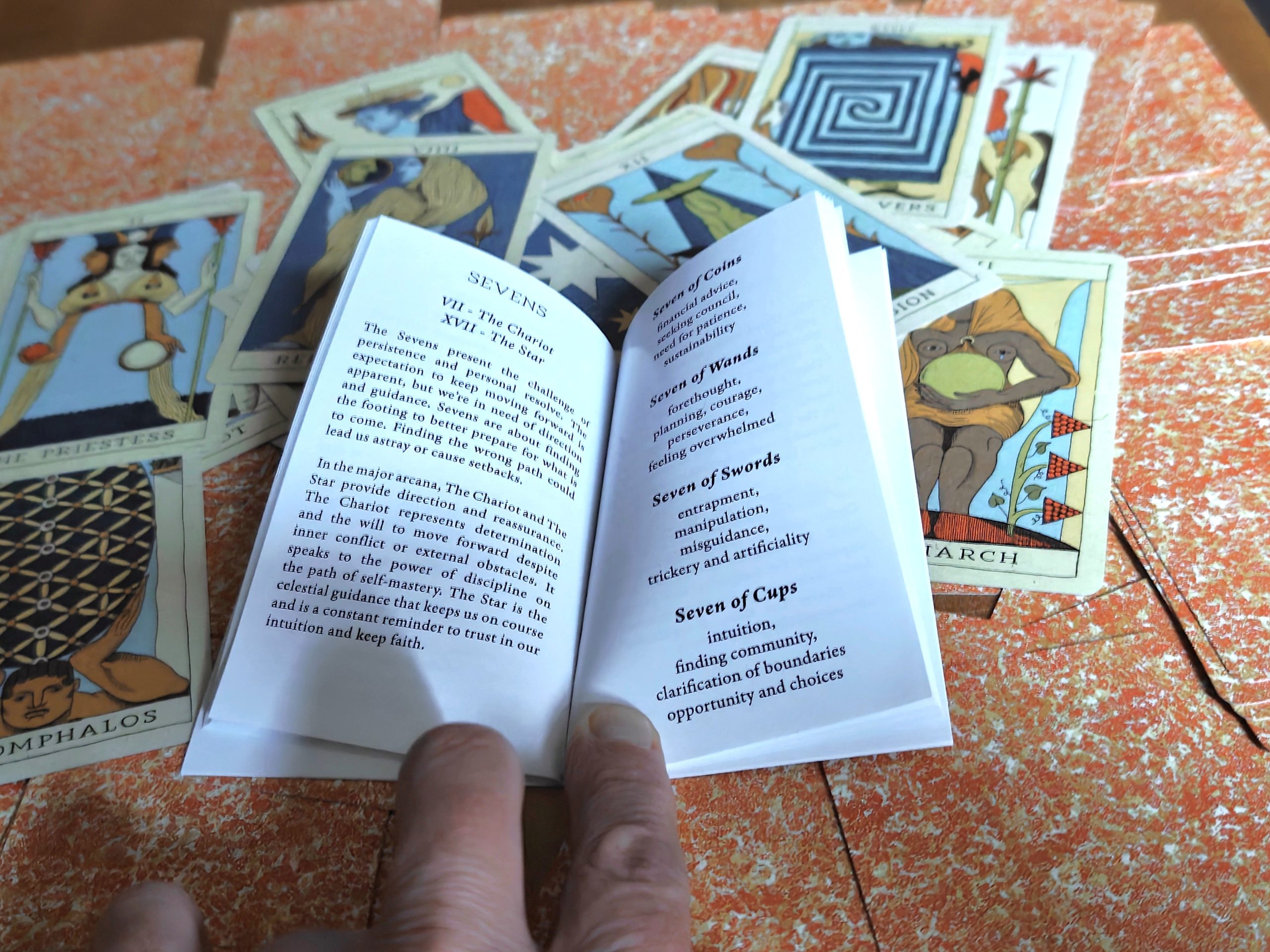
In true LWB style the guide also provides some tarot key words and correspondences. This is basic and often seems quite generic. For those not used to reading pip decks the guide suggests the approach of looking to the majors of each number to build meaning. So, for the sevens it explores The Chariot (VII) and The Star (XVII) together. This is more successful but is very limited before we’re offered more keywords. There are no spreads suggested.
What The Othrysian Tarot does so successfully is to provide a new mythological take on the tarot with engaging and beautiful images across the deck. Its artwork feels authentic and timeless and utilises a pleasing colour palette with intriguing and rich designs that allow for flexible and lively readings.
Minor grumbles about the companion guide aside, this is a wonderful deck which I sincerely hope isn’t overlooked as it’s a ‘pip deck’.
And ‘Othrysian’? Well I had to look that up as the guide doesn’t cover it – Mount Othrys was the base of the Titans (thanks Wikipedia!)
To purchase The Othrysian Tarot, please follow the links below:
https://mezzell.com/shop/vermilio/othrysian-tarot-deck
https://www.parigotte.com/all/the-othrysian-tarot-deck