
- Authors: Peter Mark Adams & Christophe Poncet, convened & with a Foreword by César Pedreros
- Publisher: Scarlet Imprint https://scarletimprint.com/publications/p/two-esoteric-tarots
- Publication Date: 2023
- RRP: GBP £30.00
- ISBN: 978-1-912316-75-5
- Reviewer: Gwen Enstam @goldenpomt on IG
The evidence [Adams] presents unequivocally challenges the notion that the tarot served as a mere game of chance; instead it is an artefact imbued with a magical purpose. It is evident that [the Sola-Busca], dating back to c. 1490, predates the commonly accepted time frame of esoteric use by almost three centuries. (p. ix)
Most students of the Tarot today view its history as a settled issue. We might not even question that the sole origin of Tarot was a game, and look no further than 18th century France for the source of the esoteric correspondences that we now associate with Qabalah. For older decks like the Sola-Busca and the Marseille, then, there was no esoteric connection. They derive from a game called tarrochi, and that’s that.
Not so fast. These ideas, explains Poncet, come to us from a 1996 book, A Wicked Pack of Cards: The Origins of the Occult Tarot by Ronald Decker, Thierry Depaulis, and Michael Dummett:
In their eyes, the esoteric or occult tarot was a mere fantasy of eighteenth-century occultists that had grown to enjoy worldwide success, and from which all of the ‘irrational’ practises associated the deck were derived: fortune-telling, divination, magic, ‘Tarotism’ […] Thereafter, this conception became some sort of untouchable paradigm. (p.24)
The problem with this, as we find out in Two Esoteric Tarots, is that there is evidence of an esoteric connection. And Peter Mark Adams and Christophe Poncet proceed to explain what they have found through their extensive and fascinating research on the 15th-century Sola-Busca and Marseille Tarots.
What if, Poncet postulates, those 18th-century French occultists were able to interpret esoteric illustrations in the Tarot in a way we are no longer able to, because we have simply forgotten the references? What if they, by contrast, had eyes to see? There may have been a leap of imagination involved by those French esotericists, Poncet admits. But if so, it was based on evidence in the cards and would have been understood via a cultural connection that, in the 18th Century, was much more recent than it is for us.
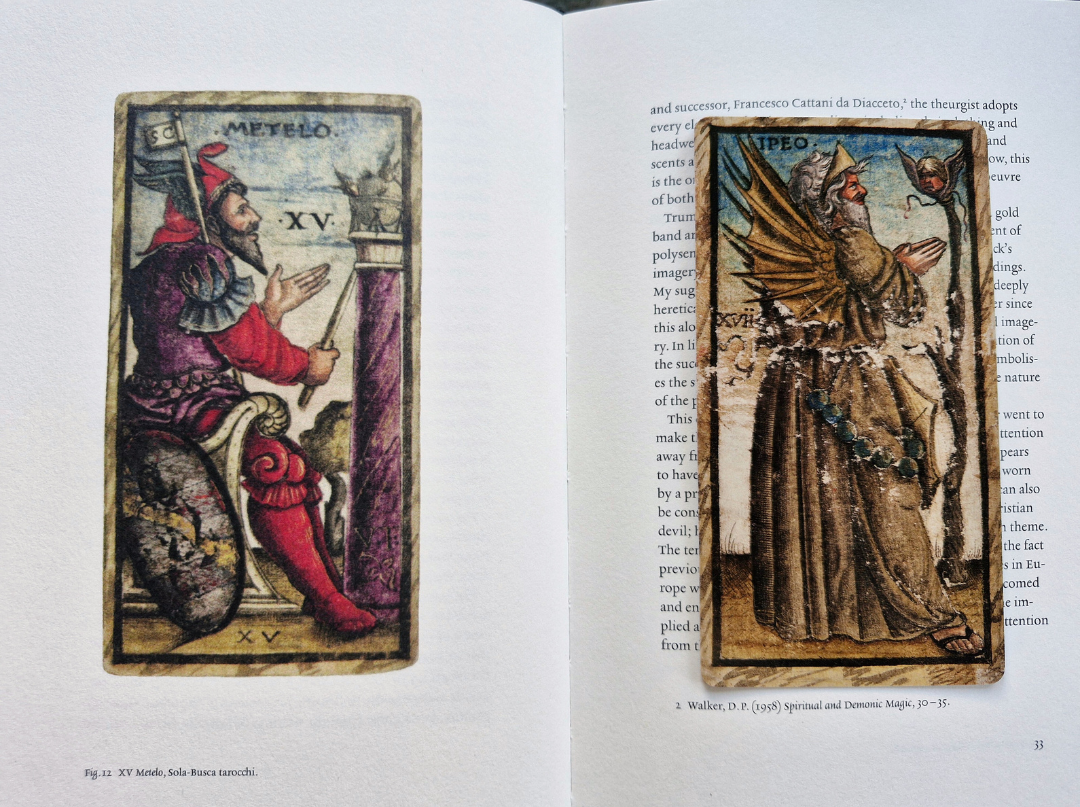
Like Stav Appel’s work on Jewish imagery in the Marseille Tarot, Adams’ and Poncet’s research suggests that the artwork of the Sola-Busca and Marseille conceal esoteric spiritual practice and ritual. For the Sola-Busca, Adams discovered ‘historical, literary, symbolic and performative elements that appeared to have been layered one on top of the other’ (p.27). But for me, the magic appears as what he calls a ‘ritual grammar’. In other words, the poses of the characters of the Sola-Busca demonstrate literal steps of a ritual procedure, and the items that can look so arcane and mysterious are ritual tools that would be familiar to anyone who took part. Adams does explain those rituals … but I will leave that for you to find out for yourself.
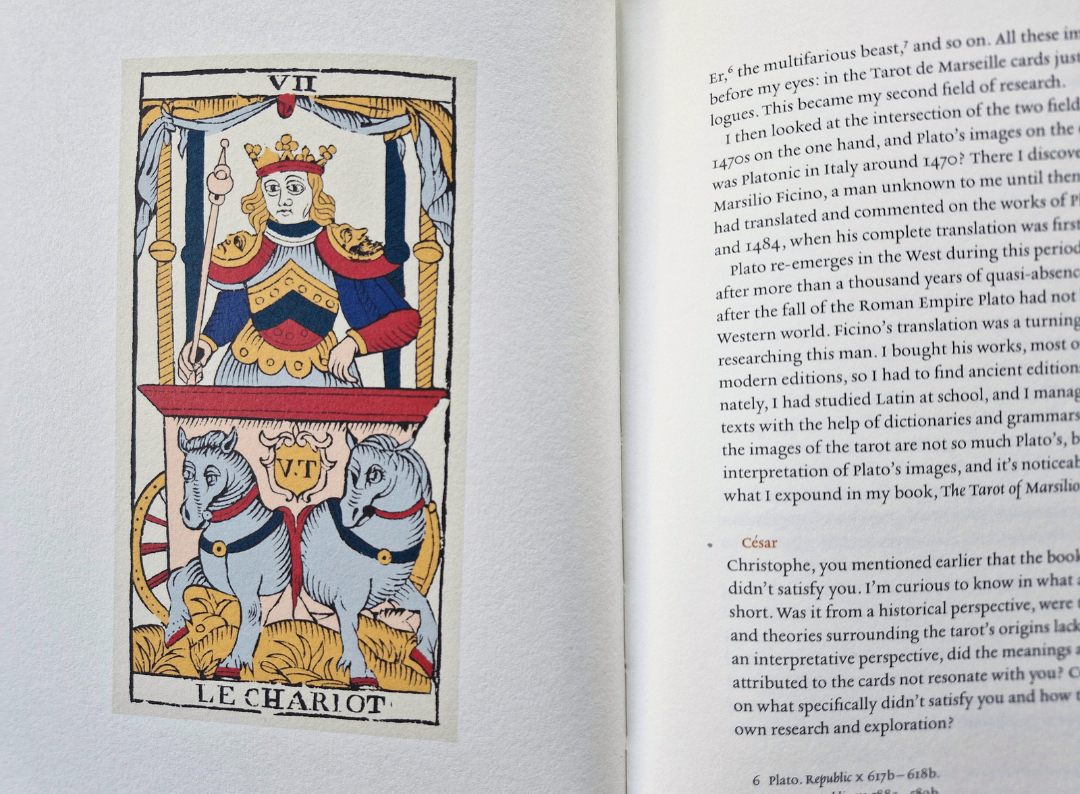
For Poncet, it was his frustration with existing books on the origins of the Tarot de Marseille that prompted him to do his own research. He started by examining and dating the style of clothing depicted in the cards. When he then researched artwork contemporary with that style, he spotted ‘images that had obviously served as direct models for the cards. I am talking about engravings, paintings, drawings, frescoes and miniatures.’ (p.4) But the jewel at the heart of Poncet’s research was a connection to the writings of Plato:
Plato’s chariot of the soul, for instance, is obviously reflected in the Chariot card of the Tarot de Marseille, in a spectacular way. […] I thus identified many Platonic myths and images in the Tarot de Marseille cards: Plato’s cave, the divine procession of the Myth of Er, the multifarious beast, and so on. (p.4, 9)
Two Esoteric Tarots revolves around the Sola-Busca and the Tarot de Marseille, but we know that no tarot deck exists in isolation. We also know that both decks are antecedents of the Rider Waite Smith (RWS) tarot. So, for me, as someone who reads primarily within the RWS system, while I absolutely loved learning about the Sola-Busca and Marseille, Two Esoteric Tarots was not purely an academic pleasure. One section, in particular, has really stayed with me and inspired my own inquiries: a discussion of the headwear in the Sola-Busca and Marseille.
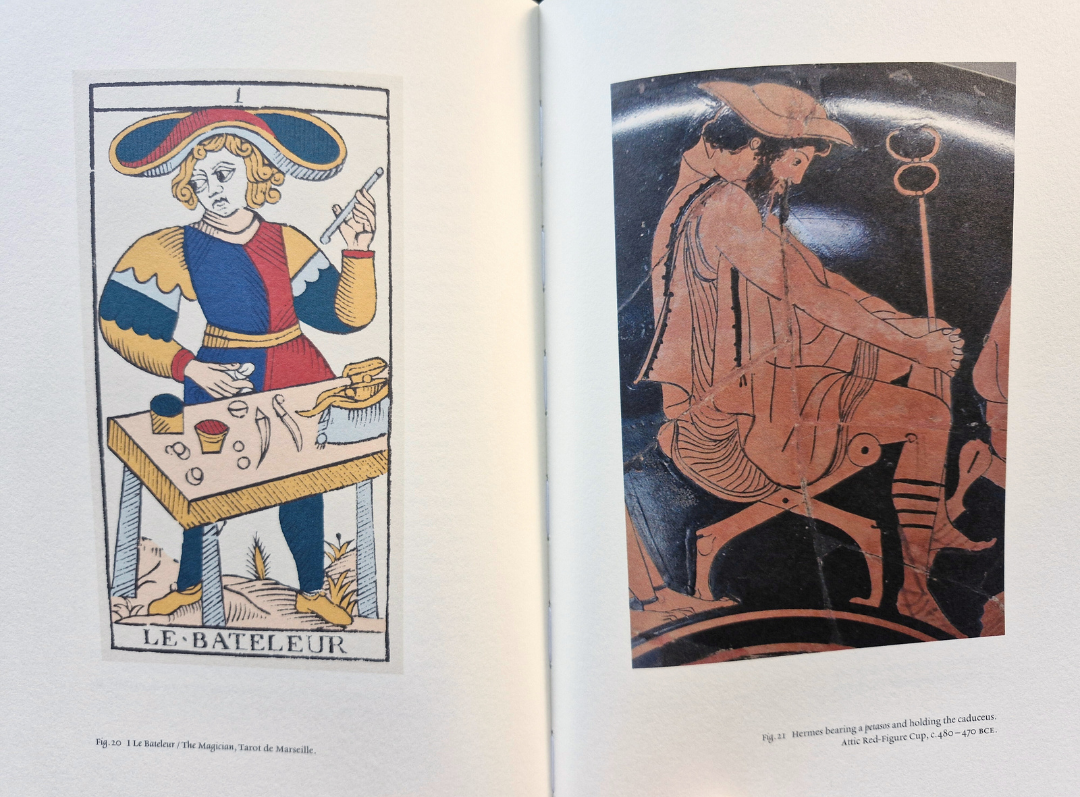
The RWS Magician has a lemniscate over his head, and we might notice that the brim of the hat of le Bateleur in the Marseille has a distinctive lemniscate shape. We know le Bateleur came first, so if we decode his hat, does it tell us something about the later RWS Magician, if we see his lemniscate as an abstracted hat? Definitely:
In the Magician card the conjuror has a flat wide-brimmed hat […] it is the typical hat of the pagan god Mercury, the petasos, and like him, the character also holds a wand. (p.81)
If you are familiar with the esoteric background of The Magician, you can confirm his association with Mercury. But you might also be thinking, Wait – there is a lemniscate over the head of the woman in Strength, too, and a similar hat to that of le Bateleur in la Force. Does this suggest the presence of Mercury in Strength/la Force? And does it mean there is a deeper relationship between The Magician/Bateleur and Strength/Force? Without straying too far into speculation and the wilds of alchemical esoterica, I would argue that it does (although Poncet emphasises a different meaning in la Force’s hat). Something to mull over, for sure. You see what I mean when I say that what we learn in Two Esoteric Tarots applies to so much more than the two decks that are discussed within it.
AE Waite had his reasons for concealing the esoteric meaning of his cards, but why did the creators* of the Sola-Busca and Marseille tarots disguise ritual and spiritual practice so thoroughly in their artwork? Again, we look to historical context. The practices these decks conceal revolve around the concept of gnosis, or self-liberation, i.e. you don’t need an intercessor to communicate with the Divine for you, which in turn means you don’t need the Church. We can imagine what the Church would think of that. Gnosticism was a recognised heresy, and the Spanish Inquisition started around 1478. It’s easy to see why it was necessary to conceal these ideas if we want to share them and survive. After all, what could be more innocuous than a simple set of playing cards? Hiding in plain sight from those who don’t have the eyes to see …
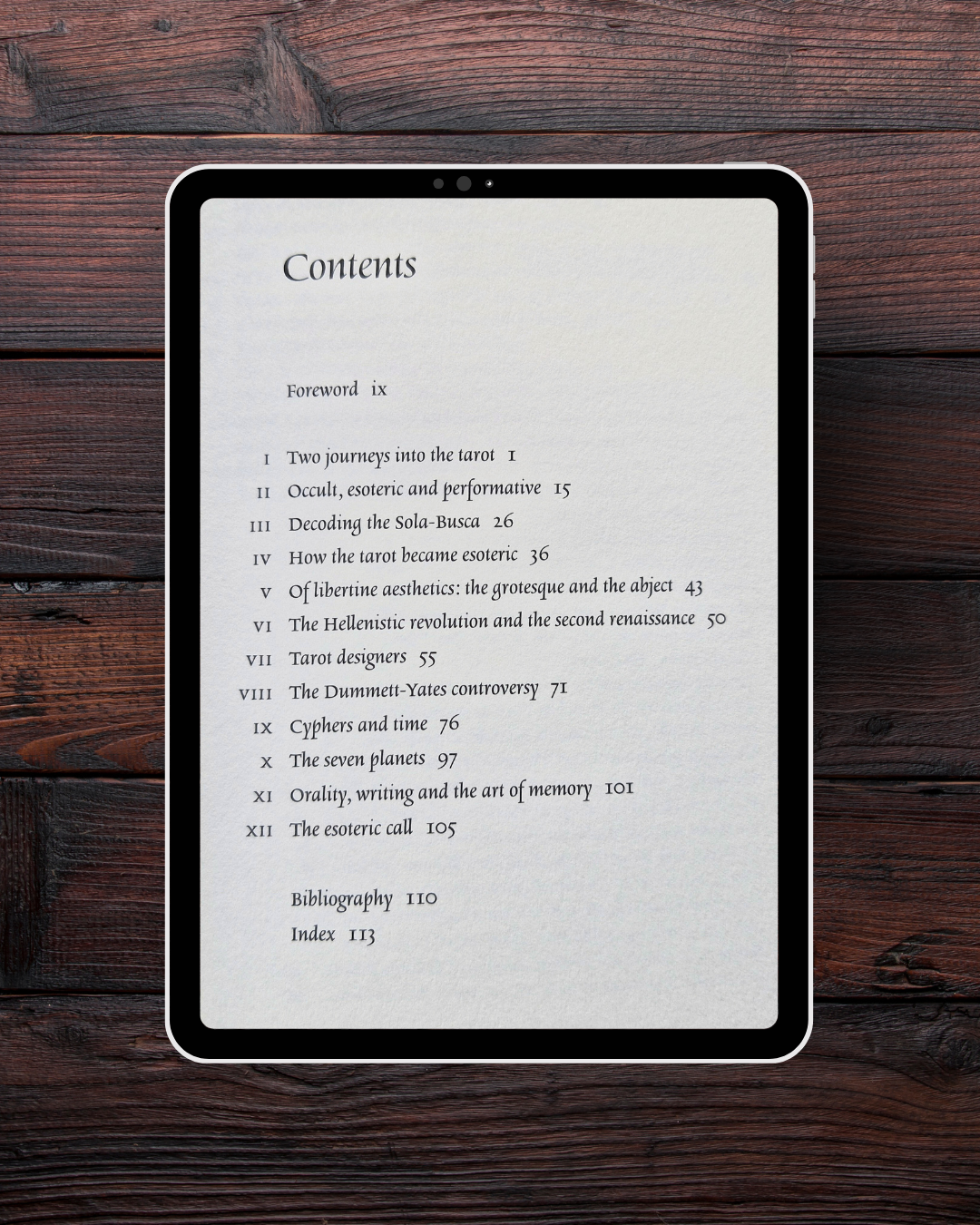
Two Esoteric Tarots is structured as a conversation between Peter Mark Adams and Christophe Poncet, moderated by Cesar Pedreros. I am not a fan of epistolary novels and initially I was worried the book would read like one, but Two Esoteric Tarots is not like that at all. It is consistently animated and engaging, and in the best esoteric tradition, the interaction between all three of the speakers brings out new revelations – in the Sola-Busca and the Marseille, and in Tarot more generally.
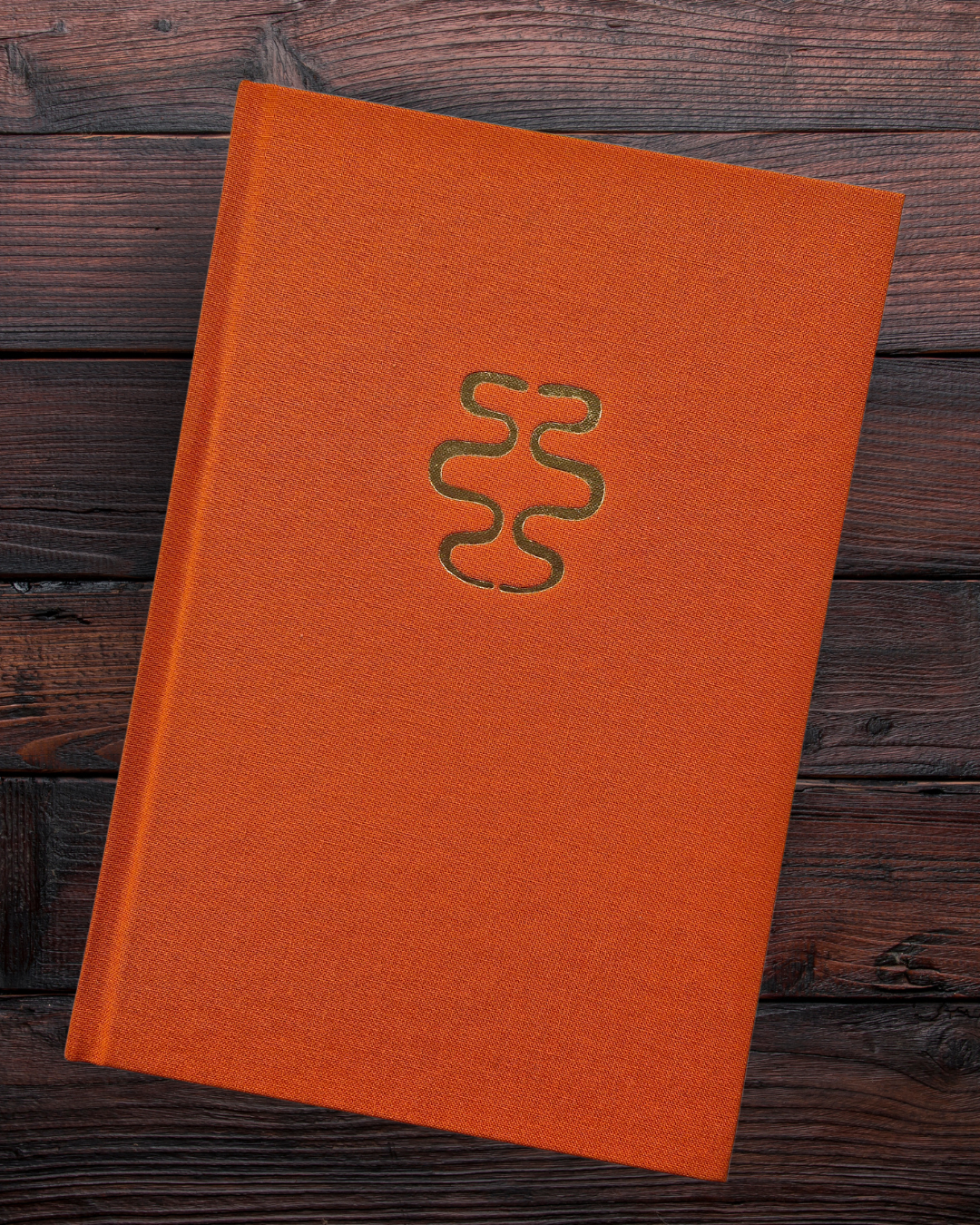
The book itself is gorgeous – it is simply a work of art. It is a 108-page hardback bound in a rich orange fabric with a gold foil stamp of two serpents (serpens sciendi, or ‘serpents of knowledge’) on the cover, and I don’t believe I have ever owned a book made with paper this luxurious. It is a joy to hold it and turn its pages. The illustrations are full-colour and of such superior quality that, as you can see in my picture of two Sola-Busca cards above, there is almost no difference between the printed images and the real cards. Even the typeface is beautiful. What a pleasure to engage with such a masterpiece, and I know I’ll be referring back to it (and all my sticky notes) again and again.
*Adams and Poncet do tell us the creators of these decks, but I’m not going to tell you. Sorry.



0 Comments