Book Review: Tarot Magic for the Reality Hacker: Divination in the Modern World
- Author: Ari Freeman
- Publisher: Aeon Books
- Published: November 2025
- Cover: Paperback (152mm × 229mm)
- RRP: GB£19.99
- ISBN: 9781801521963
- Reviewed by: Marco Visconti
Author Background: The Wizard of New Zealand
Ari Freeman isn’t just another occult author, since he holds the curious title of “Wizard of New Zealand,” a role he inherited from his mentor, the country’s original Official Wizard. Freeman spent seven years (2014–2021) as the apprentice to Ian Brackenbury Channell (the notorious Wizard of Christchurch appointed by the Prime Minister in 1990), learning the arts of public wizardry through lively street-side debates on philosophy, politics, and magic.
What does it mean to be a Wizard of New Zealand? In Channell’s case, it meant embracing a flamboyant, contrarian persona with an ultra-libertarian, anti-establishment worldview (he once avoided the national census, declaring “I am not a real person and I don’t want to be counted by the Government”). This ethos often veered into reactionary territory, as in later years the elder Wizard made divisive public comments about women and drag-queen storytime events. Freeman eventually distanced himself from his mentor over those controversies, but the very fact that he stepped into the wizard’s robes signals a similar anti-authoritarian streak. Some readers may shrug at an author’s personal ideology, but I believe it’s worth noting in today’s climate. Knowing that Tarot Magic for the Reality Hacker is written by New Zealand’s self-styled Wizard, steeped in a lineage of anarchic, free-thinking magic (which often ends with a hint of far-right flirtation), provides a telling context for the book’s perspectives.
What’s Inside Tarot Magic for the Reality Hacker
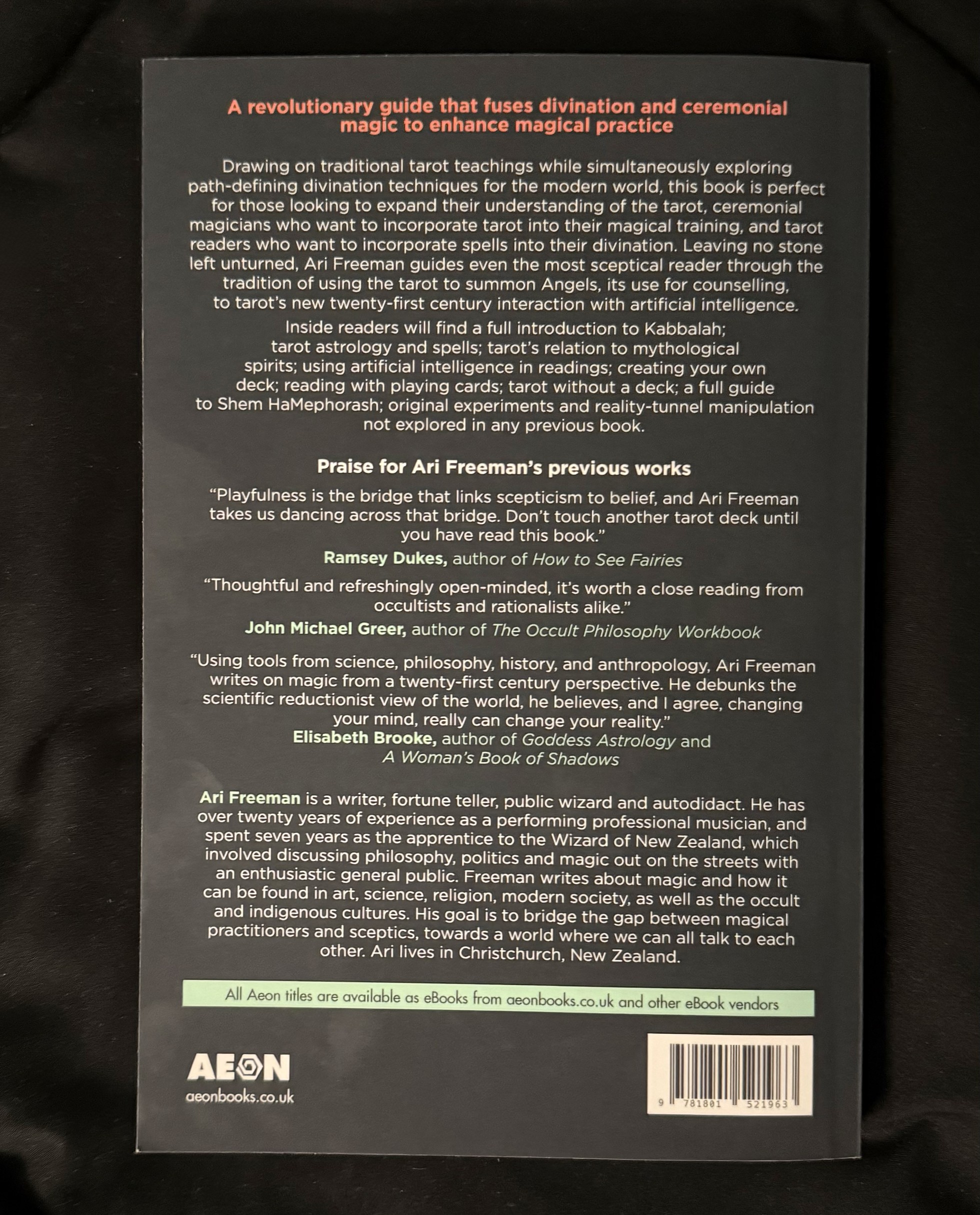
Freeman’s book is billed as “a revolutionary guide that fuses divination and ceremonial magic to enhance magical practice”. In essence, it’s an ambitious attempt to bridge traditional tarot teachings with modern, tech-era techniques – hence the subtitle Divination in the Modern World. According to the publisher’s blurb, the author draws on classical Tarot lore while “simultaneously exploring path-defining divination techniques for the modern world,” aiming to serve multiple audiences: tarot enthusiasts looking to deepen their practice, ceremonial magicians integrating Tarot into their training, and casual readers who want to add spellcraft to their tarot readings. Freeman promises to leave “no stone left unturned,” guiding even skeptical readers through everything from using Tarot cards to summon angels or for counselling sessions, to Tarot’s new 21st-century interaction with Artificial Intelligence. In fact, Tarot Magic for the Reality Hacker positions itself as a practical survey of five centuries of Tarot usage and an analysis of where Tarot is headed in the future, an ambitious scope for a single volume under 300 pages.
Inside, readers will find: a whirlwind tour of nearly every topic at the intersection of Tarot and magic. The table of contents spans from summoning angels with the flip of a card to querying ChatGPT for tarot insights, and everything in between; Freeman indeed throws in the kitchen sink. The breadth is impressive, but it’s also a signal of what kind of book this is: a compendium that skims across numerous esoteric subjects. Notably, the much-touted “original experiments” are essentially the author’s own unverified personal gnosis presented as novel techniques; a reminder that these are subjective ideas rather than time-tested tradition.
Ambitious Scope, Shallow Depth
At 298 pages (including appendices and index), Tarot Magic for the Reality Hacker has the unenviable task of covering a lot of ground in limited space. As one might expect, it often reads more like an introductory survey than a groundbreaking deep dive. Freeman touches on almost every buzzword in contemporary occultism (Kabbalah, astrology, mythic archetypes, AI), but each topic is handled briskly and at a surface level. The result feels a bit like reading a well-organised Wikipedia summary of Tarot and Western esoteric trivia, rather than a cohesive manual with new insights. This isn’t to say the book is bad. On the contrary, Freeman’s writing is clear and accessible, and he provides a decent jumping-off point for newbies to explore these concepts. It’s just that for anyone beyond the novice level, the content will likely feel overly familiar and underwhelming. The back-cover blurb may hail the guide as “revolutionary,” but in practice, it’s more evolutionary by repackaging known material in a shiny new wrapper.
That shiny wrapper, notably, has the distinct gloss of what I’d call an “occult influencer” approach. In recent years, social media magic gurus have proliferated, often offering wide-ranging but shallow content to lure in followers. Freeman’s approach in Reality Hacker is reminiscent of this trend. He covers everything (ensuring broad appeal), peppers the text with buzzy concepts like “reality tunnels” and tech integrations, and even includes personal anecdotes and experiments to brand his unique angle. It’s an engaging formula, but one that also tends to prioritise quantity over the quality of insight. This makes sense when you consider Freeman’s influences: in the preface, he even thanks Marcus Mattern – a modern Golden Dawn-style magician known for his meteoric rise on Facebook and slick online courses – for his “magical advice”. Mattern is emblematic of the new wave of instant occult “gurus” who excel at marketing. Seeing his name pop up in Freeman’s acknowledgements was, for me, a telling hint of the book’s flavour: energetically marketed esoterica with a somewhat commercial, catch-all vibe. As a reader who values vetting our sources, I found this revealing, perhaps even a subtle red flag that the work might prioritise flash over substance. Your mileage may vary, of course; if you’re less jaded about the occult influencer scene, you might simply appreciate the book’s modern, inclusive take. But those of us who’ve seen this “Magick 101, now with AI!” playbook before will recognise the pattern.
Cover Art: A Blast from the Past
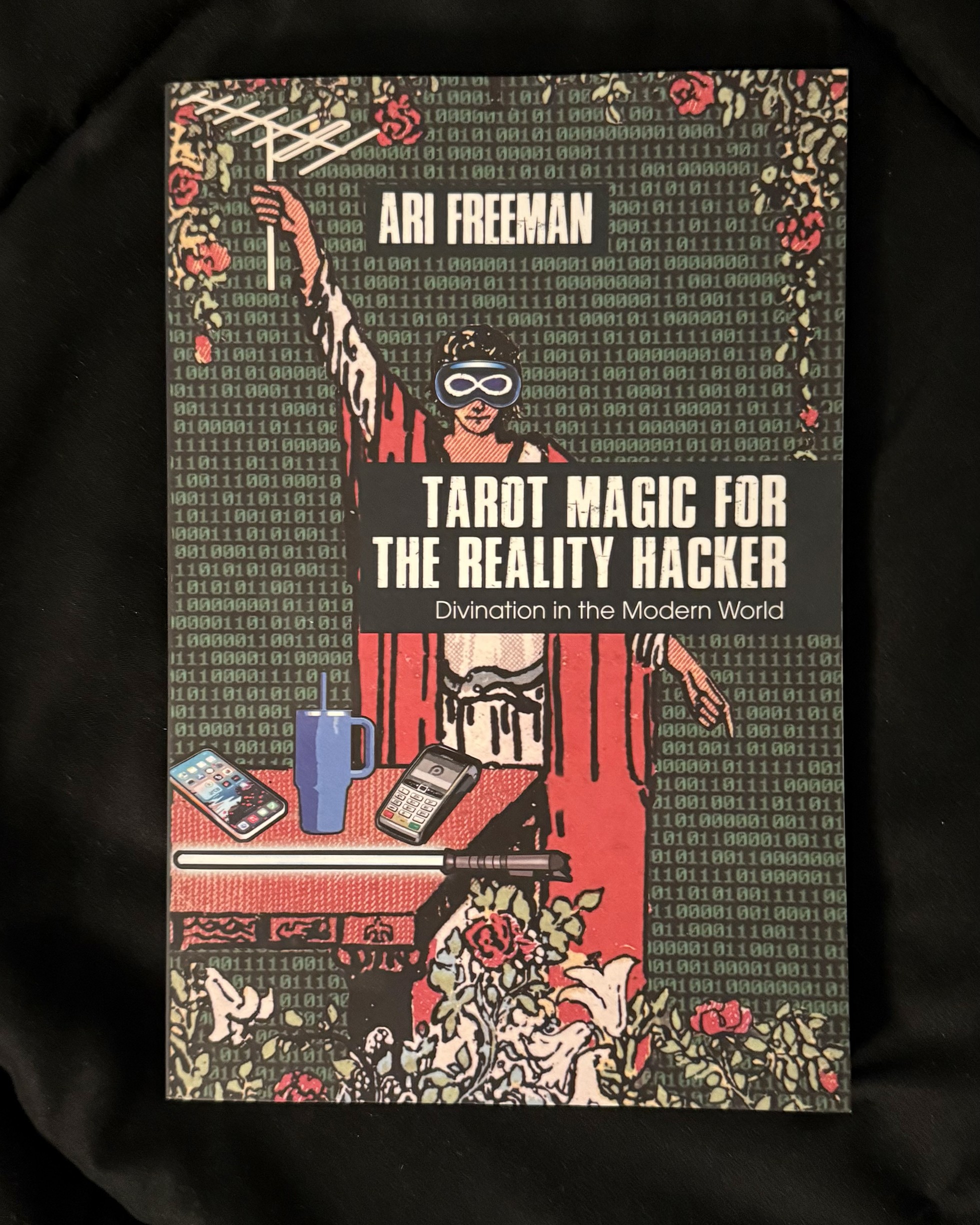
Special mention must go to the cover art, and not necessarily for praise. The design depicts a kind of “Techno-Magus”: the classic Tarot Magician re-imagined with circuit-like background patterns and modern gadgets on the altar. In theory, it’s a clever visual metaphor for merging old-school magic with 21st-century tech. In practice, the execution feels like a time warp to the late 1990s/early 2000s. With its neon-glow digital text and a protagonist that wouldn’t look out of place as someone’s MySpace profile picture circa 2003, the cover comes off as unintentionally retro. It’s almost nostalgic, as one could easily imagine this artwork adorning a trance CD or a GeoCities occult webpage from two decades ago. While looks aren’t everything, the dated aesthetic does reinforce the impression that Tarot Magic for the Reality Hacker might have missed the cutting edge of today’s occult discourse. The world of Tarot and magick has evolved significantly in the last twenty years (we’re in a postmodern, post-“Tradition vs. Chaos Magick” landscape now), and the cover design inadvertently signals a book that’s a step behind the current curve.
Verdict
In the end, Tarot Magic for the Reality Hacker is not a terrible book, but it’s actually a serviceable primer if you have little to no knowledge of Tarot, Qabalah, or ceremonial magic. Freeman’s enthusiasm for tying Tarot to just about everything is genuine, and a reader new to these arts could learn a fair few tidbits across the spectrum. If you treat it as an entry-level handbook (almost a sampling platter of occult topics), it succeeds in providing scope and spark. However, it’s hardly the trailblazing tome that the promotional blurbs would have you believe. Despite the grand claims of revolutionising one’s magical practice, the book mostly reiterates well-trodden teachings and personal theories (UPG) in a slick package. Experienced practitioners or those already versed in Tarot lore will likely find themselves skimming familiar material and yearning for deeper analysis that never comes. To put it simply, this book feels like it arrived about twenty years too late to be truly impactful. It might light a spark for a newcomer, but for the community at large, the conversation around Tarot and magic has already moved on. Tarot Magic for the Reality Hacker ends up a competent compendium with a catchy title, rather than the groundbreaking reality hack it aspires to be. It’s an okay addition to a magic bookshelf; just don’t expect it to reveal secrets you couldn’t have found with a few Google searches and a trip to Wikipedia.
Verdict: 2.5/5 – Perfectly fine as a modern Tarot 101 sampler, but not the game-changer it markets itself to be. Veteran magicians may want to seek their cutting-edge insights elsewhere.
To purchase the book, please visit:
https://spirit.aeonbooks.co.uk/product/tarot-magic-for-the-reality-hacker/95377
About the author
Ari Freeman writes about magic and how it can be found in many aspects of culture and society. He has over 20 years experience as a professional musician, and spent 7 years as the apprentice to the Wizard of New Zealand. He lives in Christchurch, New Zealand.


