Blog Post: The Tarot Exhibition in Bergamo – history, beauty… and a few raised eyebrows
https://lacarrara.it/mostra/tarocchi-2026
On 27 March 2026, I had the opportunity to visit a remarkable exhibition titled: Tarot: Origins, Cards, Fortunes at the Accademia Carrara in Bergamo, Italy. This is, without question, one of the most impressive Tarot exhibitions I have attended.
First of all, the scale. It takes over an entire wing of the gallery and is far more extensive than I expected. You think you’ll “just have a look”… and three hours later, you’re still there.
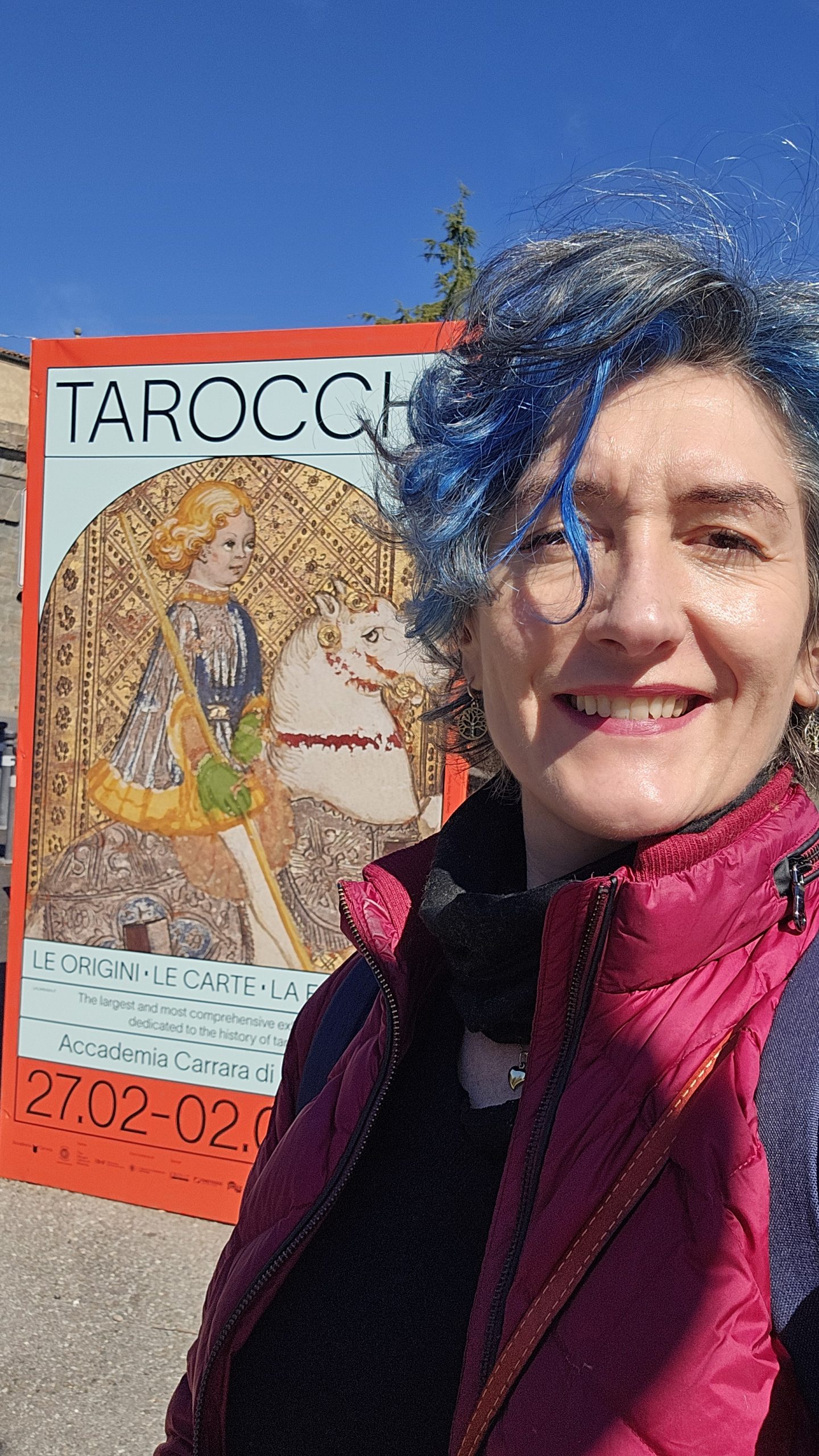
The main attraction is the famous 15th-century Colleoni deck, better known as the Visconti-Sforza Tarot. For the first time in over a century, it has been brought together almost in its entirety. Normally, the cards are scattered across three locations: some in Bergamo, over 30 in the Morgan Library in New York, and the rest in a private Italian collection. The fact that they’ve been reunited at all feels like a small miracle. “Almost” complete, because four cards are missing — including the Devil and the Tower from the Major Arcana. Apparently (and slightly mysteriously), in all tarot decks commissioned by the Visconti family, the Devil card is consistently absent – something that seems unlikely to be accidental.
From game to symbol
What makes this exhibition so engaging is that it doesn’t just focus on one deck. It offers a wide-ranging narrative of Tarot’s evolution – from its origins in the 15th century to its role in contemporary art.
The opening rooms take us back to Renaissance Italy, where tarocchi was simply a courtly pastime. This context is brought to life through additional displays of early games and recreational objects. One of the most fascinating discoveries for me was a set of 52 large German cards predating the Visconti-Sforza deck. Instead of familiar suits, they feature animals — such as a Three of Deer or a Six of Falcons (see image) — often set within hunting scenes. Even more interestingly, they weren’t really used for playing. They seem to have served a more decorative than practical purpose, described as “a metaphor for an ideal harmony between mankind and nature.”
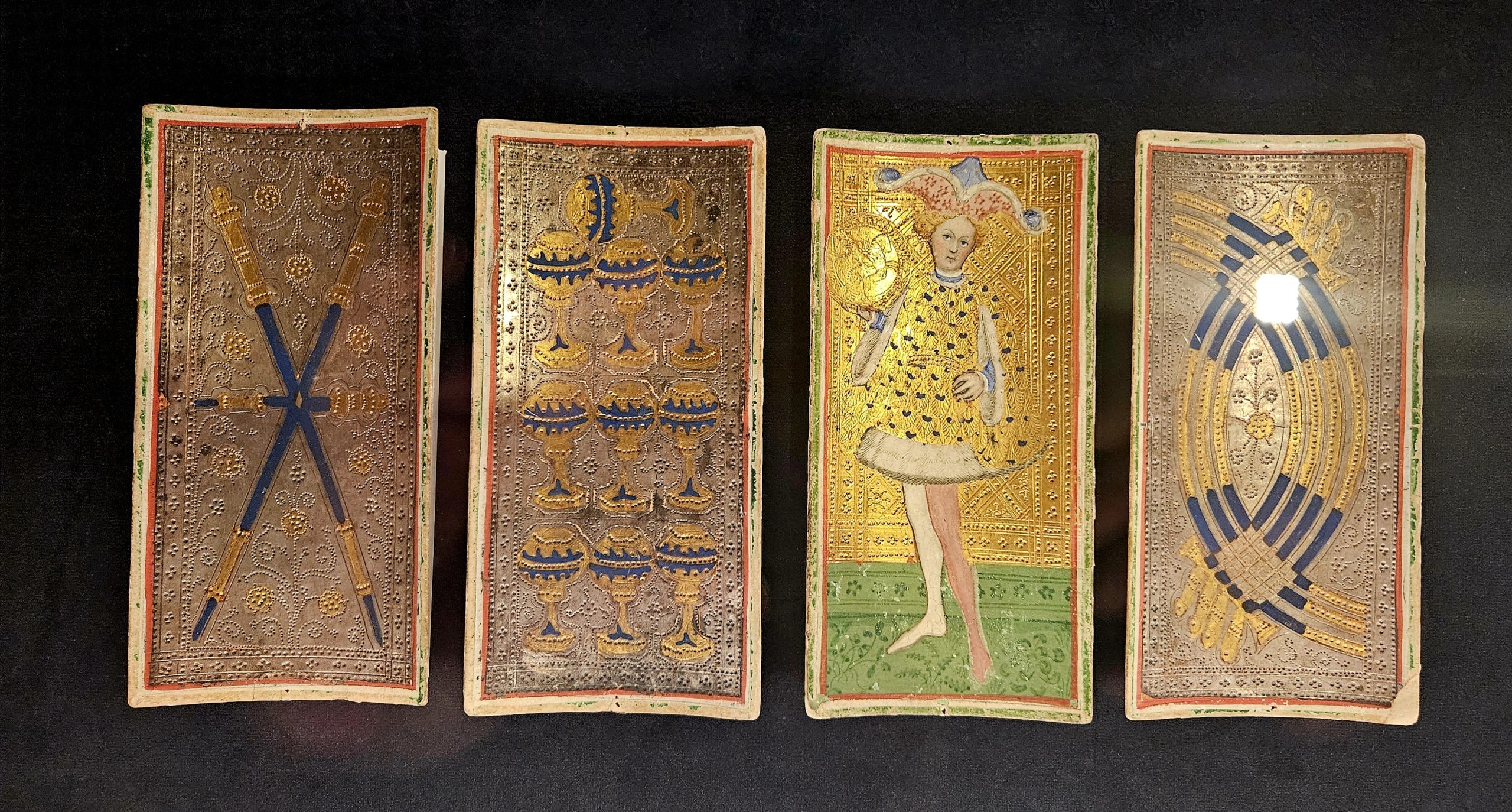
Which naturally raises the question: could the Visconti-Sforza deck itself – have been intended as much for display and contemplation as for play? Its large size and lavish craftsmanship – including gold detailing and hand-painted imagery – certainly support this possibility.
From Esoterism to Surrealism
The exhibition then moves into a chronological journey through later developments, with decks from the 16th and 17th centuries, including those from the Bergamo region.
The Marseille Tarot, often attributed to Nicolas Conver, is also prominently featured. And this is where things get quietly entertaining. The curators make a point of emphasising that, despite its strong association with France, the Marseille Tarot actually has Italian roots. Given the long-standing (and very lively) Italy–France rivalry — whether it’s food, fashion, art, or just general cultural pride — this felt both deliberate and entirely expected.
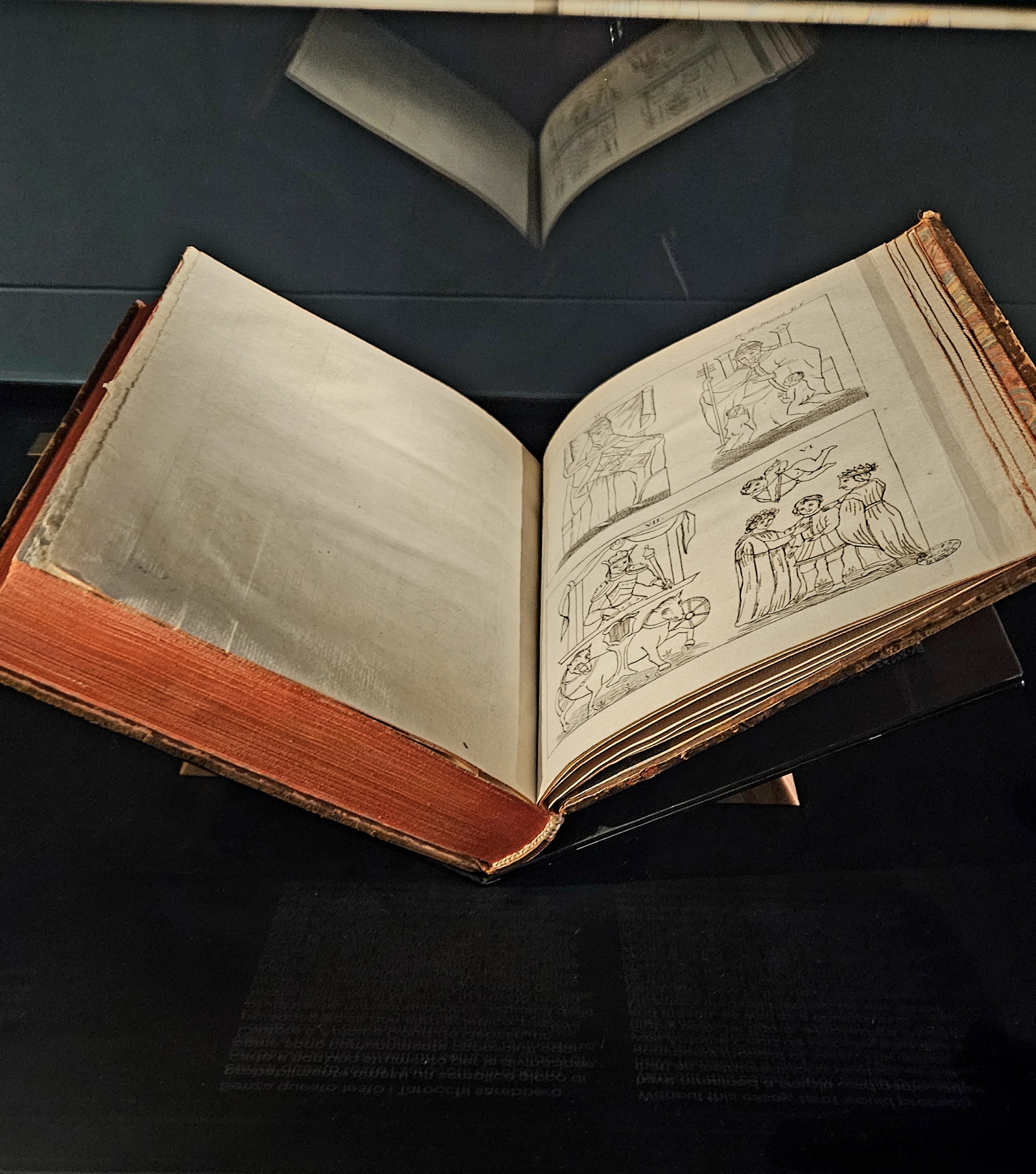
That said, the exhibition does a good job of acknowledging French contributions to tarot’s esoteric evolution. Figures like Papus and Éliphas Lévi are rightly recognised for shaping tarot into the symbolic and spiritual system we know today.
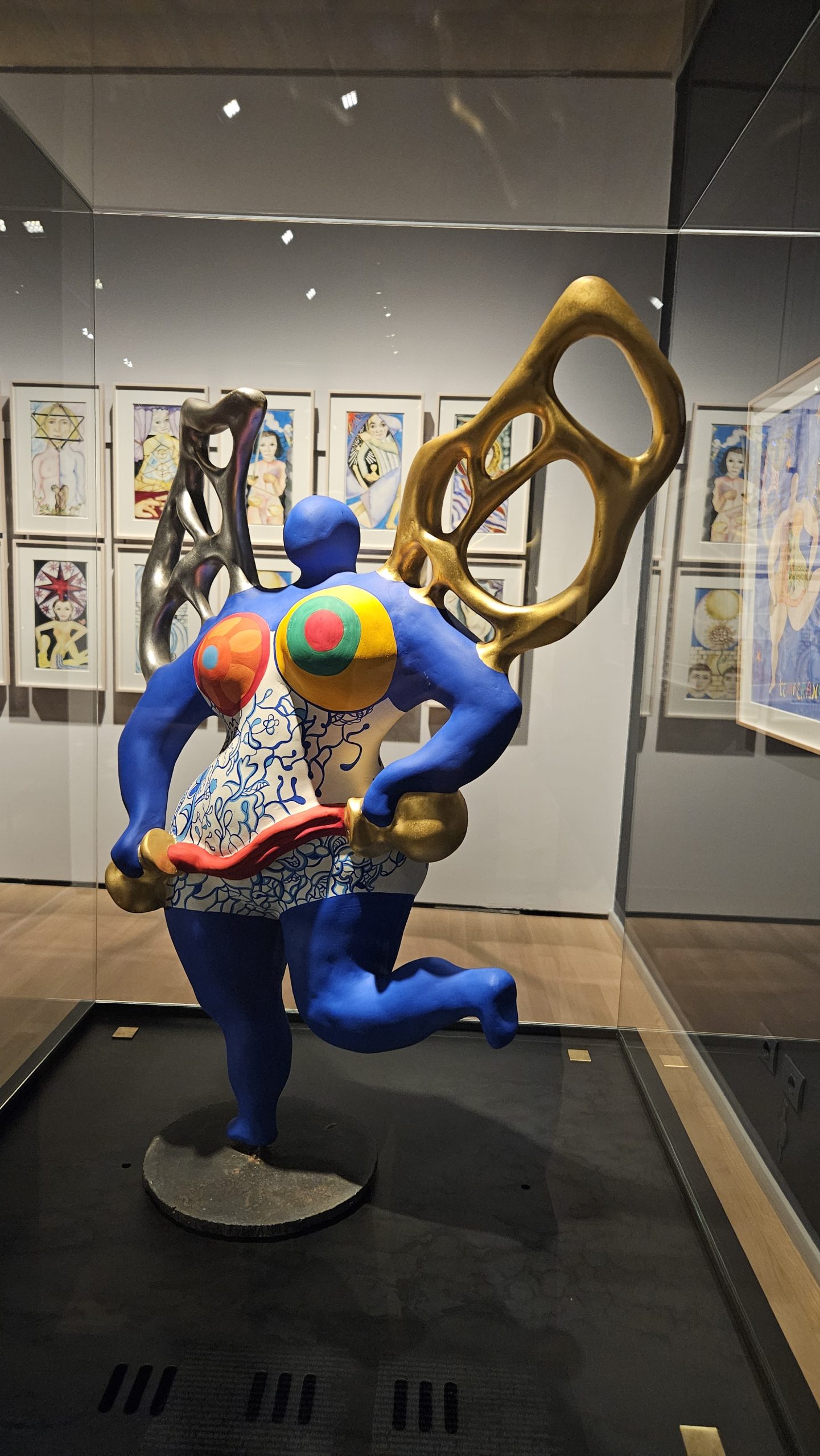
The final section of the exhibition, dedicated to the 20th century, was probably the biggest surprise for me. Here, tarot steps out of the deck and into the world of art — particularly Surrealism.
A central figure is Leonora Carrington, whose work is one of the highlights of the exhibition. You can clearly see how tarot symbolism runs through her creations — from paintings to textiles and even sculpture.
What works — and what’s missing
There’s a lot to admire here. The scale, the ambition, the sheer range of material — it’s genuinely impressive.
Halfway through the exhibition, there’s also a thoughtfully designed reading space — a small library where you can sit down, take a break, and browse books connected to the exhibition. It includes a special focus on Italo Calvino, whose novel The Castle of Crossed Destinies is built around tarot imagery, with stories unfolding through the cards themselves.
However, the exhibition is not without its shortcomings. The most noticeable one? The complete absence of the Thoth Tarot created by Aleister Crowley and Lady Harris. Given how influential that deck is — alongside Rider-Waite-Smith and the Marseille Tarot (both included) — this feels like a significant and, one suspects, very deliberate omission. Rumour has it that Aleister Crowley isn’t exactly a fan favourite in Italy.
I also found myself wanting more historical context around the Visconti-Sforza deck. We’re told it was commissioned, but not much about how or where it was created, or how it was actually used. And the story of how the deck became scattered — and then reunited — must be fascinating, yet it’s barely explored.
A practical tip
If you’re planning to visit (the exhibition runs until 2 June), here’s something worth knowing:
The tarot exhibition is located in a distant wing of the gallery, and getting there means walking through the entire permanent collection. My advice is: go straight to it. The exhibition itself easily takes around three hours to explore properly. Only afterwards, if you still have the time and energy, do explore the rest of the Accademia Carrara gallery. Or come back the next day.
And one final tip: a small book by Christina Dorsi, The Visconti Sforza Tarot, turned out to be incredibly helpful for spotting details in the cards and understanding them in a historical context.
Iwa Zielinska
For more information about the exhibition please follow the link below:
https://lacarrara.it/mostra/tarocchi-2026
Please visit me (Iwa) at my website: https://www.instytuttarota.com/
Card images of the Visconti-Sforza from the Morgan Library & Museum website.