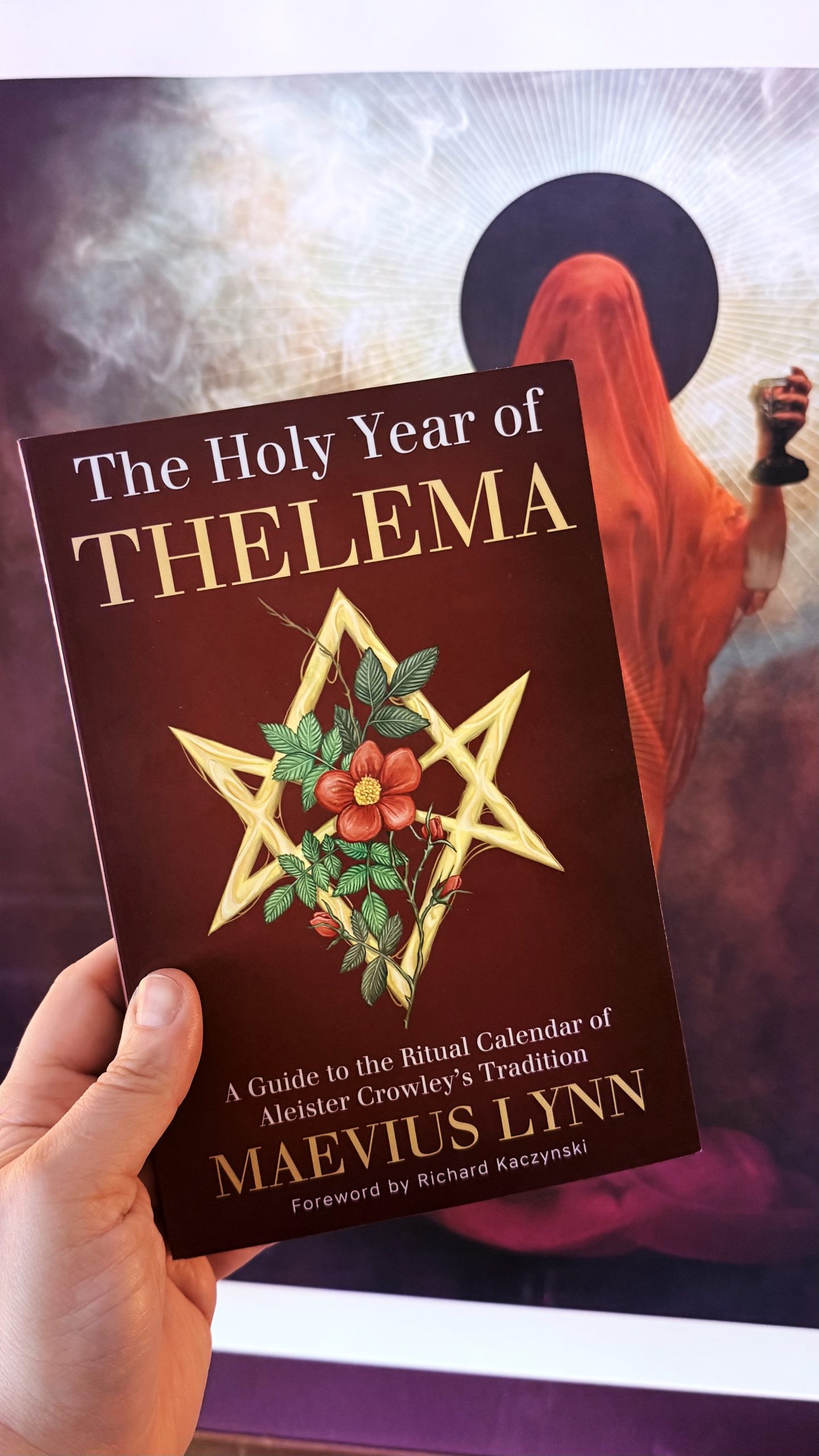
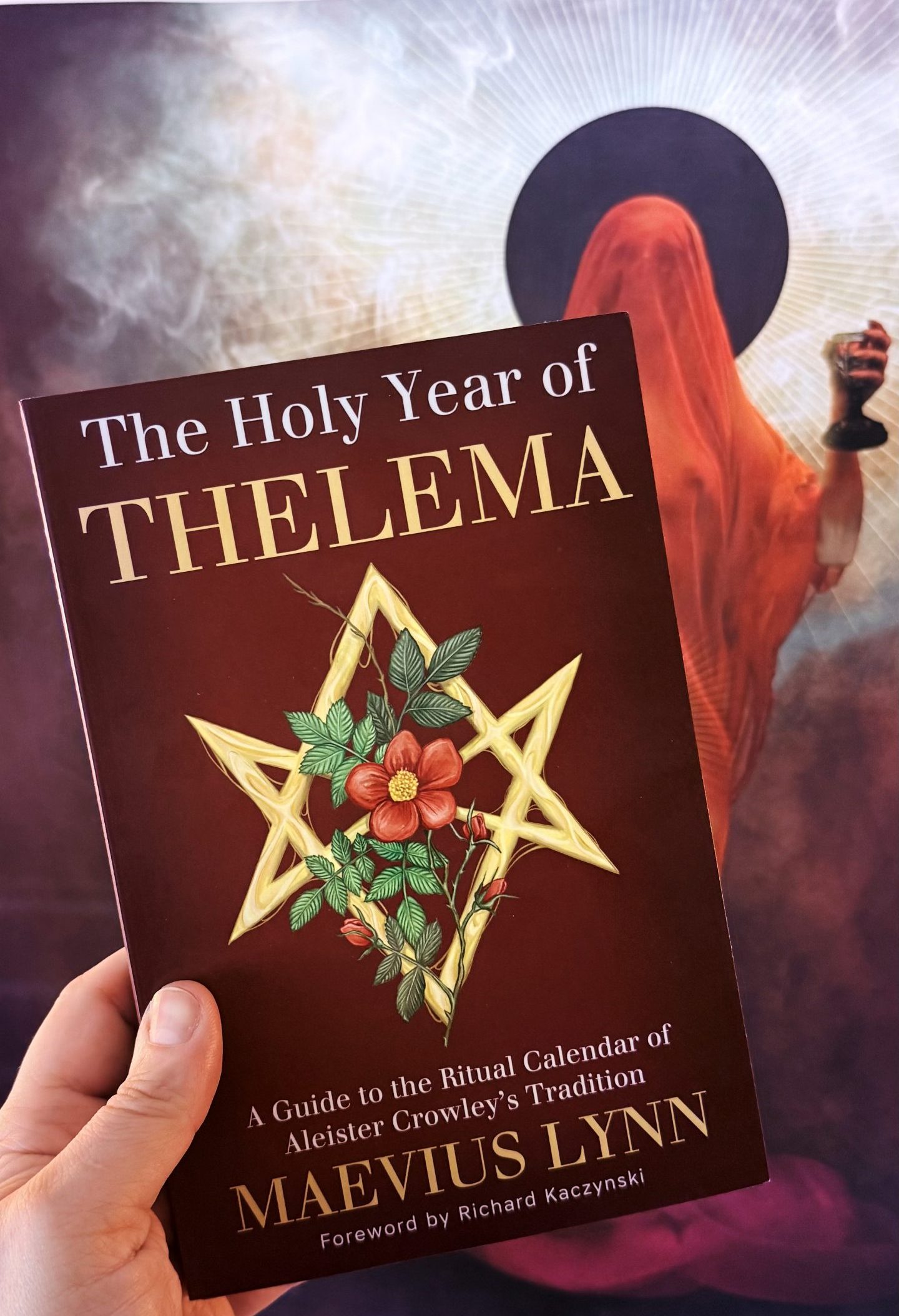
Book Review: The Holy Year of Thelema
- Author: Maevius Lynn
- Publisher: Llewellyn
- Publication Date: May 2026 (US) / June 2026 (UK)
- RRP: US $24.99 / UK £17.99
- ISBN: 9780738779355
- Reviewed by: Marco Visconti
I should begin with a disclosure. I received Maevius Lynn’s The Holy Year of Thelema from the publisher for the purpose of reviewing it for TABI. I approach it not as a neutral outsider, but as a practising Thelemite, an author of books on Aleister Crowley and Thelemic magick, and someone who knows how difficult it is to write for intelligent readers who are spiritually serious but not yet fluent in Crowley’s technical vocabulary.
The Holy Year of Thelema is really two books in one. It is partly a compressed introduction to Thelema, Crowley, ritual, doctrine, and magical practice; and partly a more substantial exploration of the sacred calendar of Thelema, its feasts, ritual stations, theology, and contemporary observance. The tension between those aims shapes the reading experience.
The opening section, roughly the first three chapters, is the weaker part of the volume. A mainstream occult publisher cannot assume that every reader already knows Liber AL vel Legis, Liber ABA, the Lesser Banishing Ritual of the Pentagram, the Star Ruby, or the grammar of ceremonial magick, so some bridge for newcomers is necessary. Even so, this section tries to do too much too quickly. Ritual rubrics are presented, but not always with enough interpretive framing to explain what these rituals do, how they differ, or why a beginner might choose one over another. For a genuine beginner, it can feel like stage directions without enough sense of the play.
This is not fatal, and the material feels partly editorially encouraged: the book the author wanted to write negotiating with the book a publisher believed the market required. I would have reduced it to a leaner orientation, so Lynn’s real subject could arrive sooner.
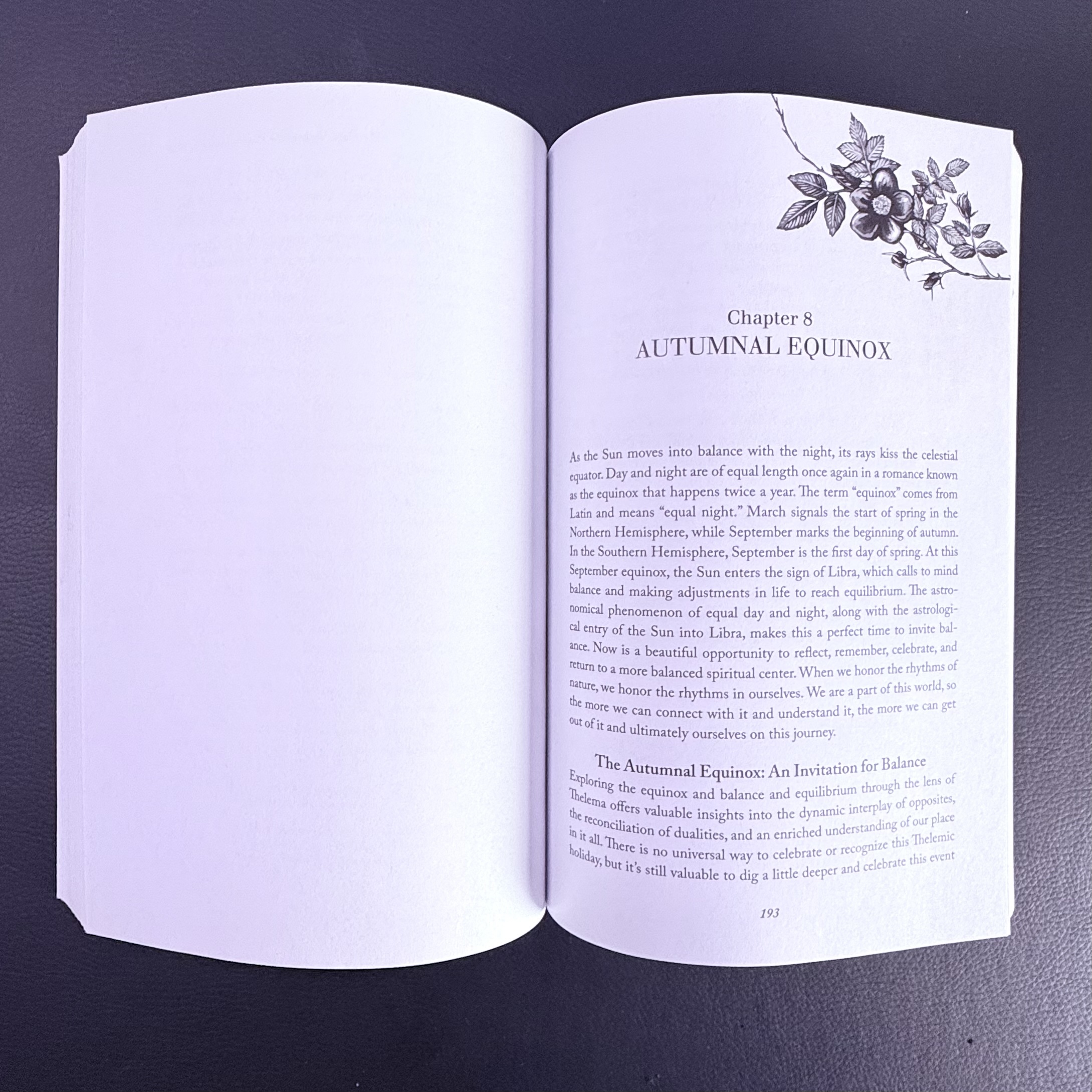
Once the book turns fully toward that subject, however, it becomes far more confident and useful. The idea of a Thelemic holy year is often mentioned but seldom explored with sustained care. Thelemites speak of the Equinox of the Gods, the feast days named in Liber AL, the Holy Season, and the rhythm of solar and initiatory observances, yet these often remain scattered fragments rather than a coherent sacred cycle. Lynn’s book is valuable because it gathers those fragments and asks how they might function as a devotional, ritual, and initiatory year.
This is where the book earns its place. Lynn does not treat the Thelemic year as a decorative calendar laid over ordinary time. At her best, she makes it feel like a sequence of initiatory weather patterns: revelation, ordeal, erotic theology, remembrance, consecration, return. One of the book’s strongest contributions is its refusal to collapse Thelemic sacred time into the neopagan Wheel of the Year. The Wheel is beautiful and meaningful in its own context, but Thelema does not simply fit inside it. Its sacred time is not only agricultural, seasonal, or folkloric. It is revelatory, liturgical, and initiatory, revolving around the reception of Liber AL, the proclamation of the New Aeon, the mystery of the Equinox, and Crowley’s ritual universe. Lynn is at her best when she resists the flattening that would make Thelema another flavour of modern occult eclecticism.
I was especially pleased by her discussion of the Summer Solstice, where she brings in the circumpunct and the Masonic associations of the two St Johns, which I discussed in my own books as well. The solstitial symbolism of John the Baptist and John the Evangelist offers a powerful way to think about the solar year as ascent and descent, increase and decrease, light at its height and light hidden in darkness. In a Thelemic context, this does not require a return to Christian theology; it allows older symbolic structures to be re-read in the light of the New Aeon.
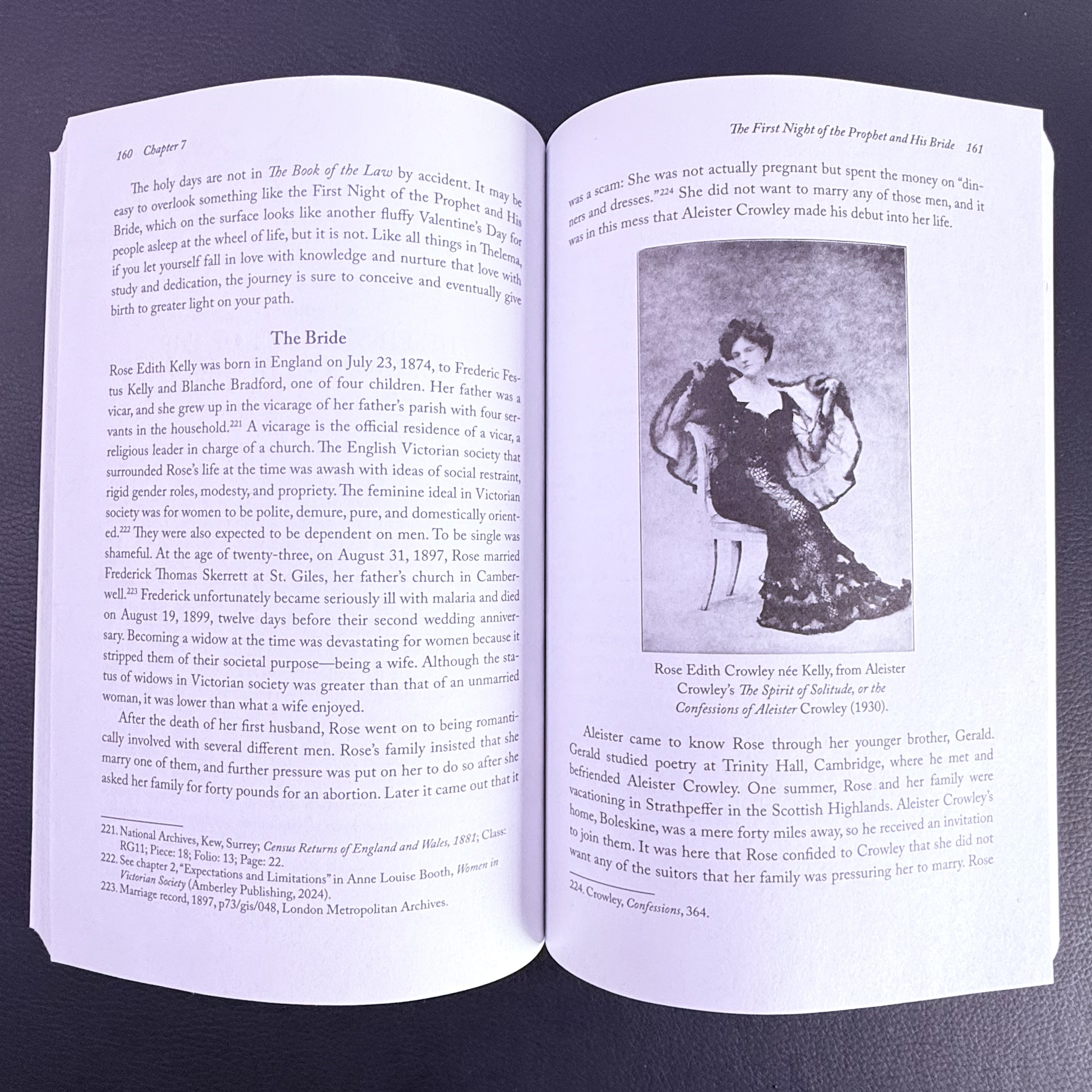
Another strength is Lynn’s treatment of the Scarlet Woman and her attention to Thelema’s women. Crowley’s personality is so vast and theatrical that the people around him are too easily reduced to supporting characters in the biography of the Great Beast. Women, in particular, have often been treated as muses, magical assistants, or casualties, rather than as practitioners and initiatory presences in their own right. Lynn’s book helps loosen Crowley’s grip on the frame.
The ritual material will likely be among the book’s most useful features. Lynn offers bespoke rituals for the stations of the Thelemic year, giving the calendar body and inviting the reader to enter sacred dates through action, speech, and offering. My own response is mixed, mostly because her rituals belong to a long, dramatic, heavily scripted ceremonial mode, while my own practice has become leaner and more internalised. Still, this is not the book Lynn is trying to write. She is giving readers ritual forms through which to inhabit the Thelemic year, and on that level she succeeds.
There is, however, a wider doctrinal and institutional question. Lynn is an initiate of the Temple of the Silver Star and Ordo Templi Orientis, and the proximity to those currents is visible throughout the book. This is not inherently a problem; every writer speaks from somewhere. In her case, the lineage gives the book clarity, structure, and a recognisable doctrinal centre. It also narrows the field of reference. The “Further Reading” section is especially telling, being composed almost entirely of authors associated with the same institutional ecosystem. Many are worth reading, but the implied canon is too narrow. Thelema is larger than the US-centric viewpoint that certain organisations, especially in their American manifestations, too often mistake for the whole tradition.
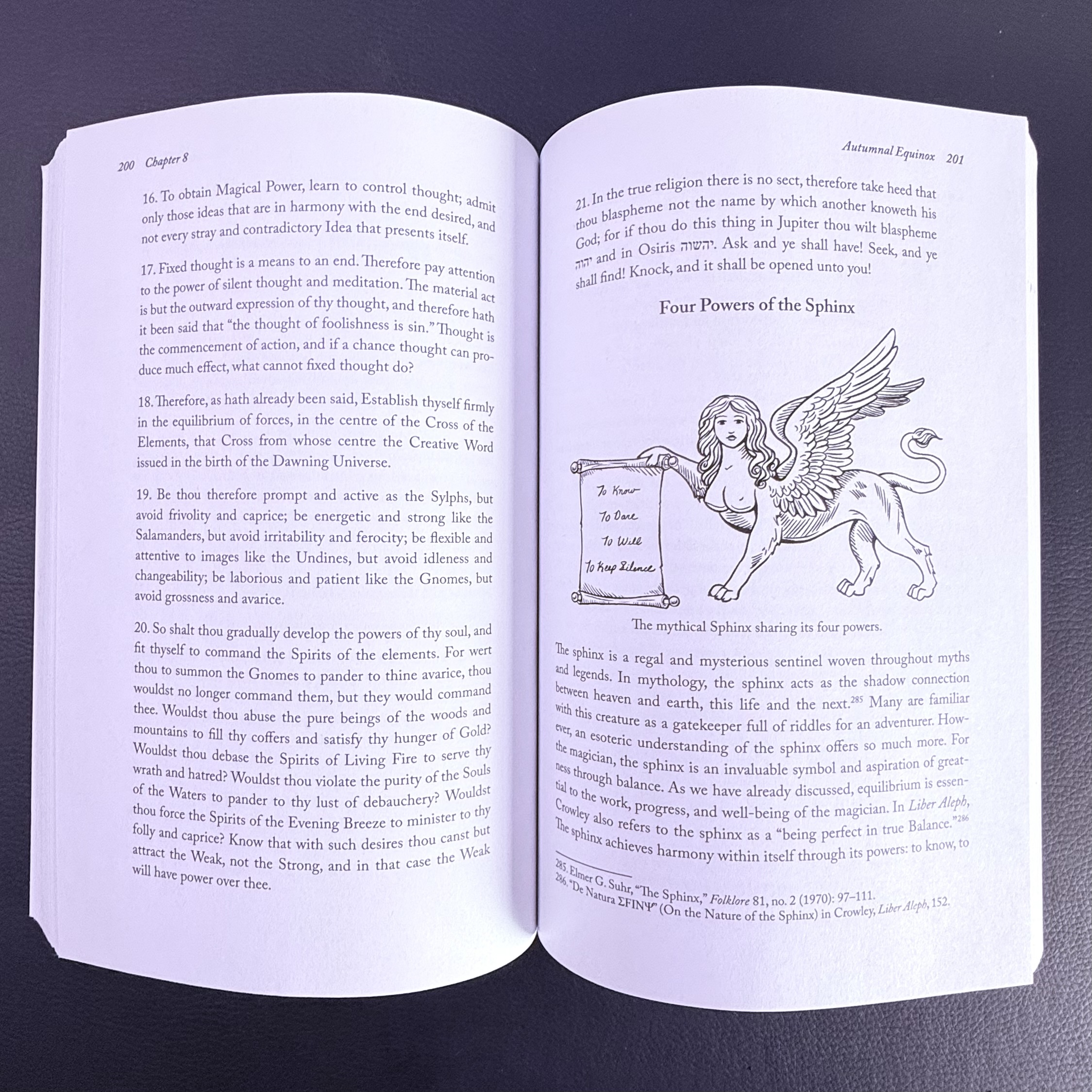
This matters because introductory books do not merely inform readers; they create maps. Lynn does not write sectarian propaganda, but the centre of gravity is clear, and readers should know what kind of map they are being given.
There is also a delicate contemporary context here. In the spring of 2026, Lynn briefly published a video on her successful YouTube channel criticising the way she had been treated by her local O.T.O. body, only to remove it less than twenty-four hours later. I do not want to make a book review revolve around a vanished video, nor would it be responsible to build too much from one public moment. Yet for those familiar with initiatory organisations, the episode is hard to ignore. It shows how quickly criticism inside such bodies can become socially charged, and how pressure toward silence can operate without announcing itself as censorship. Thelemic organisations often speak of liberty, sovereignty, and True Will, yet their internal cultures can still reproduce old habits of deference, omertà, and reputational management. That tension is not Lynn’s alone, but her position makes it unusually visible.
None of this ruins the book. It frames it. The Holy Year of Thelema should be read as a serious contribution from within a particular Thelemic institutional culture, not as a panoramic survey of the entire field. Once this is understood, the book can be appreciated for what it does well without asking it to represent all possible Thelemas.
And it does many things well. Its deepest achievement is that it gives the Thelemic year weight. A holy year is not merely a calendar of things to do, but a way of training perception. Sacred dates return, but the practitioner changes. One encounters the same ritual station after grief, success, illness, love, disillusionment, or renewed devotion. In the gap between recurrence and transformation, the holy year begins to do its real work.
In the end, The Holy Year of Thelema is a good book, and for many aspiring Thelemites it will be genuinely useful. I would have tightened the edit, reduced the introductory section, widened the range of voices, and acknowledged more clearly that Thelema is a living, contested, international current rather than a body of doctrine best interpreted through one American initiatory lens. But these objections define the book’s limits; they do not cancel its value.
What remains is a thoughtful, practical, and often intelligent contribution to contemporary Thelemic literature, written by a young female practitioner in a milieu still too often dominated by old men, inherited quarrels, institutional anxieties, and the endless shadow of Crowley’s personality. For all its unevenness, the book reminds us that Thelema is not only a set of doctrines, but a way of passing through the year under sacred symbols. That is no small gift.
POST SCRIPTUM
I have placed this note at the end so it does not distort the reader’s first impression of the book. Still, it should be mentioned. The book opens with a quotation from Miguel Serrano’s C. G. Jung and Hermann Hesse: A Record of Two Friendships. This is, unfortunately, the same Miguel Serrano who later became notorious as one of the major figures of esoteric Hitlerism and post-war neo-Nazi occultism. One can argue that the quoted work belongs to a different phase of Serrano’s career, and that the passage itself is not political in content. Even so, opening a modern Thelemic book with Serrano’s words is a startlingly poor editorial choice.
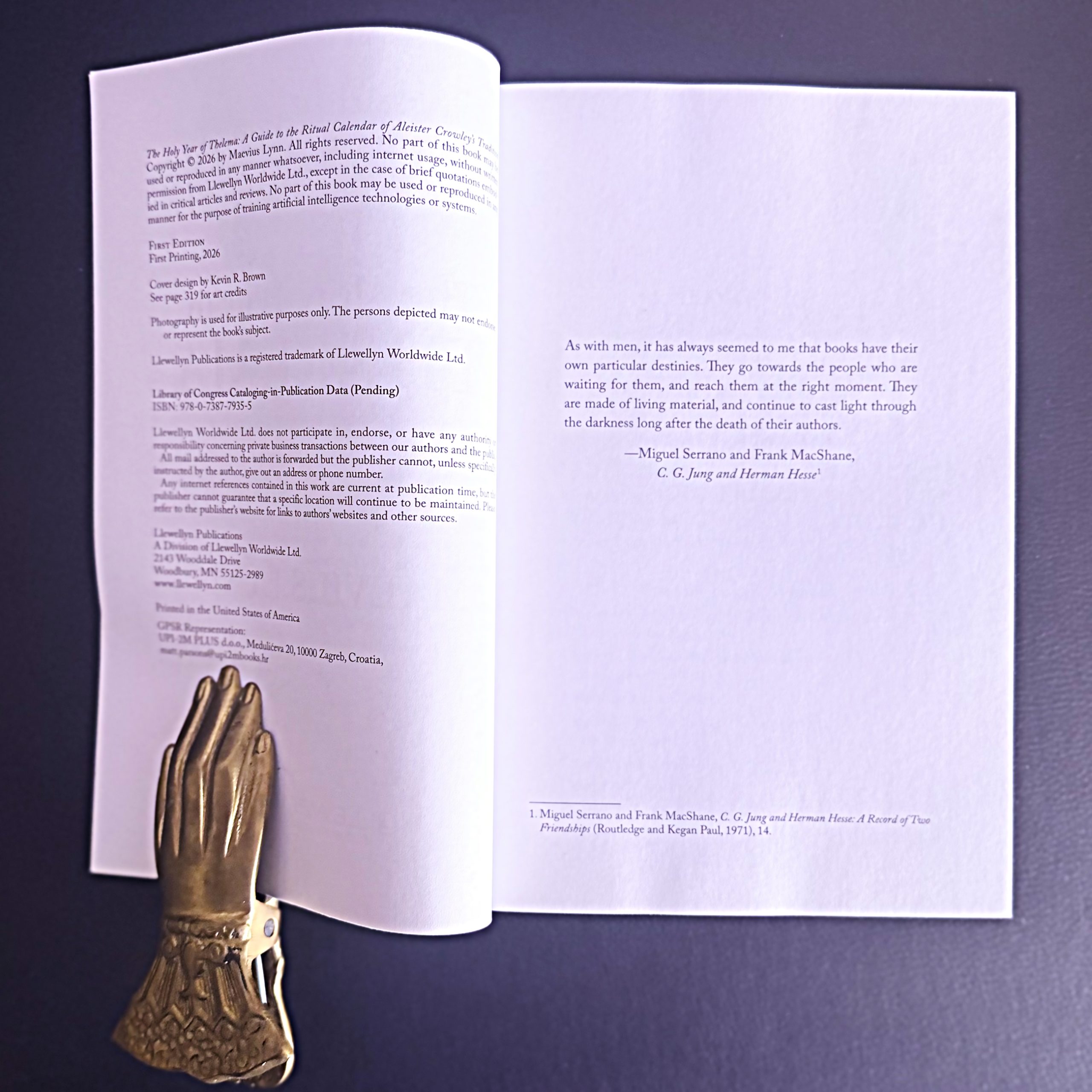
This is made more regrettable because Lynn is openly queer and has a public history of supporting minority rights, which makes the choice baffling rather than malicious. I do not think it should be used to condemn the book or invalidate the author’s sincerity. But in a field already troubled by far-right romanticism, occult fascist residue, and the lazy rehabilitation of politically poisonous figures under the cover of “mysticism,” one has to be careful about whose words are placed at the threshold. There are countless writers on Jung, Hesse, initiation, symbolism, and the religious imagination, and literally any one of them would have been a better choice.