
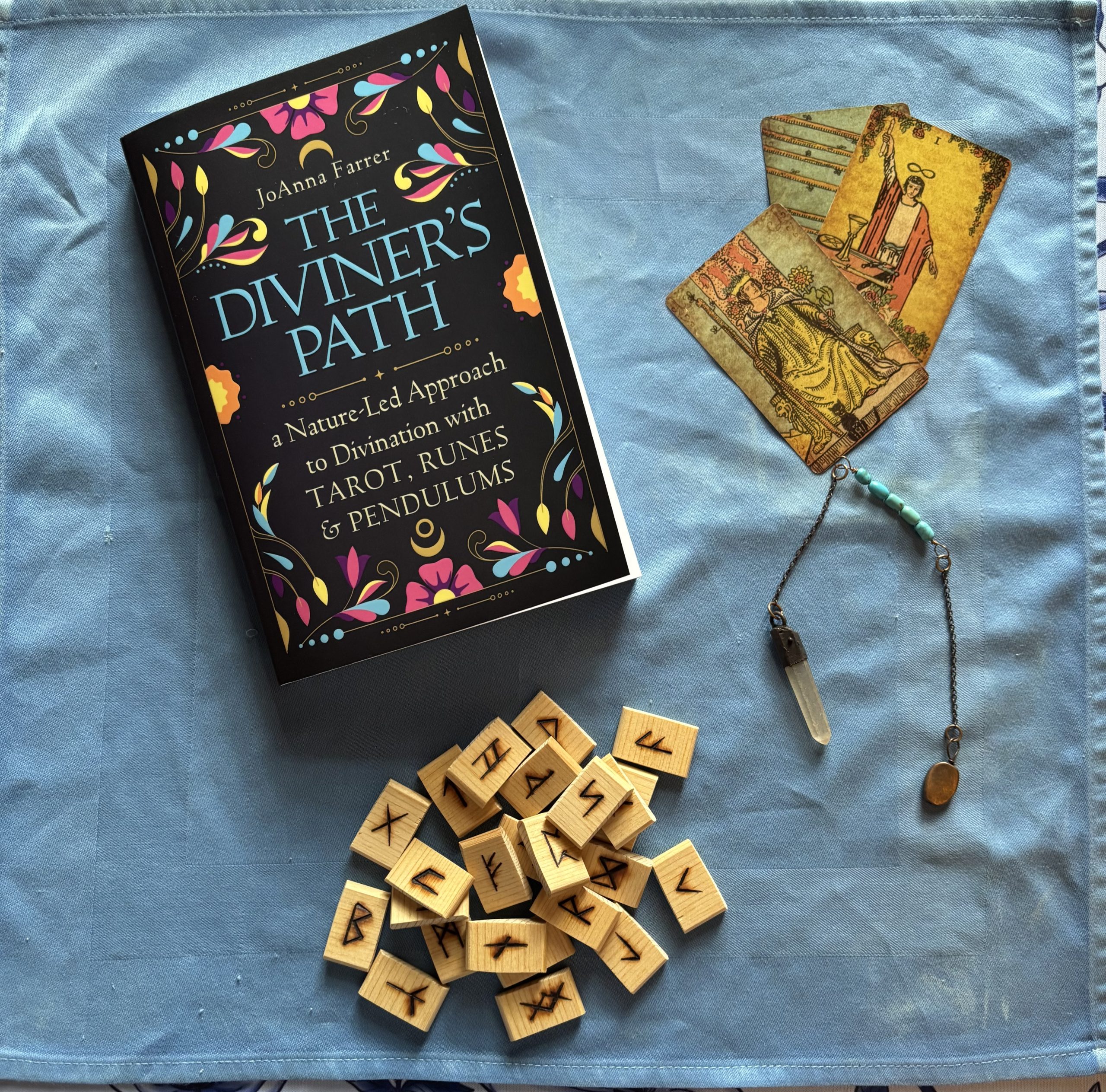
Book Review: The Diviner’s Path: A Nature-Led Approach to Divination with Tarot, Runes & Pendulums
- Author: JoAnna Farrer
- Publisher: Llewellyn Worldwide
- Publication Date: June 2026 (US) / July 2026 (UK)
- RRP: US $17.99 / UK £16.99
- ISBN: 978-0-7387-8243-0
- Reviewed by: Mary du Plessis
At First Glance:
As someone who’s explored a wide range of divinatory practices, I approached The Diviner’s Path with a fair amount of experience in reading symbols, interpreting patterns, and working with oracular systems. I found JoAnna Farrer’s book to be an opportunity to rethink how I approach divination itself.
One of the book’s greatest strengths is its expansive view of divination. Farrer presents divination as a way of engaging with the world with an emphasis on cultivating awareness, relationships, and meaningful dialogue with the people, places, and otherworldly presence around us. This broader perspective felt refreshing in a field where many books concentrate primarily on techniques and interpretations.
What Works (for me): Farrer repeatedly guides readers toward observation, reflection, and participation over prescribed meanings or established correspondences. The exercises are practical and accessible, encouraging the reader to go beyond memorization and develop their own relationship with divinatory practice. This approach acknowledges something many experienced diviners eventually discover; that wisdom often emerges through engagement rather than through the accumulation of a lexicon of meanings.
I also appreciated the way the author integrates animistic perspectives into her discussion of divination. Farrer presents the framework of animism in a grounded and approachable manner. She encourages curiosity and attentiveness, creating a book that is less intimidating and more inviting.
Another strength is the tone of the writing. Farrer’s voice is one of a thoughtful guide and patient teacher. There is a sense of generosity throughout the book, and readers are prompted to explore, question, and develop practices that are personally meaningful.
What Doesn’t Work (also for me): Readers looking for more depth in certain areas may find the material somewhat introductory. The emphasis placed on cultivating awareness and relationships is of great value, but those wanting to explore advanced techniques, complex interpretive methods, or detailed theoretical frameworks may be left unsatisfied.
At times, I found myself wishing for a deeper exploration of how the practices described might intersect with other divinatory traditions. As someone familiar with tarot/cartomancy, pendulums, and other systems, I was interested in how Farrer’s approach might compare to or enrich those methods. The book tends to focus on its own perspective, and a broader comparative discussion might have been an interesting addition.
Similarly, readers who approach divination from a psychological, symbolic, or secular perspective may also find themselves searching for alternative ways of understanding these experiences. The book is welcoming, but it generally assumes that readers are willing to entertain an animistic worldview. While I did not find this exclusionary, I think a more explicit discussion of different interpretive lenses would have strengthened the work.
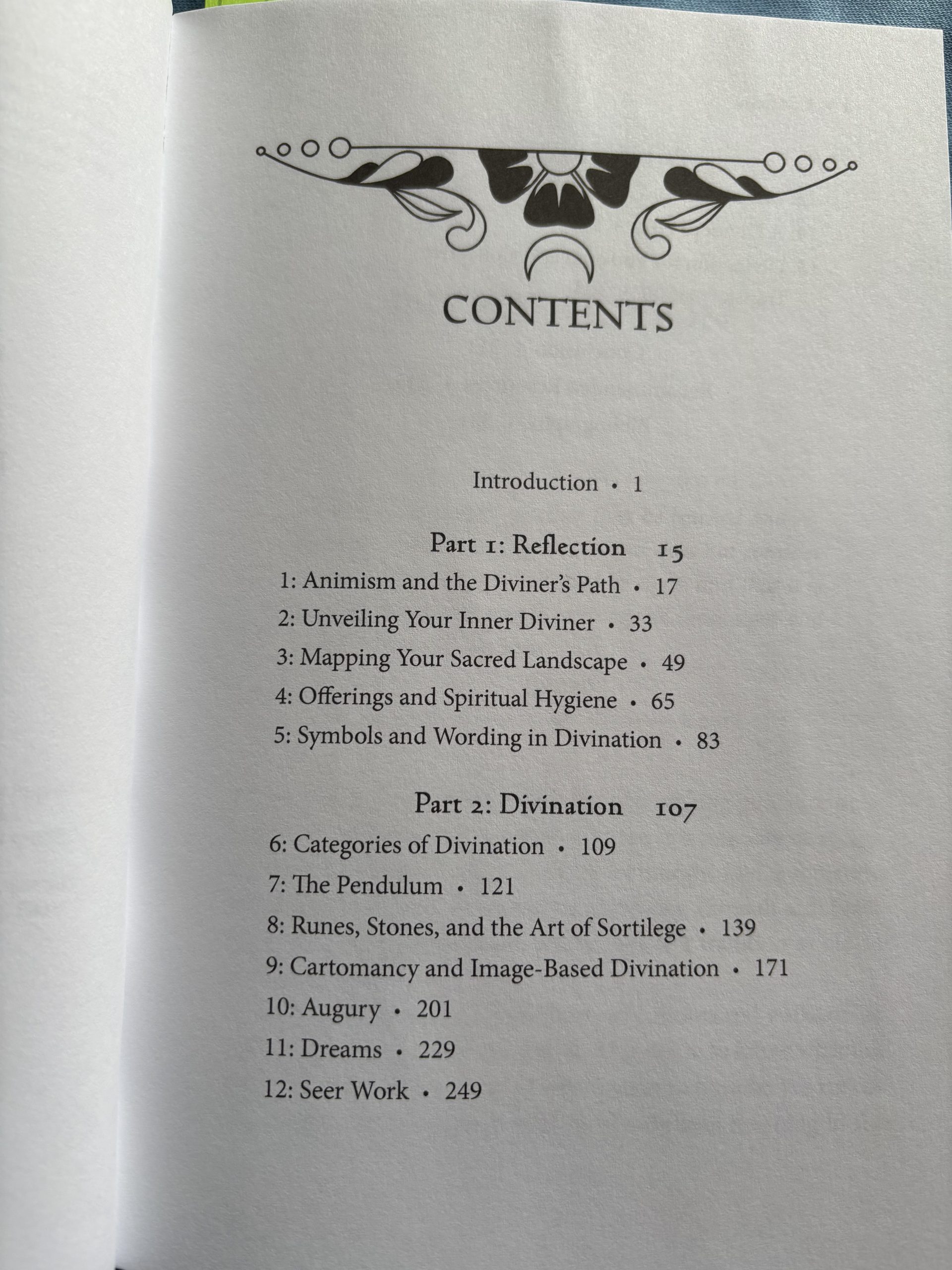
There are also moments where concepts are introduced in ways that feel more experiential than analytical. For many readers this will be a benefit, but those looking for extensive historical context, scholarly discussion, or philosophical rigor may find themselves wanting additional layers of exploration. That said, Farrer’s research is solid and well documented. The footnotes alone make for an excellent ‘further reading’ list.
What Surprised Me: What surprised me most was how much the book shifted my attention away from divination as a means of obtaining answers and toward divination as a practice of relationship.
Like many readers, my goal is to help people seek clarity through symbols and systems. Over time it can become easy to think of divination primarily as interpretation and Farrer’s work gently challenges that assumption. The focus repeatedly returns to listening, noticing, and participating with the world around us.
The book encourages readers to develop meaningful relationships with the environments they inhabit and to view those environments as active participants in the divinatory process. This offered me a refreshed perspective on which to explore familiar paths. I found renewing a practice of paying closer attention to landscape, seasonal changes, and everyday encounters to be surprisingly enriching and effective.
Another pleasant surprise was how applicable many of the ideas felt regardless of a preferred divinatory tool. While the book emerges from specific traditions and practices, its underlying principles can easily be incorporated into tarot, oracle work, scrying, or other forms of divination. In that sense, the book offers an accessible way forward, or way back in my case.
In Summary: The Diviner’s Path is best understood as an exploration of what it means to live a life with divination as a central practice. JoAnna Farrer invites readers to move beyond seeking answers and toward cultivating deeper relationships with the world around them. Through practical exercises, thoughtful reflections, and an accessible introduction to animistic perspectives, she presents divination as an ongoing conversation.
As a diviner whose animistic outlook had taken a backseat, I found the book both engaging and thought-provoking. It did not necessarily teach me a new system, but it encouraged me to reconsider some of my assumptions about the purpose and practice of divination itself. While readers seeking advanced technical instruction or extensive scholarly analysis may wish for more depth, those interested in broadening their understanding of divination as a lived practice will find much to appreciate.
From the Llewellyn Website:
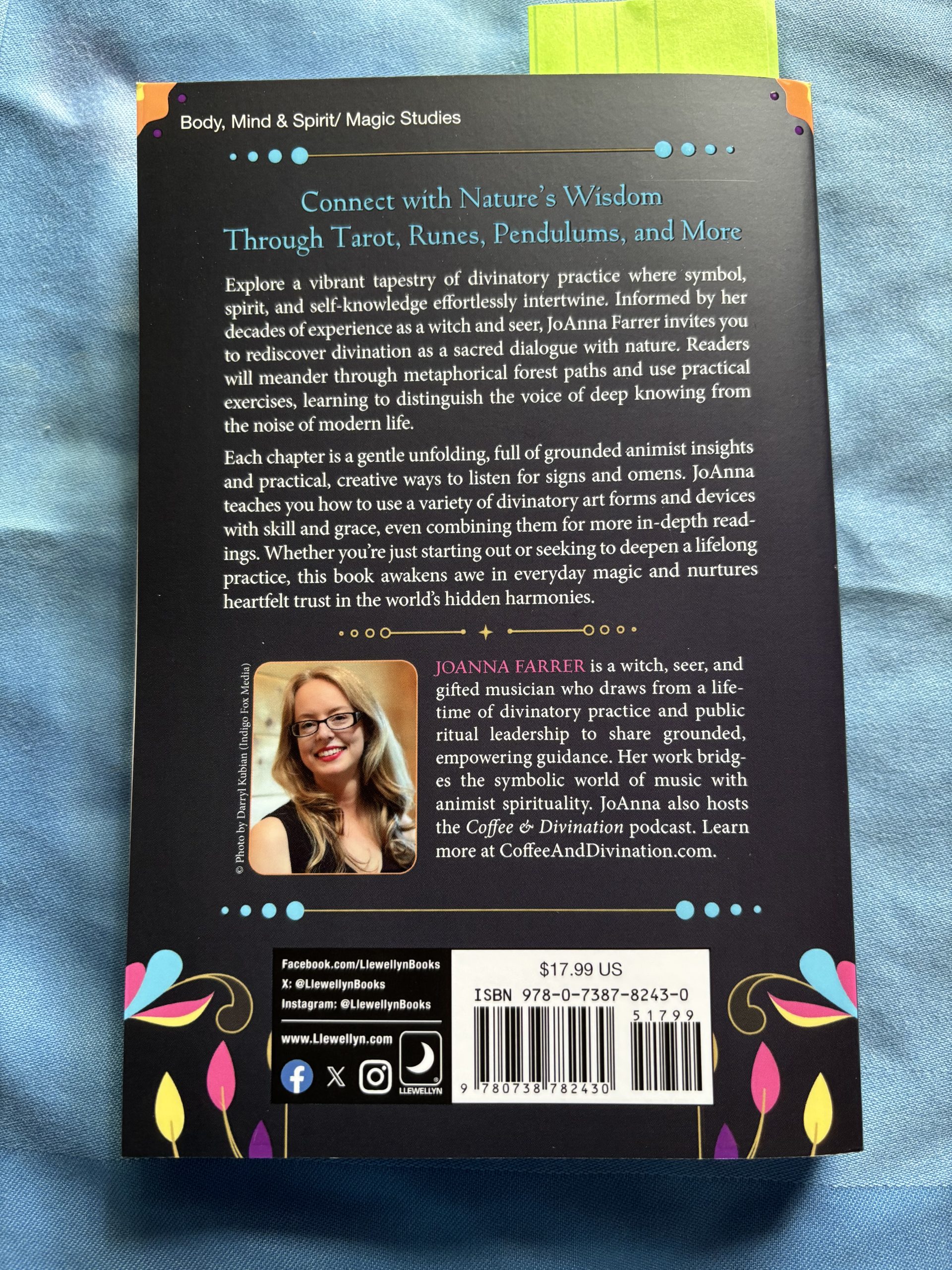
JoAnna Farrer is a seasoned witch, seer, and divination teacher who has dedicated decades to both her personal practice and public teaching in the arts of divination. She is also co-high priestess of the North Wyldewood Coven and co-founder of the North Wyldewood Tradition. Having been featured in The New York Times as a voice for modern Witchcraft, JoAnna has shared her unique perspectives on divination and intuitive work in ways that make them accessible to a wider audience. Since 2010, she has co-taught a series of beginner, intermediate, and advanced classes alongside her co-high priestess, Denise Cruci.
JoAnna’s background as a professional musician and graduate of the Juilliard School has made her uniquely attuned to the world of symbols and their nuanced interpretations—a skill she brings to her work in divination. She is the Concertmaster of the Savannah Philharmonic and a violinist in the New Jersey Symphony. In addition to her role as a coven leader and teacher, JoAnna is the host of the Coffee and Divination podcast, which she launched in 2020 to feature interviews with prominent authors and practitioners of occult, pagan, and divinatory arts. Visit her at CoffeeAndDivination.com.
You can purchase The Diviner’s Path here: https://www.llewellyn.com/product.php?ean=9780738782430 and from all good bookstores.